MATHEMATICS
Counting zeta zeros in a narrow vertical window
A September 2026 preprint gives explicit zero-density bounds in short height windows, where global averages cannot rule out concentrated exceptions.
Research checked
Newest cited publication
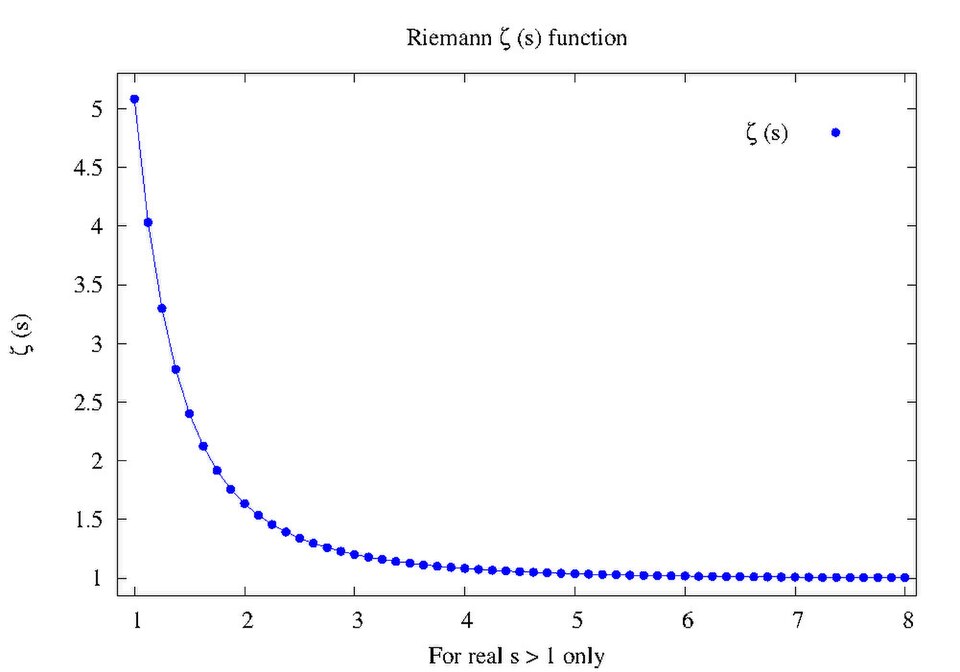
The Riemann zeta function is shown on real inputs greater than one. The complex zeros counted in this article lie outside the domain pictured here.
Koceto007 / Wikimedia Commons. Wikimedia-generated 960-pixel thumbnail; no editorial changes. · Image source · CC BY-SA 4.0

A statement about most points in a huge region can say almost nothing about one small neighborhood. That elementary distinction becomes especially important for the zeros of the Riemann zeta function. Andrew Fiori's preprint, submitted on 18 September 2026, studies explicit bounds in short vertical windows of the critical strip. Rather than claiming the Riemann hypothesis, it limits how densely zeros can crowd near the strip's two edges. Its unusually large numerical thresholds are part of the statement, not details to hide. The development highlights the gap between a global density estimate and a local guarantee that works throughout a specified range.
What the two coordinates mean
Write a complex input as s=beta+i gamma. Here beta is the real coordinate and gamma is the height. The nontrivial zeros of zeta lie in the critical strip between real coordinates zero and one, and the Riemann hypothesis predicts that every one lies on the line beta equal to one half. A density estimate can be far weaker: it may allow zeros away from that line while controlling how many occur in some region. It is essential to ask which region and whether the bound counts zeros with multiplicity.
A vertical window centered at height t with half-width h includes heights from t−h to t+h. Its full height is 2h. A statement about zeros with real coordinate between one sixteenth and fifteen sixteenths includes a broad central band, not just the critical line. The band spans seven eighths of the strip's width. Consequently, even a positive proportion in this band does not establish that any particular fraction lies exactly on the line one half. Geometric terminology can otherwise make a modest but useful local result sound stronger than it is.
The explicit example has an upper width restriction
Fiori's first-version table gives a lower bound of 0.1374 for the proportion in that central band when t exceeds 10 to the power 100 and h lies strictly between 100 and t to the power two thirds. Thus a cautious statement is at least thirteen percent under those conditions. Zeros are counted with multiplicity, with the paper's half-weight boundary convention. The same table gives a smaller positive proportion at a height threshold of 10 to the power 43. These are unconditional claims within the preprint, not numerical verification of zeros at those heights.
The upper restriction on h matters even though the paper emphasizes short intervals. It locates the displayed result in a specific family of windows. Taking h=101 and t above 10 to the power 100 satisfies the scale restriction easily, but the theorem is not a recipe for explicitly enumerating the zeros in that window. It bounds their possible distribution through analysis. As a separate arithmetic illustration, if a finite population of ten thousand counted objects satisfied a thirteen percent lower bound, at least thirteen hundred would be in the specified band. That invented population explains the percentage; it is not a reported zeta dataset.
Why subtracting two global bounds may lose the answer
Suppose a cumulative counting function has the form F(T)=M(T)+E(T), with an error bounded in absolute value by B(T). The count in a short window is F(t+h)−F(t−h). Subtracting the main terms is harmless, but the available error can be as large as B(t+h)+B(t−h). If the window count is much smaller than either cumulative error bound, the difference estimate becomes useless. No algebraic manipulation can recover local precision that the original bounds never supplied. This is the general reason local counting theorems require their own arguments.
An everyday analogue makes the scale visible. Suppose a city has roughly one million residents with an uncertainty of ten thousand. A second equally accurate estimate for the city excluding one street does not reliably determine whether that street has two hundred or four hundred residents. The two errors can swamp the difference. In zero counting, a window may contain many zeros yet remain tiny compared with its central height. Local bounds must control concentration near particular real coordinates while keeping errors below the scale of that local population.
A complementary route through large values
Larry Guth and James Maynard's paper, first submitted in May 2024, bounds how often Dirichlet polynomials can be large. It yields a zero-density estimate with exponent 30 divided by 13 multiplying one minus the real-coordinate threshold, up to a vanishing exponent error. It also yields prime-counting asymptotics in short intervals at the associated exponent 17 divided by 30, again in the stated asymptotic sense. This is complementary background: a strong global restriction on exceptional zeros should not be mistaken for Fiori's uniform guarantee in every narrow window.
A Dirichlet polynomial is a finite sum of terms with oscillating complex phases. One may visualize each term as an arrow in the complex plane. When many arrows point in unrelated directions, cancellation reduces the total; large values demand unusual alignment. Bounding the number of heights with substantial alignment can constrain zeros through analytic transformations. The fraction 17 divided by 30 is approximately 0.5667. At a purely illustrative scale x=10 to the power 30, x to that power is 10 to the power 17. The interval is short relative to x while remaining immense in absolute length.
Explicit prime bounds ask another question again
A separate preprint by Fiori and Mikko Jaskari, submitted on 19 September 2026 and revised on 8 October, develops explicit prime-number-theorem error estimates using zero sums, zero-free regions and density estimates. Its abstract separates an unconditional bound from a further consequence combined with an announced zero-free half-plane. The latter is conditional on that additional announced input. It should not be presented as an unconditional result of either September paper, nor as a proof of the Riemann hypothesis. Tracking dependencies is especially important when several rapidly updated preprints cite one another.
The weighted counting function psi(x) adds the logarithm of a prime for every prime power not exceeding x. It differs from simply counting primes, but its analytic relationship to zeta makes it useful. For example, powers of two below ten contribute log 2 three times, for 2,4 and 8. Powers of three contribute log 3 twice, for 3 and 9. An explicit bound on psi(x)−x must specify both a numerical inequality and the smallest x for which it holds. A sharper-looking decay rate can still lose at practical sizes if its constants or starting threshold are unfavorable.
What would strengthen the local picture
There are several independent directions in which the local theorem could improve. One could lower the height threshold, increase the guaranteed central proportion, shrink the excluded edge regions, or allow narrower windows while preserving effective constants. None of these improvements automatically implies the others. A result with a spectacular proportion at an extraordinary starting height may coexist with a weaker bound that is useful much earlier. Comparing theorems therefore requires keeping the entire parameter tuple together, rather than selecting the most striking number from each.
The local-window viewpoint also provides a healthy way to read progress on famous conjectures. A theorem can be substantial without moving every zero onto the critical line. It can control concentrations that older average estimates leave unresolved and provide ingredients for later explicit arguments. The September 2026 result belongs in that category. Its contribution is a carefully quantified barrier against edge concentration in every permitted short window, with visible assumptions and thresholds. Preserving those details gives readers a more accurate picture of analytic number theory than replacing them with a vague claim that the Riemann hypothesis is nearly solved.
Sources & further reading
Primary papers, project documentation, and research releases used in this article. Publication dates below refer to the sources themselves.
- Zero density theorems for short intervalsarXivPublished Checked
- New large value estimates for Dirichlet polynomialsarXivPublished Checked
- Explicit bounds for the prime number theoremarXivPublished Checked
FOLLOW THE QUESTION
Explore mathematics