MATHEMATICS
The Conway Knot’s Infinite Order: A New Question Beyond Sliceness
A June 2026 preprint, revised in September, shows why no positive connected sum of Conway knots bounds a smooth disk, extending the famous sliceness result.
Research checked
Newest cited publication
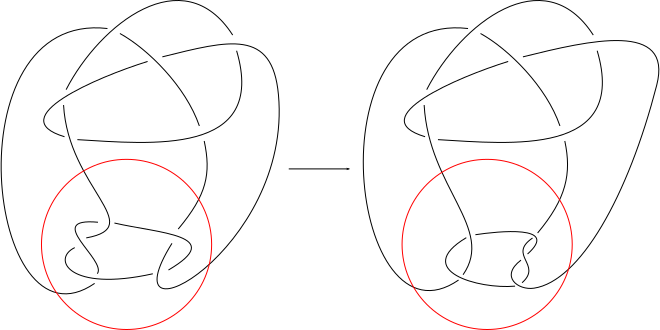
A mutation diagram shows the Conway and Kinoshita–Terasaka knots, providing direct topological context for the article’s discussion of the Conway knot’s concordance order.
Pred / Søren Fuglede Jørgensen / Wikimedia Commons. Unchanged original SVG. · Image source · CC BY-SA 3.0

The Conway knot acquired a new distinction in 2026. A preprint by Chiara Donatone, Marc Kegel, Lukas Lewark and Paula Truöl, first posted on 29 June and revised on 23 September, proves that its class has infinite order in the smooth knot concordance group. Lisa Piccirillo had already shown that the knot is not smoothly slice. Infinite order asks more: could several copies, joined together, become slice even though a single copy cannot? The new result rules that out for every positive number of copies. Understanding the difference leads directly to the strange algebra of four-dimensional topology, where a zero numerical invariant can conceal a nonzero element.
What concordance remembers and forgets
A knot is an embedded circle in the three-sphere. Ordinary knot equivalence permits deformation through embeddings, without cutting or allowing strands to pass through each other. Concordance permits a different operation: a smoothly embedded annulus in the product of the three-sphere with an interval connects one knot to another. Its successive cross-sections may look complicated. The annulus itself must remain smooth and embedded. This is a four-dimensional relation, so a drawing of planar strands cannot by itself display all the information that determines it.
The identity class consists of slice knots, those bounding a smooth properly embedded disk in the four-ball. A slice knot need not be the unknot. This distinction is essential: concordance deliberately identifies many knots that remain different under ordinary three-dimensional deformation. Topological sliceness relaxes smoothness to an appropriate locally flat embedding condition, creating another relation again. The Conway result belongs to the smooth category. Replacing the word smooth with topological would change the mathematical question and, for this knot, lose the phenomenon being studied.
Connected sum turns geometry into algebra
To form a connected sum, remove a small unknotted arc from each of two knots and join the exposed ends in the usual orientation-compatible way. On concordance classes, this becomes an abelian group operation. The inverse class is represented by the mirror image with reversed orientation. The connected sum of a knot and its inverse is slice. That cancellation explains why a group is available even though there is no meaningful operation of subtracting a physical piece of string from another piece.
An independent algebraic comparison shows why non-sliceness is insufficient. In the additive group of integers modulo five, the element represented by one is nonzero, but five copies sum to zero. In the ordinary integers, one is also nonzero, yet no positive sum of copies is zero. A proof that an element is nonzero distinguishes it from the identity without distinguishing these two behaviors. Piccirillo’s theorem addressed the first distinction for the Conway knot. Determining its order required excluding the finite-order alternative.
Why a useful invariant can say zero
A concordance invariant assigns data that remain unchanged when one passes along a concordance. An additive real-valued invariant is especially useful: if f(K) is nonzero, then f of the connected sum of n copies is n times f(K), also nonzero. This immediately proves infinite order. The converse fails. A homomorphism may have a large kernel, so a zero value can mean either that the class is zero or that the chosen measurement cannot see it.
For example, the map from integer pairs to integers that sends (a,b) to a is additive. It assigns zero to (0,1), despite that element having infinite order. This example is elementary, but it prevents a common reading error in knot theory: vanishing invariants are not certificates of sliceness. Rasmussen’s s invariant supplies a lower bound for the smooth slice genus and detects many non-slice knots. A zero lower bound merely leaves open the possibility of a positive genus. A bound need not equal the quantity it bounds.
Piccirillo’s change of viewpoint
Piccirillo’s work, posted in August 2018, resolved smooth sliceness by moving to a different knot with the same zero-trace. The zero-trace is a four-manifold constructed by attaching a suitably framed two-handle to the four-ball along the knot. The associated trace argument transfers the relevant sliceness information. For the replacement knot, a computable obstruction succeeds. This uses the same four-dimensional object to connect two different three-dimensional presentations, rather than requiring the original knot’s familiar invariants to reveal everything directly.
A useful general lesson comes from linear equations. Suppose a coordinate system makes a constraint hard to inspect, but an invertible change of variables preserves the solution set. A difficult question may become a single visible coordinate condition after the change. This analogy is limited: knots and handle attachments are not linear systems, and the replacement knot is not simply the Conway knot in new coordinates. What transfers is specified information about a four-manifold. Proving that transfer is the substantive geometric step.
Satellites and controlled changes in 2026
The new preprint combines satellite operations with controlled twists and concordance invariants that satisfy a monotonicity inequality. A satellite uses a knot pattern placed inside a solid torus, then embeds that torus around a companion knot. The pattern can reveal distinctions missed by the original measurement. Together with the allowed twists, the authors obtain an obstruction that persists for the connected sums needed to prove infinite order. This is a reported theorem in a preprint; the publication record should not be presented as completed journal review.
Here is the logical shape of such an argument without reproducing its technical proof. Assume that some positive multiple of a class vanishes. Use operations whose effect is controlled by inequalities to transport that assumption to an object with a measurable property. If the inequalities force the measurement into one range while an exact computation places it outside, the assumption is impossible. The crucial requirement is uniformity in the number of copies. Checking one, two or a thousand copies separately would still leave infinitely many untested possibilities.
Infinite order leaves a stronger algebraic question
An infinite-order class generates a subgroup isomorphic to the integers. It does not automatically generate a direct summand of the whole group. A small arithmetic example makes the distinction visible. The subgroup of even integers inside the integers is itself infinite cyclic, but there is no complementary subgroup whose direct sum with it is all the integers. A projection from the integers onto the even integers that fixes every even integer would have to send one to an integer whose double is two, while landing in the even integers, which is impossible.
Likewise, finding a homomorphism to the integers that takes value one on a particular concordance class would prove more than infinite order: it would split off an integer direction. The 2026 authors explicitly leave open whether the Conway class generates such a summand. That remaining question is useful evidence of the result’s boundary. The new theorem establishes noncancellation under repeated addition, not a full structural decomposition of the smooth concordance group or a universal formula for its elements.
A knot as a test of mathematical measurement
The Conway knot illustrates a research strategy that extends beyond topology. When a measurement vanishes, examine the transformation rules before inventing a more elaborate measurement. An operation can expose previously hidden information if it respects the equivalence relation strongly enough. It is equally important to separate a numerical calculation from the theorem that makes the calculation relevant. An exact computer output for a satellite invariant does not, on its own, establish the needed relation to every connected sum of the original knot.
For readers approaching the subject, the most useful sequence is to learn connected sum, verify the group-law calculation for an additive invariant, and compare the integers with a finite cyclic group. Only then introduce four-dimensional traces and satellites. This sequence makes the 2026 development precise: a specific smooth concordance class, previously known to be nonzero, is now proved to survive every positive repetition. A familiar-looking knot drawing thus continues to distinguish mathematical structures that simple numerical summaries collapse together.
Sources & further reading
Primary papers, project documentation, and research releases used in this article. Publication dates below refer to the sources themselves.
- The Conway knot has infinite concordance orderarXivPublished Checked
- The Conway knot is not slicearXivPublished Checked
- Khovanov homology and the slice genusarXivPublished Checked
FOLLOW THE QUESTION
Explore mathematics