MATHEMATICS
Why hypergraph Turán densities can fill whole intervals
A May 2026 preprint finds intervals among hypergraph Turán densities. Its result depends on allowing infinite forbidden families, a crucial distinction.
Research checked
Newest cited publication
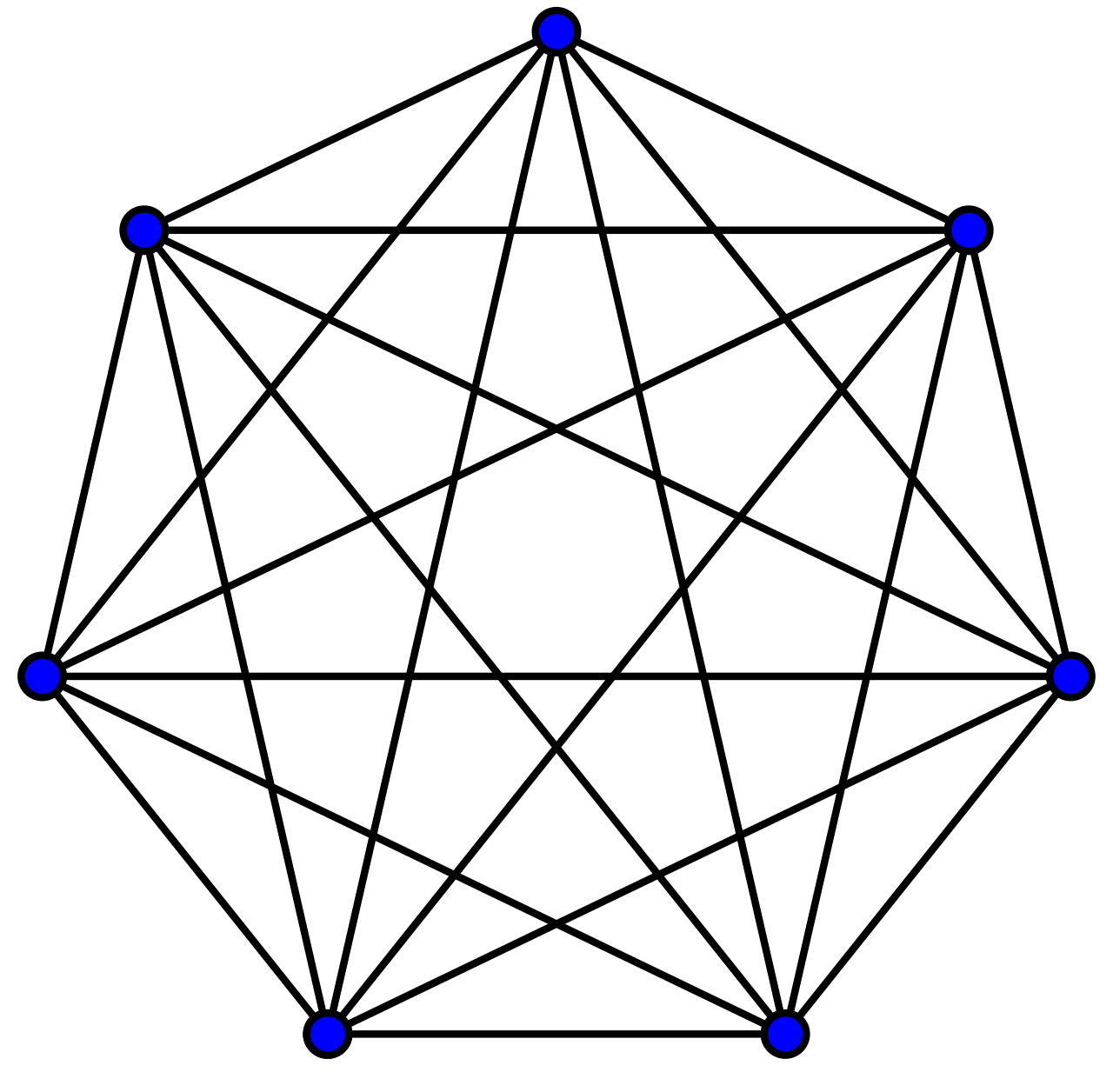
The ordinary complete graph K7 introduces pairwise edges. Hypergraphs generalize this structure by allowing edges containing larger groups of vertices.
David Benbennick / Wikimedia Commons. Wikimedia-generated PNG rendering of the SVG; no editorial changes. · Image source · Public domain (released by the creator)

How much of a large network can remain when certain small configurations are forbidden? For ordinary graphs, the limiting answers form a surprisingly sparse collection of numbers. Hypergraphs, whose edges can connect three or more vertices at once, behave much less rigidly. A preprint submitted by Xizhi Liu and Oleg Pikhurko on May 25, 2026 reports that their possible extremal densities contain whole intervals. The achievement concerns a landscape of problems, rather than one especially famous forbidden configuration. Understanding that distinction reveals both the strength of the theorem and the substantial questions it leaves open.
A continuum of answers, with an essential qualification
The authors prove that for every fixed uniformity r of at least three, some positive number delta exists such that every density between 1 minus delta and 1 is the Turán density of a family of forbidden r-uniform hypergraphs. The family is allowed to be infinite. Their paper also obtains a density statement for a different parameter, uniform Turán density, for finite families of three-uniform hypergraphs. That second statement concerns a set dense in an interval; it does not assert that finite families realize every real number in it.
These qualifications are structurally unavoidable. There are countably many finite hypergraphs, hence countably many finite lists of them. Each list supplies one extremal density, so finite lists can generate only countably many answers. A genuine real interval contains uncountably many points. Allowing arbitrary infinite families changes the size of the collection of questions being asked. This elementary counting argument explains why removing a single word from the theorem would transform a strong result into an impossible assertion.
Why normalization comes before comparison
An r-uniform hypergraph on n vertices selects some of the r-element subsets as edges. Divide its edge count by the binomial coefficient n choose r to obtain a density between zero and one. For a forbidden family, maximize that density at each n and then consider the limiting value. The denominator matters: dividing by n raised to r instead would change all constants by a factor approaching r factorial. Comparing papers without matching that convention can produce a numerical disagreement where none exists.
Here is an independent example of the normalization. With six vertices there are twenty possible triples. A hypergraph containing eight triples has density two fifths. Doubling the number of vertices while retaining eight triples makes the density much smaller; the old edge count alone says little about asymptotic abundance. The extremal question instead permits the number of edges to grow with the number of available triples, while insisting that the same forbidden configurations never appear. It is this coordinated growth that a Turán density describes.
Pairwise intuition has limited reach
For a graph, a balanced division into two groups with all cross-group edges gives edge density approaching one half. Three groups with all cross-group edges give two thirds. The general balanced k-part construction gives 1 minus 1/k. One can derive this directly: two random vertices lie in the same part with probability about 1/k, and all remaining pairs are edges. Ordinary graph extremal theory links its possible limiting densities to this discrete sequence. Three-way interactions allow much more varied recursive arrangements.
The contrast is useful whenever a model replaces pairwise compatibility with group compatibility. Suppose every pair in a team can cooperate, but some triples cannot work together. A graph retaining only pairwise information cannot record that obstruction. Conversely, a three-uniform hypergraph can specify the failing triple without deleting any of its pairs. This is a conceptual example rather than an application proved by the new paper. It explains why a theorem about triples need not inherit the numerical rigidity familiar from pairwise networks.
Recursive constructions create room for variety
An earlier Liu–Pikhurko paper, published in Forum of Mathematics, Sigma in 2025, studied finite forbidden families whose extremal constructions can mix prescribed patterns through blowups and recursion. It supplied examples with exponentially many maximum constructions and examples involving a Cantor-type maximizing set. That work is relevant background because it demonstrates how a short forbidden description can permit complicated structural choices. It is not itself the 2026 interval theorem, and a Cantor-type set of choices is not automatically an interval of density values.
To see the distinction independently, compare writing a number in base two using either digit at every position with writing it in base three using only zero and two. The first freedom fills an interval; the second leaves persistent gaps. Both descriptions offer infinitely many independent choices. What matters is whether the possible tails overlap enough to bridge the gap left by an earlier choice. Merely counting constructions, even uncountably many abstract limiting constructions, cannot establish the needed overlap.
Algebraic operations are not the whole answer
Codruţ Grosu's earlier research examined algebraic operations on sets of Turán densities and connected having positive Lebesgue measure with containing an open interval. It also constructed explicit irrational examples for finite forbidden families. Irrationality and interval structure answer different questions. A countable collection can contain many irrational numbers without occupying any interval; the rational numbers, in the opposite direction, are everywhere dense while still failing to include an interval. These examples prevent several tempting shortcuts when interpreting the new result.
Hausdorff dimension provides another way to describe the landscape. A countable set has dimension zero, while a nontrivial interval has dimension one. Intermediate-dimensional sets can be uncountable and intricate while still leaving empty stretches at every scale. Once an interval is included in a subset of the real line, that subset must have dimension one, since it cannot exceed the dimension of the line itself. Thus the dimension conclusion is a consequence of the interval inclusion, not an assertion that every individual forbidden problem has become easy.
Finite experiments see approximations
Suppose a computation produces extremal densities near 0.70, 0.71 and 0.72 for several different forbidden families. Those observations do not establish an interval. The missing values could hide persistent gaps, and the displayed decimals could change as n grows. A convincing interval proof must control all target real values in some range, together with a construction or limiting argument that realizes each target. Sampling a few finite graphs is useful for discovering patterns, but it cannot replace those universal quantifiers.
There are two limits to keep separate in an experiment. One increases the size of the host hypergraph while keeping its forbidden family fixed. Another changes the forbidden family itself to approach a target density. Interchanging those operations without justification can silently change the problem. A practical notebook should therefore record the family, uniformity, normalization and host size alongside each numerical result. That bookkeeping is a mathematical aid: it makes clear which quantity was optimized and which sequence was merely explored.
What remains difficult after a broad existence theorem
The new preprint gives a global existence theorem. It does not provide a catalog of exact answers for familiar small forbidden hypergraphs, and it should not be read as a solution to the classical ordinary-density tetrahedron problem. Nor does a terminal interval near one imply that every number between zero and one occurs. A dense region at one end of a set can coexist with substantial gaps elsewhere. The size and effective accessibility of an interval are additional questions beyond proving that some positive length exists.
My reading of the advance is that the space of extremal problems has become provably continuous in a precise region, even though individual coordinates remain hard to calculate. A useful next step for readers is to compare finite-family approximation with actual realization, or to look for explicit forbidden descriptions at particular densities. Those are different projects with different success criteria. Preserving that separation gives a more interesting picture than a sweeping claim that hypergraph density has been solved: the landscape is richer, and the map is still incomplete.
Sources & further reading
Primary papers, project documentation, and research releases used in this article. Publication dates below refer to the sources themselves.
- Intervals of hypergraph Turán densitiesarXivPublished Checked
- Finite Hypergraph Families with Rich Extremal Turán Constructions via Mixing PatternsarXivPublished Checked
- On the algebraic and topological structure of the set of Turán densitiesarXivPublished Checked
FOLLOW THE QUESTION
Explore mathematics