MATHEMATICS
Abelian-Surface Modularity Moves Beyond Potentiality
A 2025 theorem proves modularity for a positive proportion of abelian surfaces, while the 2026 ICM account explains the hypotheses and remaining gap.
Research checked
Newest cited publication
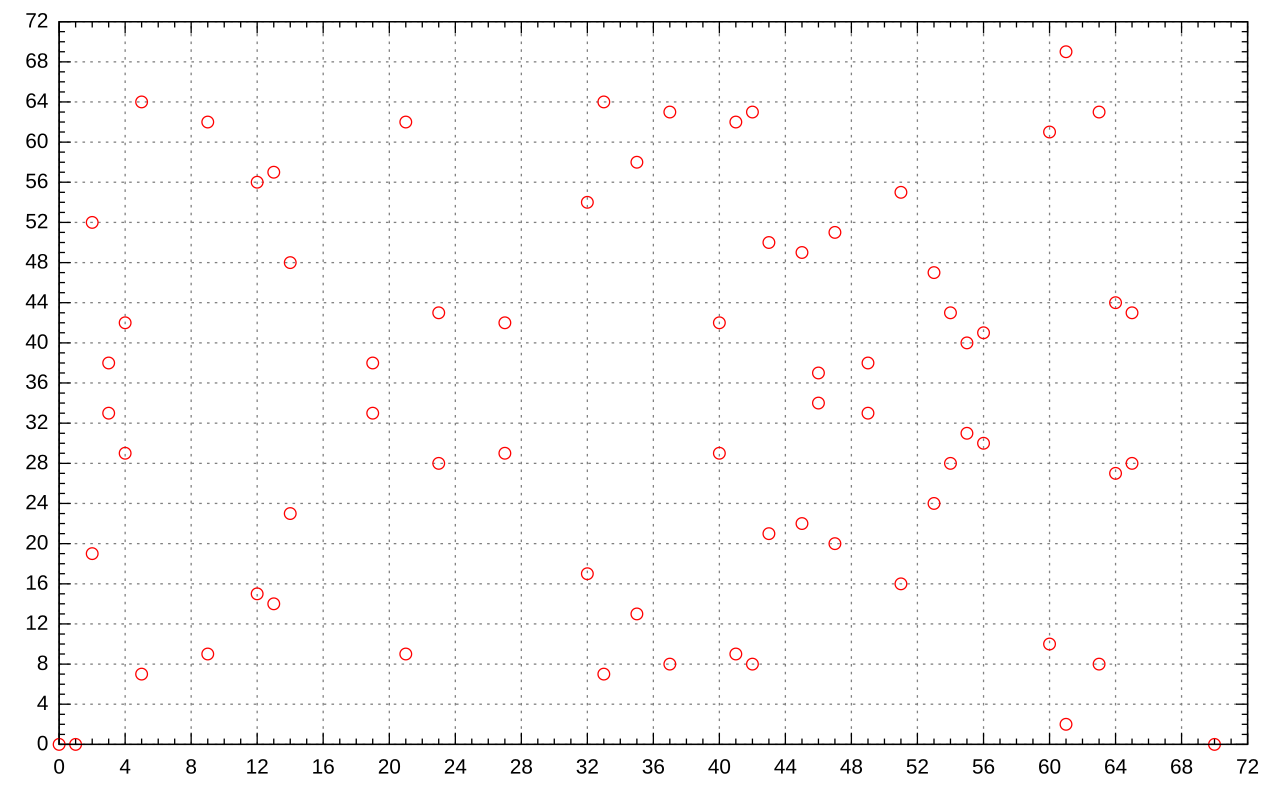
A finite-field elliptic-curve plot introduces arithmetic geometry in dimension one, before the article examines the harder dimension-two modularity problem.
Trshaffer / Wikimedia Commons. Wikimedia-generated PNG rendering of the SVG; no editorial changes. · Image source · CC0 1.0

Modularity says that arithmetic data from algebraic equations can also be organized by automorphic forms, objects governed by strong transformation laws. Moving this relationship from elliptic curves to abelian surfaces raises the dimension and the difficulty. On February 28, 2025, George Boxer, Frank Calegari, Toby Gee, and Vincent Pilloni posted a theorem establishing modularity for a positive proportion of abelian surfaces over the rational numbers under explicit local and residual hypotheses. Gee's October 3, 2025 account, submitted to the 2026 International Congress of Mathematicians proceedings, explains the advance alongside earlier potential modularity. The distinction between those two terms is central to understanding what has changed.
Why two dimensions change the arithmetic
An abelian surface is a two-dimensional algebraic group variety. The word surface refers to algebraic dimension; over the complex numbers its underlying real manifold has four dimensions. Products of two elliptic curves provide accessible examples, but a general abelian surface need not split into such a product. Jacobians of suitable genus-two curves are another important source. A theorem restricted to products would therefore miss much of the interesting territory.
The torsion bookkeeping also grows. For an elliptic curve, the points killed by a prime typically form a two-dimensional vector space over the corresponding finite field. For an abelian surface the corresponding dimension is four. A four-by-four matrix has sixteen slots, compared with four for a two-by-two matrix. Those counts alone do not measure proof difficulty, because polarization imposes symplectic structure, but they illustrate why more compatibility conditions can arise. A higher-dimensional arithmetic object carries more interlocking symmetry information.
Potential modularity changes the base field
Potential modularity means that the expected automorphic relationship becomes available after passing to a suitable finite extension of the original number field. Actual modularity over the original field asks for that relationship before making the extension. The earlier Boxer–Calegari–Gee–Pilloni work establishes potential modularity for abelian surfaces over totally real fields, with consequences for continuation and functional equations of their Hasse–Weil zeta functions. Its original preprint dates to December 2018 and is background here.
A change of field can reveal information while also creating a descent problem. Think of factoring a polynomial: x² + 1 factors over the complex numbers even though it has no linear factors over the rationals. This is only an analogy, not a model of the modularity proof. It captures why a statement after extending the allowed scalars cannot simply be relabeled as a statement over the starting field. The extension may make a construction possible without supplying a compatible construction downstairs.
The new theorem comes with specific hypotheses
The theorem requires an abelian surface over the rationals with a polarization whose degree is not divisible by 3. Its mod-3 Galois image must be all of GSp₄(F₃), the symplectic similitude group over the field with three elements. At 2, that representation must be unramified, and its Frobenius characteristic polynomial must differ from both (x² + x + 2)² and (x² − x + 2)². At 3, the surface must have good ordinary reduction with a Frobenius characteristic polynomial having distinct roots. Under these hypotheses the authors prove modularity. The proof uses a 2–3 switch and a new classicality theorem for ordinary p-adic Siegel modular forms; it does not cover every abelian surface.
Local conditions examine arithmetic through one prime at a time. A residual representation keeps information modulo a prime, which is a coarser view than the full prime-adic representation. An ordinary condition singles out a controlled structure at that prime. Distinctness and image assumptions help prevent degeneracies that would obstruct an argument. Calling such conditions technical should not imply that they are optional. Their removal would require new mathematics or another route through the proof.
Why a coarse representation can carry useful evidence
A simple matrix example shows both the value and the limits of reduction. The integer matrices with diagonal entries 1 and 4, or 1 and 7, reduce to the same diagonal matrix modulo 3. Reduction therefore forgets information. Yet if a matrix identity holds before reduction, it must still hold afterward. A contradiction in the reduced setting can rule out a proposed lift; a successful reduced calculation can identify the right family to study without uniquely recovering its members.
In arithmetic research, deformation theory turns this coarse-to-fine question into a structured one: which richer representations lift a fixed residual representation while satisfying prescribed local constraints? The elementary example does not reproduce that theory, but it explains why specifying the residual representation matters. Two objects can agree at one finite resolution and still differ at finer resolutions. A modularity lifting argument needs control over the allowed lifts, rather than a numerical resemblance between a few coefficients.
A residual calculation can also merge apparently distinct eigenvalues. The integers 1 and 4 are different, but both become 1 modulo 3. By contrast, 1 and 2 remain distinct modulo 3. This elementary observation explains why a distinctness hypothesis must specify the field in which distinctness is tested. Checking that two characteristic-zero numbers differ would not establish that their reductions remain distinguishable. The theorem requires its own precise local formulation, rather than this simplified numerical test.
A p-adic construction needs a classicality bridge
The prime-adic viewpoint measures closeness by divisibility by powers of a prime. For example, 1 and 28 differ by 27, so they are close in the 3-adic metric despite their separation on the usual number line. Replacing 28 by 244 increases the divisibility of the difference to 3⁵. This topology permits limits and families that behave differently from ordinary real or complex analytic ones.
Constructing a p-adic automorphic object is not automatically the same as constructing the classical automorphic object needed in a modularity statement. Classicality results identify conditions under which the p-adic object belongs to the classical world. The 2025 work's new theorem supplies such a bridge in its setting. It is helpful to separate these tasks conceptually: first organize a candidate in a flexible larger space, then prove that the candidate has the stronger regularity required by the arithmetic correspondence. Both steps contribute mathematical content.
Positive proportion is stronger than many examples
The phrase positive proportion is an asymptotic statement made within the paper's counting framework. It is not a percentage obtained by sampling whichever surfaces happen to be easiest to compute. An infinite set can still occupy zero proportion inside a larger infinite family. For an elementary illustration, square numbers form an infinite subset of the positive integers, but among the first M integers there are only about the square root of M squares, so their relative frequency tends to zero.
A positive-proportion theorem therefore says something that a list of infinitely many examples alone does not. Conversely, it remains weaker than a theorem covering every member of the family. These distinctions matter when interpreting mathematical announcements. The older potential-modularity work already produced infinitely many genuinely modular examples over the rationals with no extra complex endomorphisms. The 2025 result changes the scale of the unconditional modularity statement in its specified family without settling all remaining cases.
What the 2026 account helps clarify
Gee's account places the new theorem beside the broader analytic consequences already obtained from potential modularity. This prevents a common misunderstanding: an outstanding question about actual modularity does not imply that every associated analytic question is still untouched. Different conclusions require different strengths of input. An extension of an L-function and a complete automorphic identification over the starting field are related goals with distinct logical demands.
The next conceptual frontier is to enlarge the class of surfaces for which modularity is known while retaining precise control at the difficult primes. That is an inference about the research direction, not a forecast of an imminent proof. The useful habit for readers is to track the base field, the local conditions, the residual assumptions, and the exact conclusion together. Doing so reveals substantial progress without converting a theorem for a positive proportion into a universal result.
Sources & further reading
Primary papers, project documentation, and research releases used in this article. Publication dates below refer to the sources themselves.
- Modularity theorems for abelian surfacesarXivPublished Checked
- Modularity theorems for abelian surfacesarXivPublished Checked
- Abelian Surfaces over totally real fields are Potentially ModulararXivPublished Checked
FOLLOW THE QUESTION
Explore mathematics