MATHEMATICS
Why Zero Volume Does Not Allow Uncountably Many Hamiltonian Copies
A May 2026 theorem limits disjoint Hamiltonian copies of a closed Lagrangian, exposing how symplectic constraints survive when ordinary volume vanishes.
Research checked
Newest cited publication
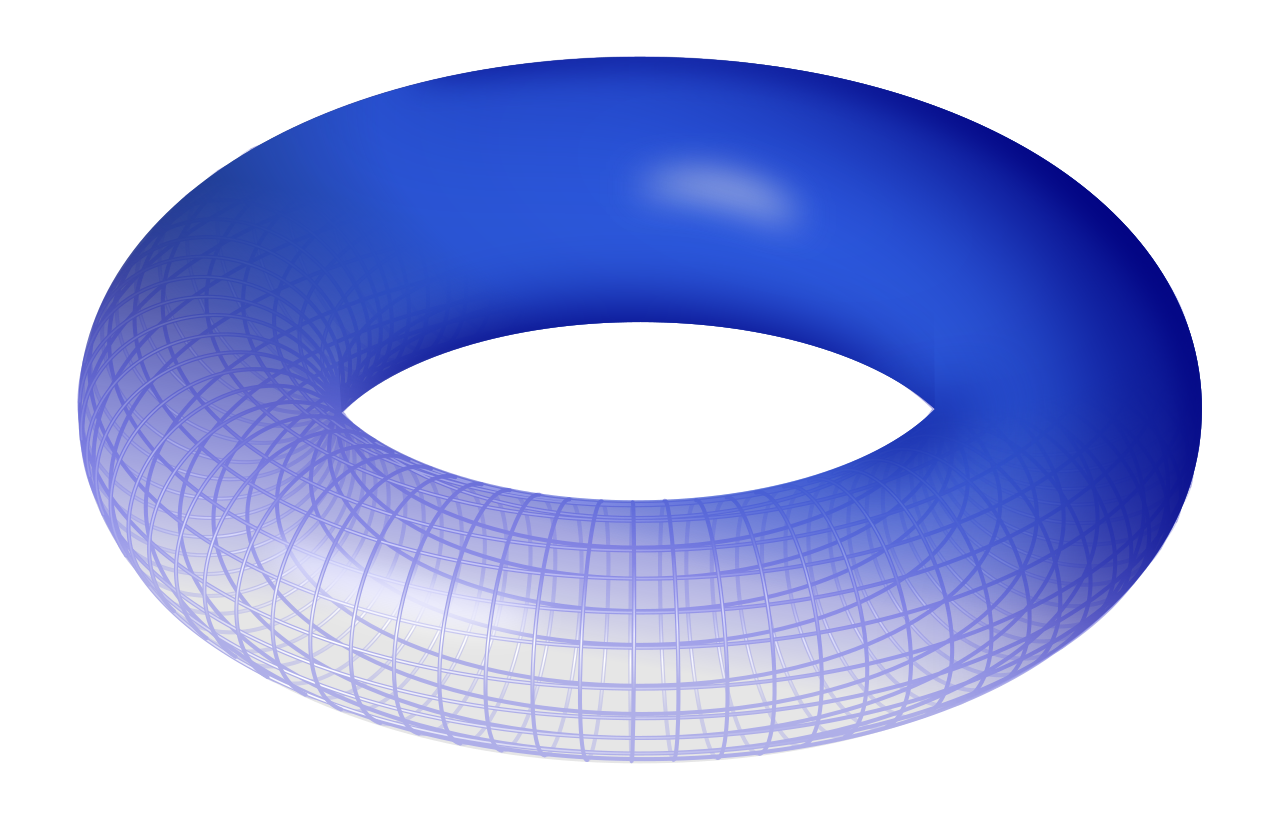
A torus is a familiar geometric object that can also appear in symplectic settings; this generic rendering does not show the particular Lagrangians in the theorem.
Leonid 2 / Wikimedia Commons. Wikimedia-generated PNG rendering of the SVG; no editorial changes. · Image source · CC BY-SA 3.0

A curve inside a surface has zero area, so volume alone seems unable to limit how many disjoint copies can fit. Symplectic geometry adds a different restriction. In a paper published online on 26 May 2026, Joé Brendel, Jean-Philippe Chassé and Laurent Côté prove that a packing of pairwise disjoint Hamiltonian images of one closed Lagrangian submanifold is at most countable. Their paper also studies a less regular setting, where extra hypotheses enter. The result does not forbid uncountably many disjoint Lagrangian submanifolds altogether. It restricts copies connected by a specific class of allowed motions. A cylinder of circles makes that distinction visible without any higher-dimensional visualization.
What Hamiltonian motion preserves
A symplectic manifold has a closed, nondegenerate two-form, conventionally written ω. In a familiar position-and-momentum coordinate chart, it pairs changes in position with changes in momentum. Hamiltonian motion is generated by a time-dependent function through that two-form. Such motion preserves ω, and therefore preserves the associated phase-space volume. But preserving symplectic structure contains more information than preserving volume when the dimension exceeds two. Moreover, Hamiltonian motions form a specific subclass even among symplectic motions.
A Lagrangian submanifold has half the ambient dimension and the two-form restricts to zero on its tangent spaces. In a two-dimensional symplectic surface, every smooth curve satisfies the local vanishing condition automatically. In four dimensions, a two-dimensional surface may or may not be Lagrangian. This is an equation imposed on tangent planes, not an observation about ambient volume. Every smooth half-dimensional submanifold has zero full-dimensional volume, but only some satisfy the symplectic condition.
A cylinder supplies the missing distinction
Consider a cylinder with angular coordinate q of period one and vertical coordinate p. Give it the symplectic form dq ∧ dp. For every real number c, the circle p = c is Lagrangian, and these circles are pairwise disjoint. There are uncountably many of them. This does not contradict the theorem. Moving the circle p = 0 to p = c by a vertical translation changes a relevant symplectic action; the translation is symplectic but is not a globally defined Hamiltonian motion of this cylinder when c is nonzero.
The obstruction can be calculated directly. The one-form p dq integrates around the circle p = c to c because q completes one period. Under Hamiltonian isotopy of these closed curves, this integral is unchanged. One way to see the local mechanism is that the change induced by a Hamiltonian vector field is an exact differential when restricted to a closed transported loop, and exact differentials integrate to zero. Thus pairwise disjointness and even smooth symplectic equivalence are weaker requirements than belonging to the same Hamiltonian class.
Why nearby Hamiltonian graphs intersect
A nearby Lagrangian can often be represented as the graph of a closed one-form over a reference Lagrangian. A Hamiltonian perturbation corresponds locally to an exact one-form, the differential df of a function f. On a compact manifold without boundary, a smooth real function attains a maximum and a minimum. At either critical point, df vanishes. The graph of df therefore meets the zero section. This basic critical-point observation explains why sufficiently nearby Hamiltonian copies cannot all remain disjoint.
The compactness qualification is indispensable. On the real line, f(q) = q has derivative one everywhere, so its graph in the cotangent plane misses the zero section. On a circle, the same expression is not a single-valued smooth real function because q is periodic. Any genuinely periodic smooth function has a critical point. The local example explains both why closedness matters and why one cannot replace an exact form by an arbitrary closed form. On the circle, c dq is closed but not exact unless c is zero.
Why local intersection gives countability
The smooth proof combines local intersection rigidity with the countable structure of a function space. Hamiltonians close enough in the relevant derivative topology produce nearby images that must intersect. For a pairwise disjoint family, each chosen motion therefore has an isolating neighborhood excluding the motions that produce the other members. The space of smooth Hamiltonians has a countable basis, preventing uncountably many such separated choices. The argument is about the allowable motions and their topology, rather than a sum of the Lagrangians’ zero ambient volumes.
An independent metric-space analogy makes the final step elementary. Suppose a separable metric space contains a family of pairwise disjoint nonempty open balls. Choose a countable dense set and assign to each ball the first dense-set point it contains. Two disjoint balls cannot receive the same point, so the family injects into the natural numbers and is countable. Separability alone does not make every subset countable: the real line is separable and uncountable. The isolating open neighborhoods supply the additional structure that makes the counting argument work.
Countable leaves room for infinitely many copies
At most countable includes finite families and families indexed by the natural numbers. It does not provide a finite packing limit. In some geometric situations a Lagrangian cannot even be moved off itself. In others several disjoint copies fit, and in still others infinitely many do. Research on product tori and on nonstandard Lagrangian tori shows why shape alone is an unreliable guide to Hamiltonian equivalence and displacement. Tori that look broadly similar in a picture can carry different symplectic data.
Ordinary sequences offer a useful comparison. The points 1, 1/2, 1/3 and so on form an infinite countable subset of a bounded interval, whereas the whole interval is uncountable. A countable packing can likewise accumulate geometrically without violating its cardinality bound. However, one should not infer an actual Lagrangian packing from that point-set example. Establishing disjoint Hamiltonian copies requires geometric constructions; cardinality arithmetic only explains which types of infinity the theorem separates.
Continuous limits require extra care
The paper also asks what happens when the permitted maps are uniform limits of Hamiltonian diffeomorphisms, with images still required to be smooth submanifolds. Uniform closeness controls positions but does not control derivatives. Two maps can be uniformly near while one oscillates rapidly, so the smooth graph argument cannot simply be repeated. In the paper’s continuous setting, a discreteness condition involving topological flux and symplectic areas of spheres supports the corresponding conclusion. The authors do not claim an unrestricted proof for every symplectic manifold in that setting.
A toy sequence shows the difference between uniform and derivative control. Let fₖ(x) = sin(k²x)/k on a fixed interval. Its maximum absolute value is at most 1/k, so it converges uniformly to zero. Its derivative is k cos(k²x), whose maximum grows. Small visible displacement therefore says little about tangent directions. This is why changing the topology on the space of allowed transformations can change the proof problem profoundly, even though the resulting images seem close in an ordinary picture.
The information hidden in a zero-volume object
A productive question after this theorem is which hypotheses in the continuous case can be weakened. Another is how countability interacts with finite packing bounds for particular Lagrangians. These are different tasks: proving that an uncountable family is impossible does not estimate the largest finite family or decide whether an infinite countable family exists. The theorem adds a universal cardinality restriction in the smooth setting while leaving detailed classification dependent on the manifold and the chosen Hamiltonian class.
The cylinder calculation provides the right lesson to retain. Geometry asks what motions are allowed, not merely whether objects intersect or occupy measurable volume. The circles p = c are individually harmless and mutually disjoint, but their action integrals prevent them from forming the required Hamiltonian packing. Local exactness, critical points and countable topology then combine to obstruct an apparently unlimited arrangement. The 2026 result makes that combination precise and shows why zero ambient volume can coexist with strong restrictions on how many equivalent copies fit.
Sources & further reading
Primary papers, project documentation, and research releases used in this article. Publication dates below refer to the sources themselves.
- A note on the cardinality of Lagrangian packingsComptes Rendus. MathématiquePublished Checked
- Lagrangian product tori in tame symplectic manifoldsarXivPublished Checked
- Notes on monotone Lagrangian twist toriarXivPublished Checked
FOLLOW THE QUESTION
Explore mathematics