MATHEMATICS
Directed graph limits finally keep track of their spectra
A result revised in January 2026 connects directed graph limits with normalized eigenvalues, with careful conditions on convergence and multiplicity.
Research checked
Newest cited publication
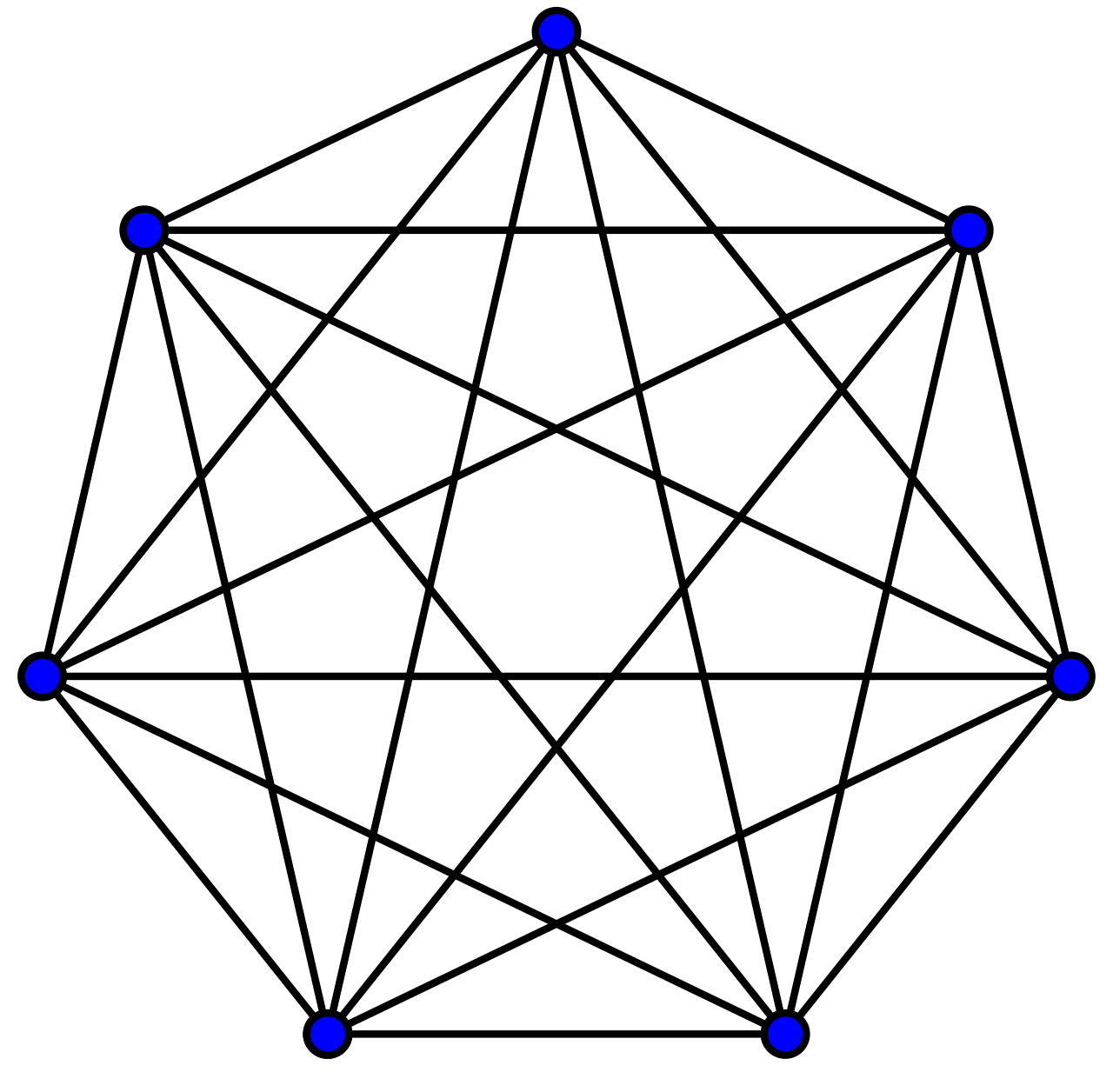
An undirected complete graph provides a basic vertex-and-edge illustration; the article explains why direction changes the spectral-limit problem.
David Benbennick / Wikimedia Commons. Wikimedia-generated PNG rendering of the SVG; no editorial changes. · Image source · Public domain (released by the creator)

A large directed network can be studied by counting small patterns or by computing eigenvalues. Those two descriptions ought to agree when the network grows, but a convincing bridge requires more than a matrix identity. Directed adjacency matrices lack the symmetry that makes undirected spectral theory comfortable. In work first posted in June 2025, revised on January 19, 2026, and published in European Journal of Combinatorics in 2026, Jan Grebík, Daniel Král', Xizhi Liu, Oleg Pikhurko and Julia Slipantschuk establish that bridge for their directed graph limit setting. Their theorem identifies the limiting spectrum and preserves the right notion of multiplicity.
The result concerns dense limits and normalized eigenvalues
The paper considers loopless directed graphs without parallel edges in either direction between a pair, so opposite arrows are not both present. A convergent sequence has increasingly many vertices and converging densities of every fixed finite directed pattern. For such a sequence with limit W, the adjacency eigenvalues divided by the number of vertices converge, as sets in the Hausdorff sense, to the spectrum of W's integral operator. Around each nonzero limiting eigenvalue, the total algebraic multiplicity also stabilizes appropriately.
Hausdorff convergence means two kinds of approximation at once. Eventually every spectral point of a finite graph lies near a limiting spectral point, and every limiting spectral point lies near a finite one. It does not choose a canonical ordering of all eigenvalues, nor promise that a chosen eigenvector has a stable direction. The qualification at nonzero eigenvalues matters because compact operators may have infinitely many spectral points accumulating at zero. Tracking each tiny mode separately would demand information the theorem does not claim.
A graphon replaces vertex labels with a continuum
The foundational work of László Lovász and Balázs Szegedy introduced limit objects for dense graph sequences by representing them with measurable functions on a square. In the undirected setting, the function is symmetric. One can think of dividing the square into a large grid and putting adjacency information into its cells. Increasing graph size refines the grid. A limit function retains statistical pattern information without requiring the first vertex in one graph to correspond to a particular vertex in the next.
This explains why labels should not be the basis of convergence. Relabeling a graph changes the arrangement of its adjacency matrix but leaves its edges, cycles and eigenvalues unchanged as mathematical structures. A useful limit theory has to identify those equivalent descriptions. A raw cell-by-cell comparison can declare two relabelings far apart even when they describe the same graph. Pattern densities, together with the appropriate distance allowing relabeling, focus instead on structural agreement. That is the natural scale at which a spectral limit should be meaningful.
Symmetry supplies more than real eigenvalues
For an undirected adjacency matrix, symmetry allows an orthogonal eigenbasis and real eigenvalues. Direction removes those guarantees. A two-by-two matrix with diagonal entries a and a, upper-right entry one and lower-left entry zero has the repeated eigenvalue a, yet only one independent eigenvector. This is a linear-algebra illustration, not a graph in the paper's loopless class. It shows why counting independent eigenvectors would miss part of a repeated spectral value: algebraic multiplicity records the repeated root, even when the eigenspace is smaller.
Balázs Szegedy's earlier paper on kernel operators developed spectral aspects of graph limit theory, including descriptions involving eigenvalues and eigenspaces. That symmetric background makes the later directed extension a distinct task. One cannot simply replace a symmetric matrix by an asymmetric matrix in every step of a proof and retain orthogonality. The 2026 publication uses operator-theoretic convergence to handle the missing structure. Readers interested in applying the theorem should therefore check the graph-limit assumptions, rather than assuming any numerical sequence of nonsymmetric matrices falls under it.
A cyclic three-part network can be checked by hand
Divide 3m vertices into three equal groups A, B and C. Put every arrow from A to B, every arrow from B to C and every arrow from C to A, with no other arrows. A vector constant on each group is transformed by a three-cycle of group values multiplied by m. The three nonzero adjacency eigenvalues are m times the three cube roots of one. After dividing by the total vertex count 3m, they become one third times those roots. All remaining eigenvalues are zero.
Count directed triangle homomorphisms independently. An ordered triple of vertices traces a cycle only when its group sequence is A, B, C or a cyclic rotation of that sequence. There are three successful group sequences among twenty-seven equally likely sequences, giving density one ninth. Cubing the three normalized nonzero eigenvalues produces three copies of one twenty-seventh; their sum is also one ninth. The complex eigenvalues cancel their imaginary contributions. This finite example makes the spectral counting identity tangible without requiring an abstract integral operator.
Closed walks explain the matrix identity
For a finite adjacency matrix, an entry of its square counts two-step walks between two vertices. Multiplying again counts three-step walks, and the diagonal entries count walks returning to their start. Summing those diagonal entries, the trace, therefore counts closed walks. The trace of a matrix power also equals the sum of the corresponding powers of its eigenvalues, counted with algebraic multiplicity. These are closed-walk or homomorphism counts, not necessarily counts of distinct unlabelled simple cycles. Confusing those objects introduces extra factors and collision errors.
The directed-limit paper proves that for a directed cycle of any fixed length at least three, its homomorphism density in the limit equals the absolutely convergent sum of eigenvalue powers with algebraic multiplicities. Passing a finite identity to an infinite limit is the substantive issue. Even when individual terms converge, an expanding sum can carry mass in its tail. A proof needs control of that tail. Merely plotting several leading eigenvalues of successively larger networks would not establish that the discarded terms contribute negligibly.
Dense scaling can hide genuinely sparse structure
Take a single directed cycle on n vertices. Every adjacency eigenvalue has absolute value one, so dividing by n sends all of them toward zero. A cyclic three-part graph, by comparison, has eigenvalues of order n and retains nonzero normalized modes. The distinction is appropriate for dense graph limits: one graph has only n edges, while the other has on the order of n squared edges. A sparse structure can be extremely organized and still disappear under a normalization designed for dense networks.
This is a limitation of the scale, not a defect in the theorem. If the question is about a sparse transport network with bounded average degree, another limiting framework or normalization may be necessary. Likewise, convergence of spectra is not a claim of causation between network connections and a physical response, nor a guarantee that spectral clustering will recover meaningful communities. Those applications require modeling choices and validation beyond the combinatorial theorem. The result secures a mathematical correspondence inside a specified setting.
A better starting point for extremal cycle questions
My inference from the theorem is that it makes certain directed extremal arguments easier to formulate directly at the limiting object. A cycle-density objective can be written through spectral data without inventing an unrelated limit of finite eigenvalue lists. That change improves conceptual bookkeeping. It does not remove the need to prove an extremal inequality or identify which limit kernels can actually attain equality. A correspondence between descriptions is a tool for solving problems, rather than a universal solution to them.
A reader testing examples can follow a useful sequence: specify the permitted directed edges, normalize eigenvalues by vertex count, count labelled closed walks, compare the relevant powers, and only then investigate a limit. The cyclic three-part construction offers an exact calibration case. More complicated examples can then reveal whether a discrepancy comes from multiplicity, normalization, relabeling or a mistaken cycle convention. Those distinctions are the practical value of the new bridge: it tells us precisely which finite calculations are supposed to agree in the limit.
Sources & further reading
Primary papers, project documentation, and research releases used in this article. Publication dates below refer to the sources themselves.
- Convergence of spectra of digraph limitsarXivPublished Checked
- Limits of dense graph sequencesarXivPublished Checked
- Limits of kernel operators and the spectral regularity lemmaarXivPublished Checked
FOLLOW THE QUESTION
Explore mathematics