MATHEMATICS
When pressure and velocity tails prevent a kinetic singularity
A July 2025 theorem replaces an entropy hypothesis with pressure and moment bounds, sharpening what can keep a non-cutoff Boltzmann gas smooth.
Research checked
Newest cited publication
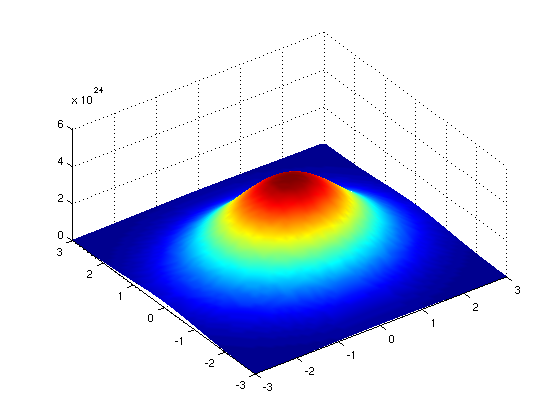
A Gaussian surface provides basic distributional context for velocity densities, moments, and the conditions needed to control their tails.
Michael Hardy / Wikimedia Commons. Unchanged original image. · Image source · Public domain (released by the creator)

What would a mathematical gas have to do before its velocity distribution could become singular? A useful answer identifies measurable warning signs rather than assuming every microscopic derivative stays bounded. A paper published on July 2, 2025, by Xavier Fernández-Real, Xavier Ros-Oton and Marvin Weidner advances this approach for the non-cutoff Boltzmann equation. Under specified mass, directional pressure and velocity-moment bounds, it controls the distribution and then its derivatives. The result is conditional regularity, not unconditional global existence. Its significance lies in the kind of information that now suffices: observable moments can replace a stronger entropy assumption.
A distribution can fail in more than one way
The unknown f records how much gas occupies a small region of position and velocity space. Its integral over velocity is local density. The equation combines transport, which moves a particle along its current velocity, and collisions, which redistribute velocities. “Non-cutoff” means that the collision model retains a singular abundance of small-angle deflections. Such a term is harder to write as a finite list of collision events, but its accumulation also creates a smoothing effect. The same microscopic feature is therefore both a mathematical difficulty and part of the regularizing mechanism.
There are several distinct potential failures. Density could grow without bound at some position. The distribution might concentrate around a thin set of velocities while retaining its total mass. Or a small population could carry increasingly large speeds. None of these possibilities is ruled out by a single global mass measurement. Conditional estimates identify combinations of local quantities that prevent the collision operator from losing the strength needed for smoothing. The adjective “local” matters: a bound integrated over the entire container does not imply the same bound at every point inside it.
Pressure has directions, even when temperature is one number
Pressure is represented mathematically by a matrix of second moments relative to the local mean velocity. For a unit direction e, multiplying by e on both sides measures the velocity variance along that direction, weighted by density. Temperature summarizes the trace, so it remembers the total variance but loses its orientation. The new theorem uses a quantitative condition that keeps at least two eigenvalues of this pressure matrix bounded below. Requiring a lower bound in every direction is a simpler sufficient condition, but it is stronger than the authors need.
An elementary example shows why temperature alone is not equivalent. Put equal weights at velocities (a, 0, 0) and (−a, 0, 0). The mean is zero and the scalar kinetic energy is positive. Yet there is no spread in the second or third direction, and the pressure matrix has only one positive eigenvalue. Replacing point masses by very narrow smooth packets gives a similar near-degeneracy without using singular distributions. The example is only a geometric illustration, but it explains how a gas can be warm by a scalar measure while still offering too little directional information for a particular regularity argument.
A moment is a budget for very fast particles
A q-th velocity moment averages speed raised to the power q. A bound on it limits how much mass can be carried far out in velocity space. Indeed, outside speeds greater than R, speed raised to q is at least R raised to q. Dividing the moment bound by that quantity gives a tail-mass bound. If a normalized distribution has fourth moment at most 16 in chosen velocity units, no more than one sixteenth of its mass can have speed above four in those units. This is a simple inequality, independent of the equation’s dynamics.
Higher moments penalize distant tails more strongly, but they do not prevent a narrow peak at moderate velocity. Pressure prevents a different kind of degeneracy and mass bounds prevent others. This is why the hypotheses appear as a package rather than competing ways to measure the same feature. Translating them into data would require velocity-resolved measurements and control of spatial variation. The theorem supplies a mathematical implication from bounds to smoothness; it does not claim that a finite experimental sample certifies uniform bounds over every unmeasured velocity or location.
The theorem’s actual operating range
In the paper’s periodic-in-position strong-solution setting, the main smoothness result concerns hard potentials, with collision parameter γ greater than zero and angular order s between zero and one. It assumes positive lower and finite upper mass-density bounds, the directional pressure condition and a bounded q-th moment, where q exceeds the dimension n and is at least γ plus twice s. Away from the initial time, derivatives of every order have quantitative bounds and rapid velocity decay. The basic uniform bound on f also covers γ equal to zero, with a qualification about obtaining decay for derivatives.
A waiting time in such a statement is meaningful. A rough or steep initial distribution may have derivatives that are large immediately, even if collisions smooth it later. An estimate valid for all times beyond τ can deteriorate as τ approaches zero without contradicting positive-time smoothing. Likewise, a bound whose constant depends on a pressure lower bound becomes weaker as that lower bound tends toward zero. Reading those dependencies reveals the actual obstruction the theorem has excluded. It also prevents an incorrect inference that the argument remains equally effective as its nondegeneracy assumptions collapse.
How this changes the earlier regularity program
Earlier work by Cyril Imbert and Luis Silvestre derives smoothness and velocity-decay estimates from pointwise control of mass, energy and entropy densities. Their survey explains the broader non-cutoff regularity program. A separate paper with Clément Mouhot proves Gaussian lower bounds under appropriate hydrodynamic assumptions for hard and moderately soft potentials in the spatially periodic setting. Such lower bounds express positivity: collisions populate velocities that might initially have been sparsely represented. The new pressure-and-moment theorem changes the entry conditions into a regularity argument rather than discarding all of this earlier structure.
It is helpful to separate upper and lower estimates. An upper bound prevents a distribution from forming arbitrarily high spikes. A positive lower bound prevents it from becoming too empty in regions where estimates need collision activity. They are not interchangeable. A density can have a modest maximum but vanish on a large set, or it can remain positive everywhere while forming a tall spike. A successful kinetic argument often needs to establish these properties in a particular order, then use regularity estimates to improve derivatives. The order is part of the mathematical architecture.
A sharper diagnosis is still a real theorem
The 2025 work also establishes a uniform version of its basic bound in a normalized grazing-collision limit toward a corresponding Landau description. Uniformity is valuable because an estimate with a constant that diverges in a limit cannot automatically survive that limit. The paper carefully distinguishes the basic bound from the full hierarchy of velocity-decay estimates, where additional information is needed for comparable robustness. This distinction is a reason to read the theorem statements rather than collapse several results into a slogan about all derivatives being uniformly controlled in every model.
The remaining question is how to obtain the assumed bounds from initial information alone in broader settings. A conditional theorem does not evade that problem; it isolates it. Instead of monitoring infinitely many derivatives, one can ask whether density, directional pressure or a moment budget can fail first. That turns an undefined fear of singular behavior into specific mechanisms to investigate. For kinetic theory, such reductions are valuable progress: they identify what a future global theorem must control, and they make clear why a scalar temperature estimate cannot simply replace the full geometric content of a pressure condition.
Sources & further reading
Primary papers, project documentation, and research releases used in this article. Publication dates below refer to the sources themselves.
- Regularity for the Boltzmann Equation Conditional to Pressure and Moment BoundsCommunications in Mathematical PhysicsPublished Checked
- Global regularity estimates for the Boltzmann equation without cut-offarXivPublished Checked
- Gaussian lower bounds for the Boltzmann equation without cut-offarXivPublished Checked
- Regularity for the Boltzmann equation conditional to macroscopic boundsarXivPublished Checked
FOLLOW THE QUESTION
Explore mathematics