MATHEMATICS
Lighting a smooth shape from a lattice
Lenny Fukshansky’s 2025 theorem bounds how far lattice-based light sources must sit from a smooth convex body, with geometry and translation kept explicit.
Research checked
Newest cited publication
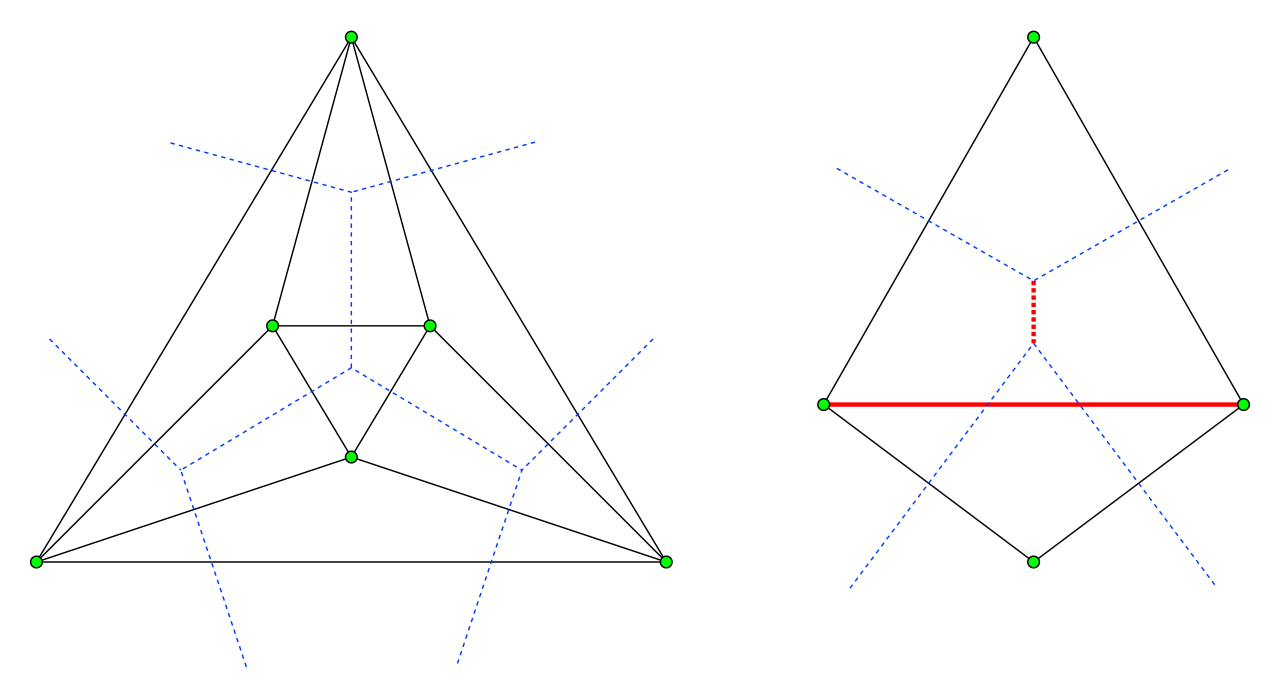
Planar point-set triangulations provide elementary geometric context; the illumination result concerns the smooth convex bodies and lattice-point distance bounds defined in the text.
David Eppstein / Wikimedia Commons. Wikimedia-generated PNG rendering of the SVG; no editorial changes. · Image source · Public domain (released by the creator)

How many lights illuminate the whole boundary of a convex object? For a smooth convex body in n-dimensional Euclidean space, the classical answer is n plus one. But a count leaves out a practical geometric restriction: what if lights can occupy only the points of a prescribed lattice? Lenny Fukshansky’s paper, submitted on January 17, 2025, and revised on March 27, gives explicit distance bounds for that setting. The arXiv revision says the paper is to appear in Archiv der Mathematik. Its main new question concerns controlled placement rather than a reduction in the number of lights. A crucial qualification is that the body may be translated relative to the lattice.
Illumination means crossing a supporting boundary
The model is geometric, not photometric. A source illuminates a boundary point when the segment from the source reaches that point without entering the object, and the line continuing through the point enters the interior. Merely touching along a tangent does not count. There is no brightness, diffraction, reflection or energy budget. Convexity makes this rule especially clean because a supporting hyperplane separates an external direction from the interior.
For a disk of radius R centred at the origin, write a boundary point as R u, where u is a unit vector. A source a sees that point in the required strict sense when a·u is greater than R. The scalar product measures how far the source lies beyond the tangent line. If a·u equals R, the line is tangent and misses the strict condition. This elementary example explains why a drawing in which rays just graze an object can look sufficient while failing the mathematical definition.
Three lights around one disk
Place three sources at the vertices of an equilateral triangle centred on the disk, each at distance L from the origin. For any unit normal u, some vertex direction lies within sixty degrees of u. Consequently at least one source has a·u at least L/2. Taking L greater than 2R guarantees strict illumination everywhere. This is a direct calculation for a disk, not the general theorem’s optimal distance estimate.
It also exposes the difference between two distance objectives. A source at radius L is only L minus R from its nearest point on the disk, but L plus R from its farthest point. Fukshansky defines illumination distance as the maximum distance between any chosen source and any point of the body. It therefore controls the full spatial spread of the arrangement. Replacing that definition by nearest-source distance would produce a different problem and would make comparisons with the paper’s explicit bounds misleading.
The lattice restriction changes the construction
A full-rank lattice consists of all integer combinations of an independent collection of vectors. It can be skewed, stretched or highly uneven. A source arrangement chosen freely in continuous space need not have any lattice point near its ideal vertices. The theorem constructs a containing lattice simplex with n plus one vertices and controls its size using geometric information about a lattice basis. The smooth body is illuminated after a suitable translation, as the paper explicitly specifies.
That translation is a substantive allowance. Sliding a disk by half a grid spacing changes which lattice points sit near its useful illumination directions. A theorem permitting such a slide cannot automatically be read as the same bound for every fixed placement of the body. The count of sources may remain plausible under other placements, but a quantitative distance assertion has to be proved with its actual placement assumptions. In any attempted numerical illustration, the translation should be reported beside the lattice and source coordinates.
A bad basis can disguise a simple grid
Consider the vectors (1,0) and (N,1), with N an integer. They generate exactly the ordinary integer lattice, because subtracting N times the first vector from the second gives (0,1). Their parallelogram has area one, yet the product of their lengths is the square root of N² plus one. As N grows, the displayed basis looks increasingly slanted and unnecessarily large even though the underlying set of possible lamp positions has not changed.
This is the purpose of basis-quality quantities such as orthogonality defect. In an unsquared convention it is the product of basis-vector lengths divided by covolume; its minimum value is one for an orthogonal basis. Some literature uses the square of this quantity, including the cited work on Hermite–Korkine–Zolotarev reduced bases. The conventions must not be mixed. Porter, Dable-Heath and Ling’s paper studies sharp low-dimensional bounds and general-rank estimates for that reduced-basis setting, supplying useful context for why controlling a basis can sharpen a geometric construction.
Well-rounded is not the same as perpendicular
A lattice is well-rounded when its shortest nonzero vectors include n independent directions. This balances available short directions without requiring right angles. For instance, unit vectors at sixty degrees generate a triangular lattice in the plane. Their cell has area square root of three divided by two, so their unsquared orthogonality defect is 2/√3, approximately 1.155. The lattice is well-rounded, yet this basis is not orthogonal.
Fukshansky’s 2025 paper gives improved distance estimates for special lattice classes, including well-rounded, nearly orthogonal and virtually rectangular cases. These hypotheses encode different geometric advantages, not interchangeable adjectives for regularity. Fukshansky and Kogan’s earlier study of nearly orthogonal lattices also shows why one should avoid a universal notion of best geometry: in its well-rounded setting and dimension at least three, the nearly orthogonal set contains no local maxima of packing density. A feature useful for controlling illumination distance need not maximize the density of round balls.
A finite lamp is different from a direction at infinity
There is another instructive calculation for the disk. Put a source at distance L greater than R and let θ be the angle between its position vector and the outward normal u. The condition L cos θ greater than R means the lamp illuminates normals within angular distance arccos(R/L) of its direction. Moving the lamp farther away increases this angle toward ninety degrees, but any finite lamp covers a strictly smaller range. Position therefore controls angular reach even when the source count is unchanged.
With L equal to 3R, the angular half-width is approximately 70.53 degrees. Three evenly spaced sources then have overlapping coverage intervals, rather than only tangent endpoints. That overlap provides robustness: small perturbations of the sources or a small translation of the disk can preserve illumination. On a prescribed lattice, robust angular margins can be useful when approximating an ideal arrangement with allowed sites. They do not by themselves prove the general distance theorem, especially for bodies with changing curvature. They show why a quantitative construction needs both enough directions and enough room to make those directions effective from finite points.
What a numerical example should test
A meaningful experiment would specify a smooth convex body, a full-rank lattice, its allowed translation, the n plus one proposed sources, and the paper’s maximum-pair distance. For an ellipse, testing finitely many evenly spaced boundary samples is useful for exploration but is not a proof that every boundary point is illuminated. A narrow angular gap can sit between samples. An analytic normal calculation or a rigorous interval argument would be needed to convert the picture into a certificate.
The broader illumination conjecture asks for a universal bound of 2ⁿ for arbitrary convex bodies. The present result concerns smooth bodies with positional restrictions and does not solve that conjecture. Its value lies in turning a qualitative existence statement into a quantitative one whose parameters can be inspected. In geometric design, it is easy to count components and overlook how far apart they must be placed. This theorem makes that hidden spatial cost part of the mathematical statement, while showing that the arithmetic shape of a grid can affect the guarantee.
Sources & further reading
Primary papers, project documentation, and research releases used in this article. Publication dates below refer to the sources themselves.
- On lattice illumination of smooth convex bodiesarXivPublished Checked
- A New Bound for the Orthogonality Defect of HKZ Reduced LatticesarXivPublished Checked
- On the geometry of nearly orthogonal latticesarXivPublished Checked
FOLLOW THE QUESTION
Explore mathematics