MATHEMATICS
Geometry Behind the Jacquet–Langlands Transfer
A September 2026 preprint relates arithmetic cohomology through Igusa stacks, proving many cases of a geometric conjecture while retaining explicit limits.
Research checked
Newest cited publication
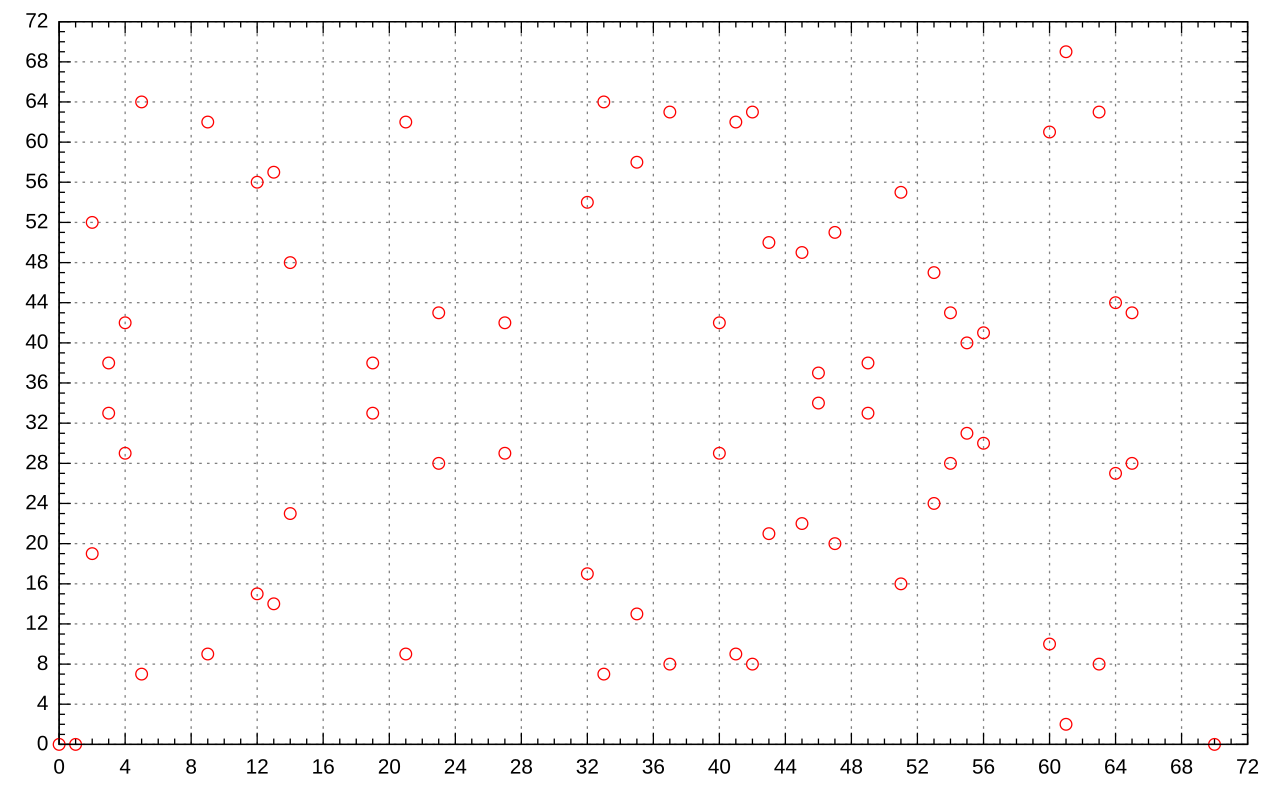
A finite-field elliptic curve supplies basic arithmetic-geometric context; the stacks and correspondences in the new result are substantially more sophisticated objects.
Trshaffer / Wikimedia Commons. Wikimedia-generated PNG rendering of the SVG; no editorial changes. · Image source · CC0 1.0

Two different mathematical spaces can encode related arithmetic information without being the same space. A September 8, 2026 preprint by Pol van Hoften and Jack Sempliner investigates this phenomenon for Shimura varieties through a geometric version of the Jacquet–Langlands correspondence. The authors formulate a conjecture about unusual isomorphisms between associated Igusa stacks and prove it for many cases of interest. Combining those geometric results with the spectral action developed by Laurent Fargues and Peter Scholze yields comparisons between cohomology groups. The paper is a preprint at this research cutoff, and its conjectural framework extends beyond its proved cases. Understanding the architecture is more useful than treating its title as an announcement of unrestricted Langlands reciprocity.
Representations make symmetries comparable
A representation turns an abstract symmetry into a linear operation on a vector space. For example, let a symmetry exchange two coordinates. Its matrix sends the vector (a, b) to (b, a). The vectors (1, 1) and (1, minus 1) respond differently: the first is fixed and the second changes sign. Decomposing a representation into such distinguishable pieces can reveal structure that is hidden when one only counts its total dimension.
Arithmetic geometry contains far richer symmetry actions, but the organizing idea remains useful. Geometric spaces contribute cohomology carrying group actions and Hecke operators. Automorphic representations organize compatible symmetry data. A correspondence can then ask which pieces appear on two sides and how their multiplicities compare. Equality of dimensions would be a very weak comparison: two two-dimensional vector spaces can support entirely different actions. The arithmetic content lies in preserving the relevant operations, not merely matching a numerical total.
The exchange matrix also illustrates an assumption that can disappear in a slogan. Over the rational numbers, its fixed and sign-changing directions span the whole plane. In characteristic two, minus one equals one, and these two displayed vectors coincide. A decomposition argument that divides by two cannot be copied unchanged into that coefficient field. This elementary failure is one reason coefficient restrictions in much deeper cohomological comparisons deserve explicit attention.
Related groups need not have identical rational points
Inner forms are algebraic groups related by a particular type of twisting. After a suitable extension of scalars, related groups can become isomorphic even when their arithmetic over the original field differs. A familiar broad illustration comes from the real matrix algebra and the Hamilton quaternion algebra: the latter is a division algebra over the reals, whereas two-by-two real matrices include nonzero singular elements. After extending to the complex numbers, the quaternion algebra becomes a matrix algebra.
That illustration concerns inner forms in general. It does not assert that these particular real groups satisfy the pure-inner-form and Shimura-data hypotheses of the 2026 paper. This separation matters. A motivating example can explain why related algebraic groups differ without serving as an example of every technical theorem about them. The research question is whether suitably associated geometric objects retain enough common structure to compare their arithmetic representations, even when the ambient groups or varieties look different.
Why a stack retains more than a list of objects
A moduli problem classifies mathematical objects that vary in families. An ordinary parameter list records which objects occur; a stack also retains their automorphisms and the way families glue. Consider an elementary object consisting of an unordered pair of identical points. Swapping the two labels leaves the object unchanged. If a classification discards that symmetry immediately, it can lose information needed for constructions that depend on how objects vary or are identified.
This is an analogy for why stacks appear, rather than a definition of the Igusa stacks in the paper. Those stacks retain specialized arithmetic structures associated with Shimura varieties. The adjective exotic signals a relationship that does not come from simply declaring the original Shimura varieties identical. It is therefore possible for a comparison at the level of an associated moduli object to illuminate arithmetic shared by spaces that are not globally interchangeable.
The geometric input has an earlier foundation
Liang Xiao and Xinwen Zhu's July 18, 2017 preprint constructs cohomological correspondences between special fibres modulo p of different Shimura varieties. Their work studies affine Deligne–Lusztig varieties and, under specified genericity assumptions, obtains consequences for Tate classes in middle cohomology. Van Hoften and Sempliner reinterpret the relevant exotic Hecke correspondences through perfect Igusa stacks. The 2017 paper is foundational background, not a new result from 2026.
A correspondence is more flexible than a function between two spaces. It can consist of an intermediate space mapping to both, allowing information to be pulled back along one map and pushed forward along the other when the relevant operations are available. For finite sets, a relation can likewise connect several outputs to one input without defining a single-valued function. The analogy explains the extra flexibility, but cohomological pushforward requires substantial geometric hypotheses. Existence of an arbitrary relation would not prove an arithmetic transfer theorem.
The spectral action organizes parameter information
Fargues and Scholze's work, first posted in February 2021 and revised through November 2024, builds geometric machinery for local Langlands on the Fargues–Fontaine curve. Among its outputs is an action of perfect complexes on the stack of Langlands parameters on an appropriate category of sheaves. This is the spectral action used in the 2026 preprint. It is background machinery with a precisely defined categorical setting, not a physical spectrum measured in an experiment.
The word action can be approached through an elementary operator example. If a diagonal matrix has distinct eigenvalues, polynomial expressions in that matrix can separate its eigenspaces. A richer parameter-based action can organize information according to a parameter in a much more sophisticated setting. This analogy explains why additional operators can make a comparison sharper. It does not identify categorical spectral actions with diagonalizing a finite matrix, and no such finite algorithm is claimed here.
Occurrence and multiplicity are different conclusions
Suppose two representations both contain a particular irreducible piece. That is an occurrence statement. One may contain it once and the other three times, so occurrence alone says nothing about equal multiplicities. As an elementary model, compare a vector space with one fixed direction to one with three fixed directions. Both have nonzero invariant vectors, but their invariant subspaces have different dimensions. Any claim of multiplicity preservation must account for that difference.
The 2026 paper distinguishes qualitative transfer of suitable Hecke eigensystems from stronger multiplicity comparisons under additional parameter and coefficient hypotheses. Its geometric Theorem 2 assumes the local group splits over an unramified extension of the p-adic field. It proves the broad Igusa-stack Conjecture 1 unconditionally for Shimura data of PEL type A₂ₙ₊₁ when p is greater than 2; PEL indicates polarization, endomorphism and level structures. The listed odd orthogonal and projective symplectic cases over totally real fields additionally assume Conjecture 4.4.7 on exotic Hecke correspondences, whose proof the paper reports as announced by Xiao–Zhu. That dependency must remain attached to those cases. General Conjecture 1 is not proved without restriction. A reader should also distinguish nonvanishing, a direct summand, and a full cohomological comparison: these conclusions have different assumptions and strengths.
What a geometric explanation adds
A formula equating arithmetic quantities can be powerful even before its geometric origin is understood. A geometric construction can add another layer: it may show how the equality interacts with families, operators, coefficient changes, or related spaces. This is an inference about the value of the approach, rather than a claim that every such extension has been proved in this preprint. Each additional compatibility remains something to establish.
The September result is best read as a carefully assembled bridge. Older special-fibre correspondences, newer moduli-stack geometry, and the local spectral action play different roles. Its proved cases show that the bridge carries meaningful cohomological information; its conjecture marks where the proposed architecture reaches farther than the current proof. That combination makes the research substantial while leaving an honest boundary around what was established by October 18, 2026.
Sources & further reading
Primary papers, project documentation, and research releases used in this article. Publication dates below refer to the sources themselves.
- A geometric Jacquet--Langlands correspondence for Shimura varietiesarXivPublished Checked
- Geometrization of the local Langlands correspondencearXivPublished Checked
- Cycles on Shimura varieties via geometric SatakearXivPublished Checked
FOLLOW THE QUESTION
Explore mathematics