MATHEMATICS
What Remains Smooth When Mean Curvature Flow Breaks?
An October 2026 preprint controls tangent-flow geometry under a scale-invariant curvature bound, while leaving multiplicity and continuation separate.
Research checked
Newest cited publication
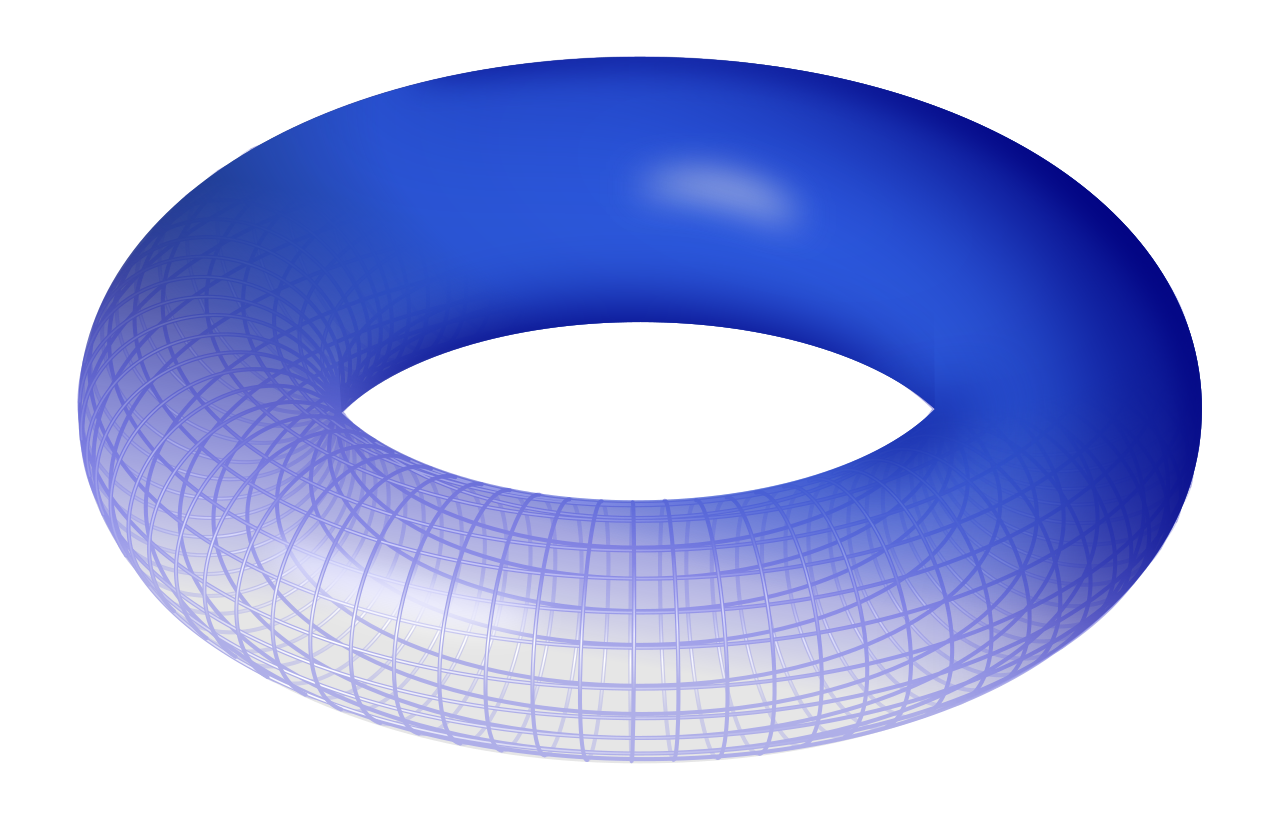
A meshed surface provides geometric context for discussing curvature and evolving surfaces; it is not a frame from the research’s mean-curvature flow.
Leonid 2 / Wikimedia Commons. Wikimedia-generated PNG rendering of the SVG; no editorial changes. · Image source · CC BY-SA 3.0

A geometric flow can become singular while retaining an orderly shape under magnification. On 13 October 2026, Yongheng Han and Zhen Wang posted a preprint establishing that every tangent flow at the first singular time has smooth support for a smooth flow of closed embedded hypersurfaces in Euclidean space, provided a particular total-curvature bound holds uniformly. The distinction between smooth support and a smooth original evolution is essential. The theorem does not say that singularities disappear. It says that their magnified geometric support is regular under its hypotheses. A shrinking sphere supplies the simplest model for seeing how a flow can fail while its rescaled shape remains perfectly smooth.
A sphere keeps its shape and loses its size
In mean curvature flow, a hypersurface moves in its normal direction at a speed determined by its mean curvature. For an n-dimensional round sphere of radius R in Euclidean space, using the convention that mean curvature is the sum of principal curvatures, the inward speed is n/R. Its radius therefore satisfies R′ = −n/R. Multiplying by 2R and integrating gives R² = R₀² − 2nt. The radius reaches zero at T = R₀²/(2n), even though the surface stays round until that time.
This direct calculation explains why a singularity need not involve a visibly wrinkled surface. Curvature is the reciprocal of length, so every principal curvature diverges as the radius shrinks. The surface’s diameter simultaneously tends to zero. If one magnifies by the inverse radius, the image is a unit sphere throughout the evolution. The limiting shape is smooth; the unscaled evolution still ceases to be a smooth embedded hypersurface at extinction. Confusing these two observations would erase the very distinction that tangent flows are designed to preserve.
Why the curvature exponent equals the dimension
Let A denote the second fundamental form, which records curvature, and let dμ denote n-dimensional area on the evolving hypersurface. The quantity in the new hypothesis is the integral of |A| raised to the n-th power. Under a dilation of all lengths by a factor c, curvature is divided by c while area is multiplied by cⁿ. Their factors cancel exactly. The integral is unchanged by scaling. That is why it can remain informative when one repeatedly enlarges a tiny neighborhood of a singular point.
The shrinking sphere gives a second consistency check. Its squared curvature norm is n/R², so |A|ⁿ is n raised to n/2 times R to the power −n. Multiplication by its area, which is the unit sphere’s area times Rⁿ, produces a constant independent of R. Thus uniformly bounded total curvature is compatible with curvature becoming arbitrarily large at individual points. A bound on an integral and a bound on a pointwise maximum are different kinds of information, even when both are casually called curvature bounds.
How a tangent flow changes the microscope
To inspect a singularity at location x₀ and time T, translate x₀ to the origin and enlarge spatial distances by factors λ that tend to infinity. Time must be enlarged by λ². This is the parabolic scaling built into diffusion-type evolution. A rescaled time s corresponds to original time T + s/λ². Fixing a negative s therefore inspects an earlier time that approaches T as magnification increases. A convergent subsequence of these rescaled evolutions gives a tangent flow in the appropriate weak geometric sense.
The square in the time scaling is easy to check dimensionally. Curvature has units of inverse length, so normal velocity also has units of inverse length in geometric time. If lengths are multiplied by λ, velocities under a new clock change by λ divided by the clock’s scale. To transform velocity like curvature, that denominator must be λ². This calculation does not establish compactness or convergence; those require estimates. It shows why enlarging photographs at unchanged time intervals would not produce the mathematical object used in singularity analysis.
Smooth support does not determine multiplicity
A weak geometric limit can retain how much surface accumulates at a location. Its support is the set where the limiting measure lives. Multiplicity records the number or weight of layers there. As an elementary measure example, two parallel planes approaching each other can converge to twice the area measure on one plane. The support is a smooth plane in either case. This example illustrates the distinction; it is not asserted to be a tangent flow from an initial hypersurface satisfying the new theorem.
Han and Wang’s conclusion concerns smooth support. Their paper separately states a stronger multiplicity-one convergence conjecture in this setting. It would therefore be inaccurate to report the theorem as having settled that stronger claim. Nor does knowing that each possible tangent support is smooth automatically identify a unique tangent limit at every scale. Regularity, multiplicity and uniqueness are logically distinct. A result about one should not silently acquire the other two merely because a drawing of the limit looks simple.
A higher-dimensional result with an older foundation
Tom Ilmanen’s paper on singularities of surface flow was uploaded to arXiv on 29 January 2026. The archive explicitly says that the unpublished manuscript was written in 1993 or 1994 and posted with his family’s permission. Its 2026 upload date is therefore not the date of a newly discovered 2026 proof. The work establishes smooth branched shrinking models for surface tangent flows, with a stronger embedded conclusion in three ambient dimensions. Branching and multiplicity remain separate features in its statement.
Brian White’s work on subsequent singularities treats an initially smooth mean-convex flow and shows strong local convexity near singularities. Mean-convexity is a directional curvature restriction, not the same assumption as a bound on an integral of |A|ⁿ. These different routes illustrate why a theorem’s hypotheses matter as much as the attractive shape of its conclusion. One can simplify a problem by restricting allowed curvature signs, by restricting topology, or by controlling a scale-invariant curvature budget; the resulting classes need not coincide.
What an integral can and cannot control
Consider a nonnegative toy function on an interval: height k on a subinterval of width 1/k, and zero elsewhere. Its integral stays one, but its maximum grows without bound. In geometry the curvature and area are linked, so they cannot be chosen as arbitrary independent functions. Nevertheless, the example explains why concentration is the central difficulty. Finite total mass does not prevent very high values on very small sets. To recover regularity, one must exploit geometric equations and the structure of the limiting surface.
There is also a difference between boundedness at each time and one bound valid for all times before T. A function such as 1/(T − t) is finite at every earlier time but has no uniform upper bound. The hypothesis uses the supremum over the full time interval, excluding precisely this escape. A computation that samples only a handful of simulation frames cannot establish that supremum is finite. Numerical evidence can suggest a plausible bound, while an analytic estimate must control what happens between and beyond the sampled frames.
Better questions after the singularity is magnified
The immediate value of a regularity theorem is a narrower set of possible local models. Smooth support lets researchers ask geometric questions about an actual smooth object rather than an unrestricted singular set. Further progress would need to resolve the extra information that the theorem leaves open, or establish comparable conclusions under weaker curvature assumptions. Because the October result is a recent preprint, independent checking of its argument and later publication remain relevant to how firmly the research community incorporates it.
For learning purposes, three calculations provide an unusually effective starting point: derive sphere extinction, verify the scaling cancellation in the curvature integral, and distinguish a plane’s area measure from twice that measure. Together they explain the theorem’s premise, its conclusion and its limit. The research question is no longer merely whether a surface becomes singular. It becomes which geometric data survive magnification, which remain hidden in multiplicity, and which additional estimates would turn a regular limiting support into a more complete description of the original evolution.
Sources & further reading
Primary papers, project documentation, and research releases used in this article. Publication dates below refer to the sources themselves.
- Singularities of Mean Curvature Flow with Bounded Total CurvaturearXivPublished Checked
- Singularities of Mean Curvature Flow of SurfacesarXivPublished Checked
- Subsequent Singularities in Mean-Convex Mean Curvature FlowarXivPublished Checked
FOLLOW THE QUESTION
Explore mathematics