MATHEMATICS
Why packing bounds need a definition of density
A 2025 preprint extends linear programming bounds to homogeneous spaces, showing why hyperbolic packing needs invariant probability and careful averaging.
Research checked
Newest cited publication
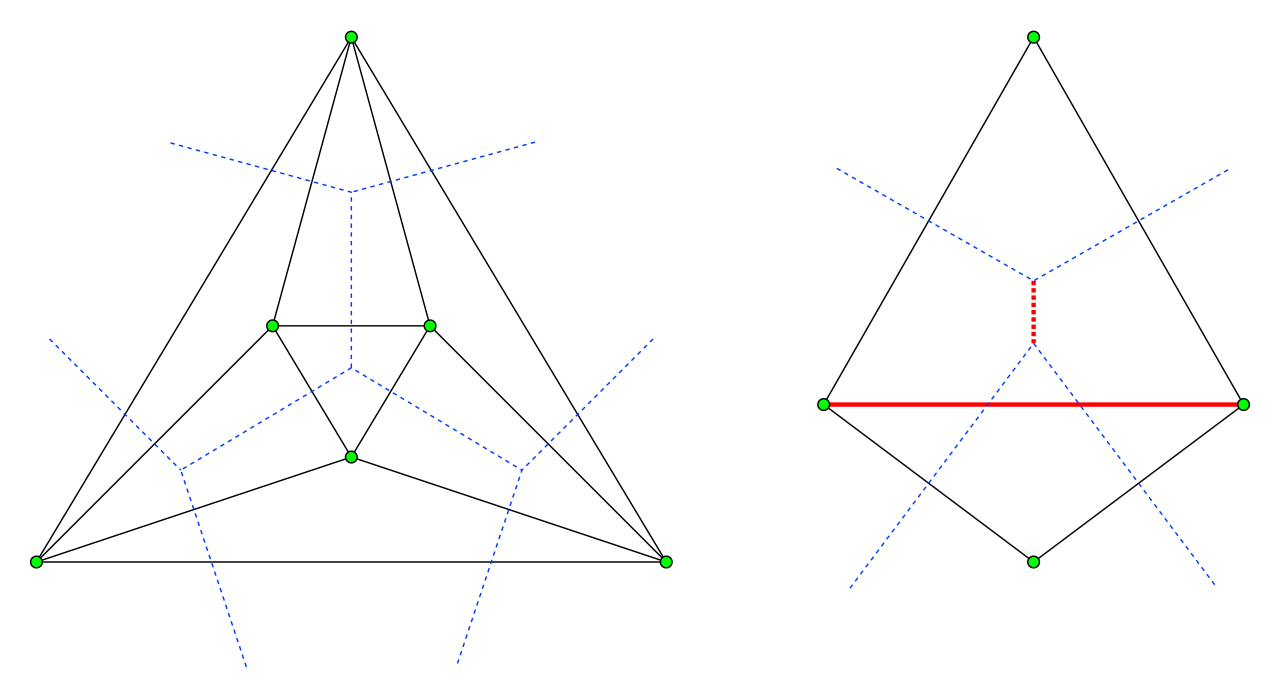
A planar triangulation provides elementary geometric context for decomposing space; density in hyperbolic space needs the invariant definition explained in the article.
David Eppstein / Wikimedia Commons. Wikimedia-generated PNG rendering of the SVG; no editorial changes. · Image source · Public domain (released by the creator)

Before asking how tightly balls can fill a space, one must decide what fraction filled actually means. In the Euclidean plane, increasingly large sampling windows make their edges relatively insignificant. In hyperbolic geometry, where the surrounding space grows differently, the edge can remain a major part of the measurement. Maximilian Wackenhuth’s preprint of May 29, 2025, develops linear programming packing bounds in a framework of commutative homogeneous spaces. A hyperbolic special case proves a version of a conjecture from Henry Cohn and Yufei Zhao. The story is about more than transplanting a successful inequality: the right probability model determines which arrangements the inequality can meaningfully describe.
A window whose edge fades away
Consider counting a square grid through a square window of side R. A boundary strip of fixed width w has area roughly 4Rw, while the entire window has area R². The strip’s fraction therefore approaches zero as R grows. Cells cut by the edge become a diminishing source of disagreement. A disk, a square or another reasonably regular family of expanding windows can then reveal the same bulk density for a periodic packing.
That argument contains an assumption that often remains invisible: volume growth makes the boundary negligible. If a setting violates it, extending the Euclidean definition mechanically can allow the shape or placement of the measuring window to influence the answer. It becomes necessary to distinguish a count from a geometric invariant. A huge window is not automatically a fair sample; the correct question is whether the sampling procedure loses its positional bias in the limit.
Curvature keeps the outer shell relevant
In a hyperbolic plane normalized to curvature minus one, a disk of radius R has area 2π(cosh R minus one). This gives a useful independent calculation. Remove an inner disk of radius R minus w. For large R, the fraction left in the outer shell approaches one minus e to the power minus w. With w equal to one, that is about 0.632. A shell of fixed thickness therefore keeps a substantial share of the area even when the window becomes enormous.
This example explains the difficulty without asserting that any particular packing has an ill-defined density. It shows why a Euclidean boundary-error proof cannot simply be reused. It also shows why the radius of the packed balls matters in hyperbolic geometry. Euclidean scaling carries one equal-ball packing problem into another. Scaling lengths while keeping the curvature fixed does not preserve hyperbolic distances and volumes in that way. Radius and curvature together establish a meaningful dimensionless scale.
Replace a privileged origin with an invariant law
A stationary random packing is a probability distribution over packings whose law is unchanged when an allowed spatial symmetry is applied. Its density can be described as the probability that a chosen reference point lies inside a packed ball. The reference point is fixed, but the invariant distribution removes its special status. Think of selecting a random phase of a periodic Euclidean grid: one point’s chance of being covered equals the covered fraction of a cell.
For an elementary probability model, suppose a fundamental cell has area twenty and the disk portions occupying it have total area fifteen. A uniformly selected location is covered with probability three quarters. There is no need to choose a large observation window to obtain that answer. In a curved setting the invariant-law construction requires considerably more care, but it preserves this clean distinction between the random experiment and an individual realization. Wackenhuth relates invariant random packings to the generically measured packings in the density theory used by his theorem.
An auxiliary function acts as an obstruction
Cohn and Elkies’s Euclidean method uses a witness function that is nonpositive at distances at which distinct centres may occur, while its Fourier transform is nonnegative. Roughly, those conditions let geometry and spectral positivity estimate the same aggregate in opposite directions. The diagonal contribution, where a centre is compared with itself, then limits how many centres can be present. Smoothness and decay conditions ensure that the sums and transforms used in the argument behave properly.
There is a finite-dimensional analogy that makes the bookkeeping less mysterious. A positive semidefinite matrix has a nonnegative quadratic form for every vector of weights. If its off-diagonal entries are constrained to have the opposite sign, a large collection of points must pay through its diagonal terms. An auxiliary kernel built from a function of distance packages a similar tension. This analogy does not establish a packing theorem, but it explains why the sign of the function and positivity in a transform domain are complementary requirements rather than unrelated technical preferences.
The transform changes with the symmetry
On Euclidean space, translations lead naturally to the ordinary Fourier transform. On other symmetric spaces, the relevant harmonic analysis uses spherical functions and a spherical transform. The word spherical here refers to the symmetry-adapted machinery, not simply to a round observation window. A Gelfand-pair framework supplies the commutativity that makes this kind of transform useful. It does not claim that the underlying space is flat or that all of its motions commute.
Cohn and Zhao’s earlier work connected spherical codes and packing bounds, including hyperbolic bounds and a conjectural extension beyond the periodic setting. Wackenhuth’s 2025 paper works directly with invariant point processes and spectral positivity. Its hyperbolic theorem imposes a specified smooth, decaying class of witness functions; the paper explicitly distinguishes this from the weaker continuity and integrability assumptions in the earlier conjectural formulation. Thus a version of the conjecture is the careful statement, not a declaration that every possible regularity condition has disappeared.
A small matrix version of a packing obstruction
To see how positivity can force a numerical ceiling, imagine an N by N positive semidefinite matrix with every diagonal entry d and every off-diagonal entry at most minus a, where a is positive. Test its quadratic form on the vector containing only ones. Positivity says the sum of all its entries is nonnegative. The entrywise bounds say that same sum is at most Nd minus N(N minus one)a. Combining the inequalities gives N at most one plus d/a.
For d equal to three and a equal to one half, the ceiling is seven. This calculation is not itself a sphere-packing bound: it assumes a strictly negative off-diagonal margin that a real distance kernel may not possess. It does, however, isolate the architecture of an obstruction proof. One ingredient supplies a global nonnegativity statement, another makes the aggregate expensive as the collection grows, and the diagonal controls the remaining allowance. In an actual harmonic-analysis argument, constructing a witness satisfying every required inequality is the substantial task. The final division is often the least mysterious part.
A general inequality is not an optimal packing
A theorem allowing upper bounds still requires useful witness functions. Giving a machine the correct rules for a certificate does not ensure that it will find a sharp one. Nor does a valid upper bound prove an arrangement is optimal unless an equally dense construction meets it. This distinction matters especially when the new result’s achievement is broad applicability. A framework can remove a major logical obstacle without immediately producing a headline numerical record in every space it covers.
At the October 18, 2026 research cutoff, the cited arXiv record identifies Wackenhuth’s work as a preprint; no acceptance is assumed here. Its mathematical contribution is valuable precisely because it specifies the objects, density notion, symmetry assumptions and test-function class together. When a familiar geometric question moves to unfamiliar space, the definition of the measured quantity can carry as much weight as the calculation. The next useful advance could be a sharper witness, an extension of the admissible class, or a better understanding of which deterministic packings arise from the invariant model.
Sources & further reading
Primary papers, project documentation, and research releases used in this article. Publication dates below refer to the sources themselves.
- Linear programming bounds in homogeneous spaces, I: Optimal packing densityarXivPublished Checked
- Sphere packing bounds via spherical codesarXivPublished Checked
- New upper bounds on sphere packings IarXivPublished Checked
FOLLOW THE QUESTION
Explore mathematics