MATHEMATICS
Short Geodesics Can Also Twist: Density of Complex Systoles
A 2025 construction controls both the length and rotational holonomy of shortest hyperbolic geodesics, revealing more than short loops alone.
Research checked
Newest cited publication
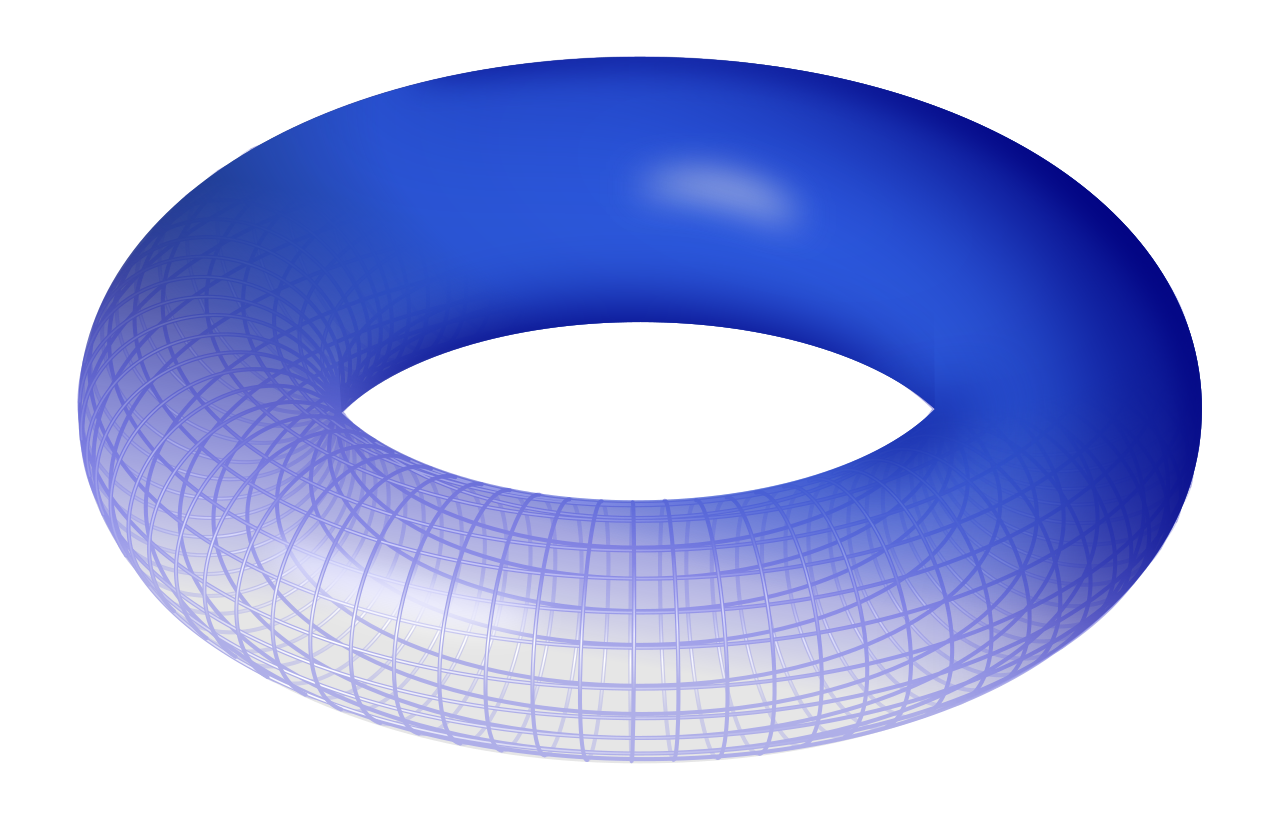
A torus introduces the idea of a surface with noncontractible loops; the geodesics in the article belong to the hyperbolic manifolds specified there.
Leonid 2 / Wikimedia Commons. Wikimedia-generated PNG rendering of the SVG; no editorial changes. · Image source · CC BY-SA 3.0

The shortest closed geodesic of a hyperbolic manifold has a length, but it also carries rotational information. Walk around the loop while parallel-transporting perpendicular directions, and those directions may return rotated. Junzhi Huang and Matthew Zevenbergen’s preprint, first posted on 30 May 2025 and revised on 20 July, proves a density result for this combined information across closed orientable hyperbolic manifolds of every dimension at least three. Their construction enlarges selected groups without introducing unwanted shorter geodesics. As of this article’s cutoff, the checked source is the revised preprint. The result concerns approximation across a family of manifolds, not an ability to adjust every shortest loop arbitrarily inside one fixed manifold.
A shortest loop carries a normal frame
A geodesic locally follows the straightest possible path allowed by a metric. A closed geodesic returns to its starting position and direction. In a closed hyperbolic manifold, the shortest such geodesic has length called the systole. Hyperbolic here means constant sectional curvature minus one, which fixes the unit of length. Arbitrarily shrinking the entire metric is not an allowed way to obtain a smaller systole while preserving that normalization. A short loop must arise from the global way hyperbolic space is identified.
In the orientable setting considered here, the perpendicular directions along the loop form a separate measurement. In three dimensions the perpendicular space is two-dimensional, so its orientation-preserving rotation is described by an angle modulo a full turn. In larger dimensions, a single angle is insufficient. The natural object is a conjugacy class of a rotation in SO(d − 1), the group of orientation-preserving orthogonal transformations of the perpendicular space. Changing the starting orthonormal frame changes the matrix by conjugation but leaves that class unchanged.
Complex length is more than a real distance
In the three-dimensional setting, one often packages length and angle together using complex-number notation. The real part measures translation along an axis and the imaginary part records rotation around it, subject to conventions about orientation and angle period. In higher dimensions, the preprint uses the pair of a positive length and a rotation conjugacy class. Calling this complex translation length should not suggest that one ordinary complex number captures every higher-dimensional rotation. The paired definition makes the additional information explicit.
For an independent elementary example, consider an ideal screw motion that advances two units along its axis and rotates the perpendicular plane by a quarter turn. Applying it four times advances eight units and makes a full rotation. The translational and rotational parts have different arithmetic behavior. A rotation by an irrational multiple of a full turn never returns exactly to the identity after any positive number of repetitions. That is what infinite-order rotational holonomy means; it does not mean that a finite-length loop has infinite length.
Density is an approximation statement
The theorem says that the complex systoles realized by closed orientable hyperbolic d-manifolds are dense in the product of positive lengths and rotation conjugacy classes, for d at least three. Thus a target length, target rotation class and sufficiently small allowed neighborhoods can be approximated simultaneously by some manifold’s shortest geodesic data. The manifold is allowed to vary. The statement does not promise exact realization of every real target pair, a bound on the necessary volume, or a practical finite algorithm that produces a small example.
The distinction between approximation and equality is visible in the rational numbers. Fractions can approximate the square root of two arbitrarily well, yet no fraction equals it. A countable set can be dense, so density also says nothing by itself about a uniform probability distribution. If examples crowd particular regions under a chosen enumeration, that does not conflict with being dense elsewhere. These elementary distinctions prevent geometric density from being confused with typical behavior, randomness, or the frequency with which a target appears in a computational census.
The central construction problem is avoiding shortcuts
Suppose one builds a space containing a desired closed loop. That loop need not be shortest: some entirely different route may provide a shortcut. Controlling one object locally is therefore insufficient for controlling a global minimum. A simple graph demonstrates the problem. Start with a cycle of length ten, then add another cycle of length three elsewhere. The original ten-cycle survives unchanged, but it no longer determines the graph’s shortest cycle. Building larger spaces while preserving a prescribed minimum requires control over everything newly introduced.
Huang and Zevenbergen formulate that control through a D-systolic lattice extension. Their extension ensures that every loxodromic element with translation length at most D is conjugate to an element of the original group. Loxodromic isometries are the hyperbolic-space transformations with a translating axis and possible perpendicular rotation. Their theorem applies to classical Schottky subgroups in a specified arithmetic-algebraic setting, with a cocompact extension available under an anisotropy condition. It is not an unrestricted lattice-extension theorem for every subgroup one might write down.
From transformations to a closed manifold
A hyperbolic manifold can be represented as hyperbolic space divided by a discrete group of isometries. Here the deck group preserves orientation, as in the source paper. Discreteness prevents transformations from accumulating near the identity in a way that destroys the local manifold picture. Removing torsion prevents fixed-point phenomena that would instead create an orbifold. Cocompactness makes the quotient compact. These conditions perform different jobs. A group generated by perfectly legitimate individual isometries need not automatically satisfy any of them as a whole.
This framework explains why preserving a loop’s transformation data is useful. The translating axis descends to a closed geodesic in the quotient, and its translation length becomes the loop length. Adding group elements creates additional identifications and potentially additional closed geodesics. A systolic extension restricts precisely the dangerous short transformations. One can then connect a desired local translation-and-rotation pattern to a global closed manifold while protecting the claim that the selected loop realizes a minimum.
How earlier short-loop results fit
Belolipetsky and Thomson showed that compact hyperbolic manifolds with arbitrarily small systoles exist in every dimension at least two. Their construction also quantified volume growth within the family they built. Douba and Huang later proved that real systole lengths of closed hyperbolic manifolds are dense throughout the positive reals, going beyond merely approaching zero. These are distinct advances: one finds shorter and shorter loops, while the other approximates any positive target length.
The new paired result asks for rotational information at the same time as length. A real length measurement discards all that information, just as recording a screw’s forward displacement discards how much it turns. There is no logical reason that a construction controlling the discarded measurement must automatically control the full pair. The preprint also constructs arbitrarily short systoles with infinite-order holonomy. The revised version should be used: its archive history records removal of an earlier corollary and replacement by corrected statements about arithmetic restrictions.
What this lets geometers ask next
A useful follow-up is quantitative: how large or topologically complicated must a manifold become to approximate a specified pair within a specified error? A qualitative density theorem does not answer that. Another question is how strongly additional restrictions, such as arithmeticity or a fixed volume range, reduce the attainable data. The general-family theorem cannot simply be transferred to a narrower family. Restricting the construction changes the available transformations and can introduce number-theoretic obstructions.
For readers exploring the mathematics, the most revealing exercise is to keep three datasets separate: loop length, rotational return, and the list of all competing shorter loops. A construction must address all three to establish a complex systole statement. That perspective makes the achievement concrete. The work connects the ability to approximate a desired isometry with the ability to place it inside a closed manifold, while maintaining enough global control that its geodesic remains shortest. Local motion, group structure and global geometry meet in one carefully protected minimum.
Sources & further reading
Primary papers, project documentation, and research releases used in this article. Publication dates below refer to the sources themselves.
- Systolic lattice extensions of classical Schottky groupsarXivPublished Checked
- Density of systoles of hyperbolic manifoldsarXivPublished Checked
- Systoles of Hyperbolic ManifoldsarXivPublished Checked
FOLLOW THE QUESTION
Explore mathematics