MATHEMATICS
Why Curvature Gaps Matter: Lu’s Conjecture for Minimal Spheres in 2026
A January 2026 preprint resolves Lu’s curvature-gap conjecture for minimal two-spheres, revealing how topology and normal directions restrict bending.
Research checked
Newest cited publication
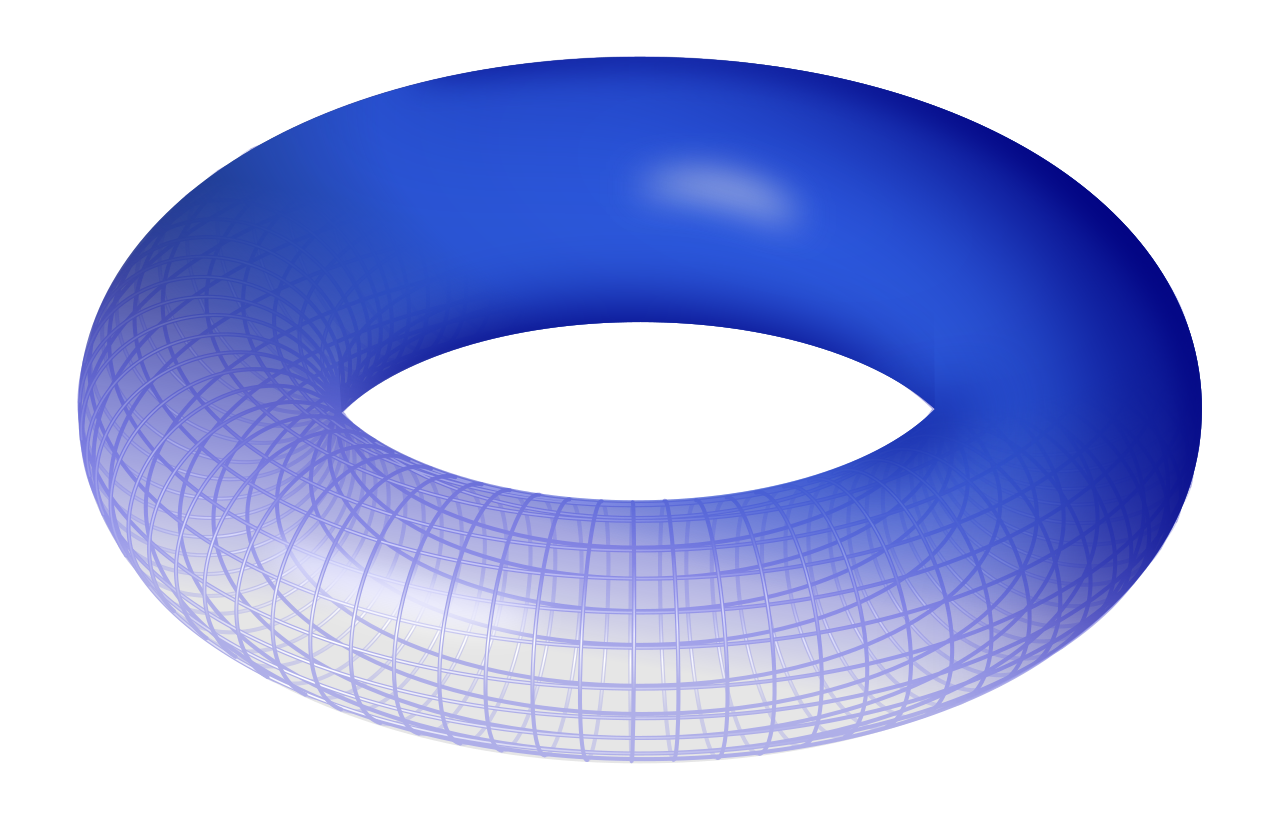
A rendered torus provides general surface-geometry context. The theorem discussed here concerns minimal spheres in the specified ambient sphere.
Leonid 2 / Wikimedia Commons. Wikimedia-generated PNG rendering of the SVG; no editorial changes. · Image source · CC BY-SA 3.0

A surface can bend without having any preferred direction in which its area decreases. Such a surface is minimal, and its curvature can still be surprisingly complicated. A preprint posted on 12 January 2026 by Weiran Ding, Jianquan Ge, Fagui Li and Xize Yang proves a precise restriction for minimal two-spheres inside unit spheres of arbitrary codimension. Under its stated constancy assumption, the relevant curvature expression belongs to a rigid family. This is a result about Lu’s conjecture in a specific setting; it does not settle every version of Chern’s conjecture or classify all minimal surfaces. Its interest becomes clearer when we ask why continuously varying shapes can have forbidden intervals of curvature.
Minimal does not mean flat
Imagine a tiny patch of surface with two perpendicular directions through a point. Each direction bends toward some normal vector. Mean curvature adds these directional contributions. If one direction bends upward and the other downward by an equal amount, their average vanishes even though the patch is far from planar. A saddle provides the familiar local picture. The word minimal describes the first variation of area: sufficiently small normal variations have zero linear contribution. It does not assert that every variation increases area, so minimal surfaces need not be stable.
An independent elementary model is the graph z = a(x² − y²). At the origin its slopes vanish, and its principal curvatures there are 2a and −2a. Their sum is zero while the sum of their squares is 8a². Increasing a strengthens the bending without changing the cancellation at that point. This graph is only a local explanatory example, not one of the compact spherical surfaces in the new theorem. It separates two quantities that intuition often mistakenly treats as equivalent: average bending and total bending.
Measuring bending in several normal directions
Inside ordinary three-dimensional space, a surface has one normal direction at each point, up to sign. A surface in a higher-dimensional sphere has several independent normal directions. Each normal direction comes with a symmetric shape operator, a matrix recording how the tangent plane bends toward it. Taking inner products between these matrices produces a positive semidefinite Gram matrix. Its trace, conventionally called S, is the squared norm of the second fundamental form. Its ordered eigenvalues reveal how unevenly bending is distributed among normal directions.
For a simple linear-algebra illustration, take two mutually orthogonal matrix directions with squared lengths 3 and 1. The Gram matrix has diagonal entries 3 and 1, trace 4, and second eigenvalue 1. Its trace plus second eigenvalue is 5. If all bending instead lies in one matrix direction with squared length 4, the trace remains 4 but the second eigenvalue becomes zero. The two configurations therefore receive different values of Lu’s expression. These arbitrary matrices illustrate the measurement; they are not asserted to satisfy the global equations of an immersed surface.
A forbidden interval is stronger than an inequality
Suppose a classification problem produces a scalar Q. A lower bound Q ≥ 2 permits values such as 2.001 and 2.000001. A gap theorem adds information: after the special value 2, some whole interval contains no admissible constant values. A discrete list is stronger still, because it forbids accumulation throughout the relevant range. These statements have different logical strengths. An experiment that samples many examples above 2 cannot establish any of them, because a missing value might belong to a family no one has constructed.
Constancy also matters. A continuous function on a connected surface usually takes every intermediate value between its minimum and maximum. A theorem about a quantity that is constant everywhere does not say that a nonconstant quantity avoids the same interval pointwise. One should therefore distinguish a bound on the maximum from a classification of constant values. Writing those quantifiers explicitly often reveals why an impressive geometric result has narrower scope than an informal headline suggests.
What the January result establishes
The 2026 paper works with Q = S + λ₂, where λ₂ is the second eigenvalue of the fundamental Gram matrix. For a minimally immersed two-sphere in a unit sphere, constant Q forces constant intrinsic curvature and identifies the immersion with a Calabi two-sphere. It also gives a sharp maximum bound: if Q exceeds 2 everywhere, its maximum is at least 5/2. The equality case is specified in the paper. The result is stated in a preprint, so its appearance on arXiv should not be described as completed journal review.
The fraction 5/2 makes the gap tangible. If a proposed example had Q constantly equal to 2.4, and met all of the theorem’s hypotheses, its maximum would be 2.4 as well. That contradicts the bound 2.5. A numerical image of a surface cannot establish that its Q is constant, however. Mesh errors, coordinate choices and incomplete derivative estimates can produce apparent constancy. The theorem concerns exact geometric data, with the ambient sphere normalized to radius one.
An independent curvature accounting exercise
For a minimal surface in a unit sphere, the Gauss equation gives K = 1 − S/2, where K is Gaussian curvature. This formula supplies a useful consistency check. A totally geodesic sphere has S = 0 and K = 1. A minimal Clifford torus in the three-sphere has S = 2 and K = 0. The zero mean curvature in both cases therefore conceals very different intrinsic geometry. One cannot determine K from the vanishing of mean curvature alone.
Integrate the same equation over a closed orientable surface of genus g. Gauss–Bonnet gives the integral of K as 4π(1 − g), so the integral of S equals twice the area minus 8π(1 − g). For a torus, this says the average of S is exactly 2. For a surface of genus greater than one, the average exceeds 2. This calculation does not prove the new gap theorem: it controls an average of S rather than the eigenvalue expression Q. It explains why topology can constrain curvature while leaving difficult local questions unresolved.
Why additional normal directions are difficult
Symmetric matrices can fail to commute. For example, let A have diagonal entries 1 and −1, and let B exchange the two coordinate directions. Then AB has off-diagonal entries 1 and −1, whereas BA has those signs reversed. Their commutator is nonzero. In submanifold geometry, such failures of commutation enter the curvature of the normal bundle. Higher codimension therefore adds interactions between bending directions, rather than merely adding independent copies of a familiar hypersurface equation.
Lu’s earlier work established the normal scalar curvature inequality and related pinching results. Simons’ foundational analysis supplied differential equations for the second fundamental form. The useful conceptual combination is algebra plus analysis: matrix inequalities constrain what can happen at a point, while differential identities connect neighboring points across an entire closed surface. A pointwise matrix construction can suggest an extremizer, but it cannot by itself establish that the matrices arise from a globally defined minimal immersion.
What to look for next
For surfaces beyond the two-sphere, the January paper obtains further conclusions with explicit restrictions involving normal scalar curvature. Those assumptions should travel with any account of the result. A natural next research question is whether the conditional cases can be widened, or whether examples show that some conditions are necessary. Another is how the methods behave when the submanifold dimension rises beyond two. The classification of all higher-dimensional constant-curvature possibilities remains a substantially broader problem.
For a reader learning geometry, this development offers a productive route into a technical subject. Begin with principal curvatures and the area variation, then calculate the Gram matrix of several shape operators, and finally compare pointwise, maximum and integral bounds. Each step changes what information is available. The new theorem belongs at the point where these viewpoints reinforce one another: topology limits the global surface, matrix spectra resolve normal bending, and analytic identities prevent an apparently continuous parameter from drifting through a forbidden gap.
Sources & further reading
Primary papers, project documentation, and research releases used in this article. Publication dates below refer to the sources themselves.
- Lu's conjecture for minimal surfacesarXivPublished Checked
- Normal scalar curvature conjecture and its applicationsarXivPublished Checked
- Minimal varieties in Riemannian manifoldsAnnals of MathematicsChecked
FOLLOW THE QUESTION
Explore mathematics