PHYSICS
XRISM’s Perseus maps separate cosmic stirring from heating
XRISM’s 2026 Perseus results map gas motions across a galaxy cluster and test the assumptions needed to turn X-ray line widths into heating rates.
Research checked
Newest cited publication
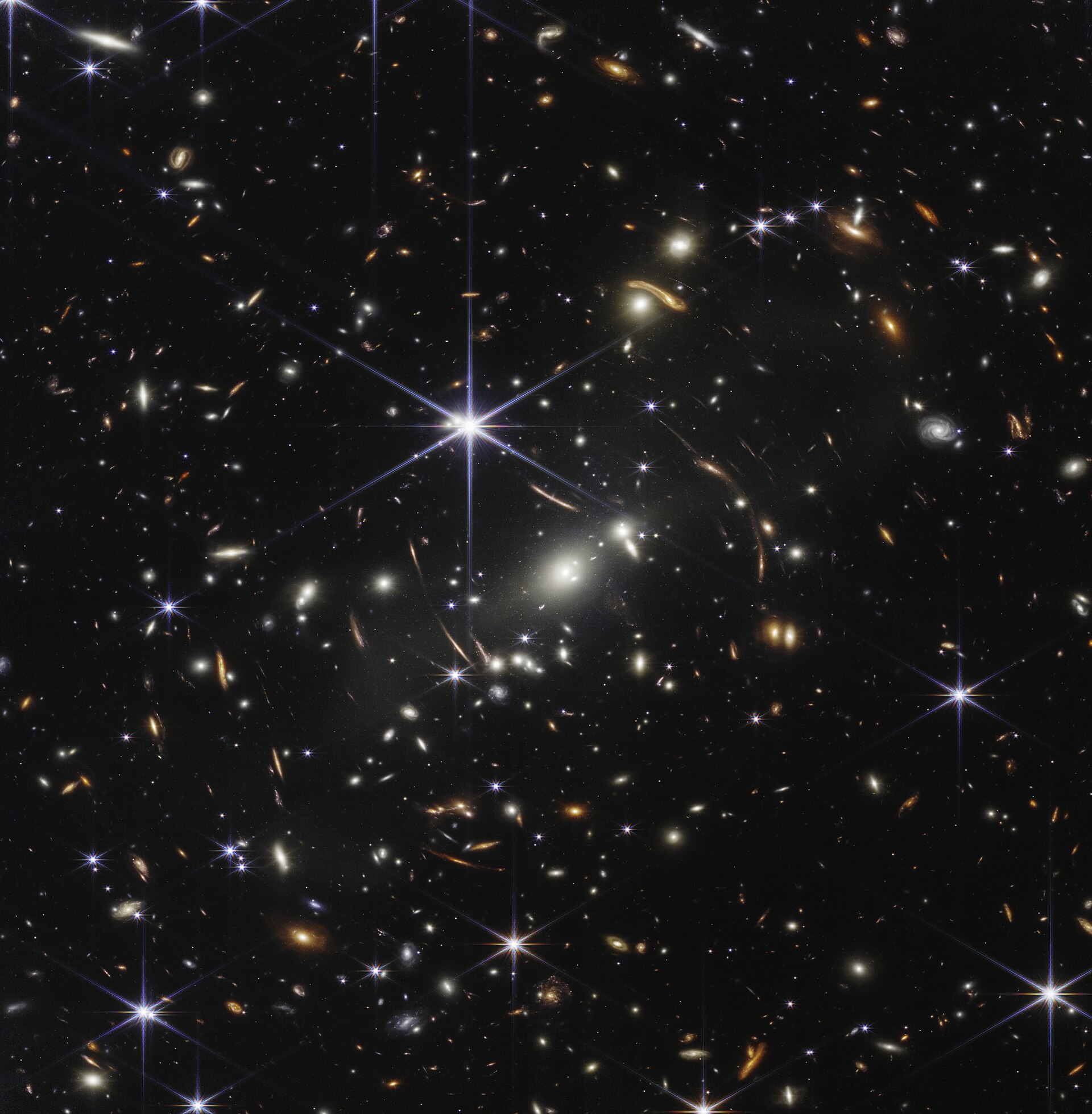
A deep-field galaxy image provides cosmic-structure context. XRISM probes the Perseus cluster through X-ray spectroscopy of its hot gas.
NASA, ESA, CSA, and STScI · Image source · Public domain

Most of the ordinary matter in a galaxy cluster is not inside its stars. It resides in a vast hot plasma that radiates X-rays and gradually loses energy. Explaining why the central gas does not simply cool unchecked requires an account of how energy reaches it. XRISM has supplied a new measurement: spatially resolved velocities from high-resolution X-ray spectra. A Nature paper published on January 28, 2026 separated different drivers of motion in the Perseus cluster. A September 2026 preprint then examined whether the measured motions really have the small-scale character needed for common turbulence interpretations. Together they clarify a crucial distinction: measuring stirring and measuring irreversible heating are different tasks.
An X-ray line becomes a velocity measurement
Hot cluster gas contains ions that emit photons at characteristic energies. Motion toward or away from the observer shifts those energies through the Doppler effect. In the nonrelativistic limit, the fractional energy shift is approximately the line-of-sight speed divided by the speed of light. For an illustrative iron line at 6.7 kiloelectronvolts, a speed of 300 kilometers per second corresponds to about a 6.7-electronvolt shift. These are tiny changes that ordinary broad-band images cannot measure.
XRISM’s Resolve instrument measures photon energies with a microcalorimeter. An absorbed photon raises the temperature of a very cold detector by a small amount, allowing its energy to be inferred. Summing many detected photons builds a spectrum. A line’s centroid constrains an average velocity; its width can constrain the spread of velocities among the emitting ions. Those two observables answer different dynamical questions.
The width is not entirely caused by large-scale gas motion. Thermal agitation, instrumental response, and unresolved blends also contribute. When independent broadening mechanisms are approximately Gaussian, their variances add rather than their widths adding directly. Removing the instrumental and thermal contributions therefore requires a physical spectral model and calibrated detector response. A reported gas velocity dispersion is already an inference from that modeling, even though it is much closer to the measured spectrum than a calculated heating rate.
The January 2026 result separates two drivers
The Nature study found evidence for a smaller-scale driver within roughly sixty kiloparsecs of the center, probably associated with supermassive-black-hole feedback, and a larger-scale driver in the outer core associated with mergers. JAXA’s February 20 explanation describes a velocity-dispersion profile that decreases away from the center and then rises again. Spatial mapping was essential: one spectrum integrated across the entire region would mix these environments together.
An analogy helps explain why the profile matters. Stirring the center of a bowl and moving the entire bowl can both make liquid move, but they inject motion on different scales. A measurement that averaged everything together could miss the distinction. In a cluster, jets and outflows can affect gas near the central galaxy, while gravitational interactions disturb a much wider region. Their characteristic spatial patterns offer a way to distinguish the drivers.
This inference still uses comparisons with physical models and simulations. A measured rise in dispersion is not a label attached to a particular energy source. The question is whether proposed drivers reproduce the spatial pattern, scale dependence, and accompanying gas structures consistently. Alternative combinations must also be considered. The result is strong because it uses the velocity field across the cluster rather than assuming that every broadened central line is a complete description of the surrounding dynamics.
A broad line does not uniquely reveal turbulence
Imagine two unresolved clouds traveling in opposite directions. Their combined emission can have a broad line even if each cloud is internally quiet. Now imagine one cloud containing many small random eddies. Its line can also be broad. Spectral width alone can struggle to distinguish these cases. The difference matters because coherent motion and small-scale turbulence store and transport energy differently.
Velocity measurements are additionally projected along the line of sight and weighted by the X-ray emission. Bright dense gas contributes more strongly than faint diffuse material. Structures at different depths can overlap in one sky pixel. A two-dimensional velocity map therefore does not reveal the complete three-dimensional flow. Recovering that flow requires assumptions about geometry, statistical symmetry, or comparison with simulated clusters.
A separate mapping study, published in Astronomy & Astrophysics in 2026 after its October 2025 preprint, combined nine Resolve pointings and examined a broader region. It reported enhanced velocity dispersion in the east and an east-west bulk-velocity pattern interpreted in a merger scenario. These are complementary constraints on the cluster’s dynamics. The inferred merger history remains a model-based explanation of the measured pattern, rather than a direct observation of the past encounter itself.
The September 2026 test adds resonant scattering
A preprint submitted on September 9, 2026 by Heinrich and colleagues targets the distinction between random and coherent motion. It analyzes resonant scattering: photons in particular strong spectral lines can be absorbed and re-emitted by matching ions. This process can redistribute photons across the cluster rather than merely broaden a line at the point where it was emitted.
The authors report central suppression, outer enhancement, and non-Gaussian structure in an iron line. Using radiative-transfer simulations, they find small-scale velocity amplitudes consistent with line-broadening measurements in the central sixty kiloparsecs. They interpret the agreement as evidence that random motions dominate there. The retrieved manuscript is submitted to The Open Journal of Astrophysics; it should be read as a preprint rather than presented as a completed peer-reviewed confirmation.
Why does scattering help? A photon’s chance of interacting depends on whether an ion sees it near the resonant energy. Random velocities alter that matching locally. Coherent motion over a large region affects the transfer differently. Combining these diagnostics tests properties of the velocity field that a width alone cannot settle. The analysis also explores directional preferences, but the authors say longer observations are needed to improve those constraints. It adds an independent physical handle while retaining uncertainty about the detailed flow.
Turning motion into heat requires a timescale
A velocity measurement constrains kinetic energy only after the dimensional and geometric assumptions are specified. If a one-dimensional dispersion is 200 kilometers per second and motions are isotropic, the mean kinetic energy per unit mass is three halves of the dispersion squared: approximately sixty billion joules per kilogram. This illustrative calculation is not a new energy measurement for Perseus. It shows the role of isotropy when converting one observed velocity component into a three-dimensional energy estimate.
Heating is energy transferred irreversibly per unit time. A turbulence estimate therefore needs a cascade or dissipation timescale, often related to the velocity and a characteristic length. In a simple dimensional scaling, available power per unit mass varies like velocity cubed divided by the driving length. Doubling the assumed speed changes that estimate by a factor of eight; doubling the length halves it. Uncertainty in the motion’s scale can consequently matter as much as an accurate line width.
The Nature paper appropriately conditions its heating argument on dissipation of the observed motion into heat. The September work addresses part of that condition by testing the random character of the flow. My inference is that the next challenge is to connect velocity statistics, spatial scales, and plasma dissipation more tightly, while checking whether the resulting rate balances cooling throughout the relevant region. XRISM has made that question observationally sharper. It has not turned a velocity map into an assumption-free calorimeter for an entire galaxy cluster.
Sources & further reading
Primary papers, project documentation, and research releases used in this article. Publication dates below refer to the sources themselves.
- Disentangling multiple gas kinematic drivers in the Perseus galaxy clusterNature / XRISM CollaborationPublished Checked
- XRISM Unmasks the Cosmic Stirrer: Disentangling the Forces Behind Perseus’s Raging GasJAXAPublished Checked
- Mapping the Perseus Galaxy Cluster with XRISM: Gas Kinematic Features and their Implications for TurbulenceZhang et al. / arXivPublished Checked
- XRISM observations of the Perseus cluster along two arms: Chaotic ICM motions probed by resonant scatteringHeinrich et al. / arXivPublished Checked
FOLLOW THE QUESTION
Explore physics