PHYSICS
ACT’s Sharper Cosmic Background Tests More Than the Universe’s Age
ACT’s detailed microwave maps support cosmological consistency tests, while 2026 polarization searches show how the same data can probe additional physics.
Research checked
Newest cited publication
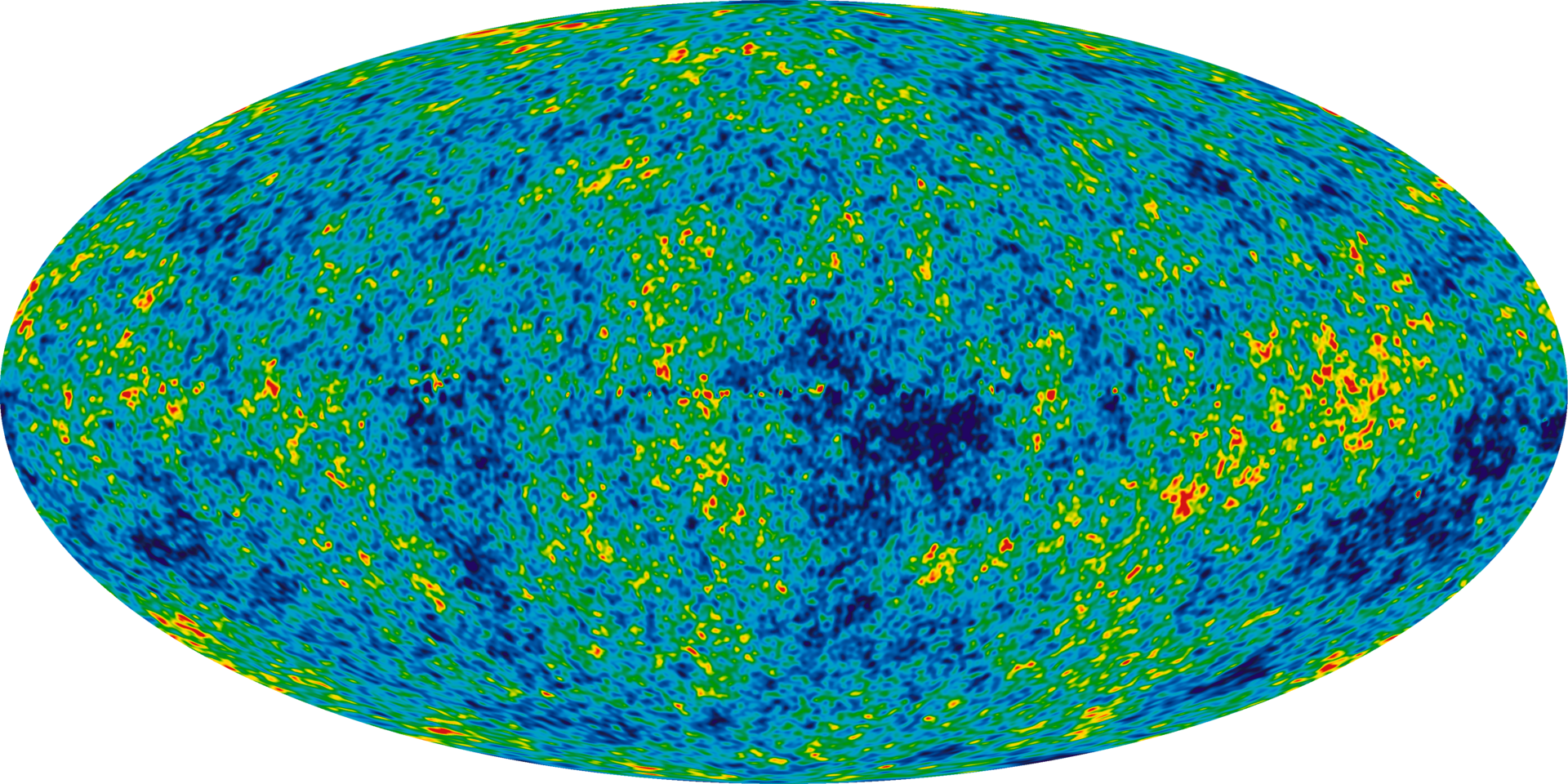
NASA’s WMAP nine-year cosmic microwave background map, released in 2012, illustrates the temperature pattern left by the early universe. ACT’s DR6 measurements use a separate instrument, data set, and analysis.
NASA / WMAP Science Team · Image source · Public domain

A sharper view of ancient light is valuable because it creates more opportunities for a theory to fail. The Atacama Cosmology Telescope, or ACT, released its major sixth data-release papers on March 18, 2025. By October 18, 2026, that dataset was also supporting new searches for subtle polarization effects. The central story is therefore broader than a revised estimate of the universe's age. ACT measures patterns whose relative sizes, amplitudes, and polarization relationships must fit a single physical account. The best question is not whether a cosmic photograph looks impressive. It is whether independent features of that photograph continue to give compatible answers when the analysis changes.
A map of fluctuations, rather than a picture of galaxies
The cosmic microwave background is radiation released when the early plasma became transparent. ACT measures very small variations in its intensity and polarization across the sky. Its DR6 maps cover roughly 19,000 square degrees using observing bands centered near 98, 150, and 220 gigahertz. The maps combine observations taken from 2017 through 2022. These are microwave measurements with foreground objects and instrument effects superimposed, not a direct photograph of an unmodified surface surrounding Earth.
A useful distinction is between map coverage and the area used for a particular statistical analysis. The power-spectrum paper estimates its main spectra over a selected area of about 10,000 square degrees. Selecting a cleaner subset can improve a physical inference even when it uses fewer pixels. This resembles recording an orchestra in a noisy hall: keeping every microphone channel does not guarantee the cleanest estimate of a quiet instrument. The purpose of selection is to control contamination, with the selection's effect included in the model.
Many features must fit the same cosmic recipe
Sound propagation in the early plasma creates characteristic angular patterns. Scientists summarize the strength of variations at different angular scales using a power spectrum. The resulting peaks are not decorative. Their positions and relative heights depend on the plasma's ingredients, gravitational evolution, initial fluctuations, and the geometry between then and now. Polarization adds another set of relationships. A proposed cosmology must explain these features together, rather than selecting one attractive peak and assigning it an age.
Consider an original analogy involving a vibrating string. A single measured frequency could be reproduced by changing either length or wave speed. Measuring several harmonics, damping rates, and the response to a known disturbance adds constraints. The analogy is imperfect, because cosmology involves a coupled fluid and evolving geometry, but it captures the problem of parameter degeneracy. Better resolution is powerful when it supplies qualitatively different relationships. It is less informative when it merely repeats the same combination of unknowns with additional precision.
Agreement between channels is a substantive result
The 2025 parameter analysis reports consistency between important alternatives: temperature versus polarization in the combined ACT-and-Planck dataset, and Planck alone versus ACT combined with WMAP. This matters because different instruments and observables encounter different practical difficulties. The agreement is not proof that every systematic error is absent. It is evidence that several routes through the data support a compatible baseline model. A cosmological estimate becomes more convincing when those routes are explicitly compared rather than combined immediately.
Imagine two laboratory thermometers that share the same calibration bath. Agreement between them checks some instrument behavior, but an error in the bath could move both readings together. In cosmology, shared sky signals, calibration information, and theoretical assumptions can similarly create common dependencies. Crosschecks should therefore be described precisely. An independently manufactured detector is helpful; a different observable is helpful in another way; an independent distance method tests another part of the inference. None of these phrases means that every assumption has become independent.
An inferred Hubble constant comes with a model
Using a specified combination of ACT, Planck, lensing information, and DESI baryon acoustic oscillations, the parameter paper reports a Hubble constant near 68 kilometers per second per megaparsec. Including DESI DR2 gives 68.43 with an uncertainty of 0.27 in those units. This is an inference within the baseline cosmological model and named data combination. It is not a direct measurement of the recession speed of a galaxy at a distance of exactly one megaparsec.
The unit describes an expansion-rate conversion. For a deliberately simplified nearby example, a rate of 68 kilometers per second per megaparsec would correspond to an expansion contribution of 6,800 kilometers per second across 100 megaparsecs. The calculation is multiplication, not a detailed prediction for a particular galaxy: local motions and distance-estimation issues also matter. Keeping this distinction clear prevents an appealingly precise number from obscuring the chain of inference that produced it. Changing the assumed cosmological model can change that chain.
Adding new physics does not guarantee a better explanation
The companion extended-model analysis tests possibilities including additional light particles, unusual neutrino behavior, early dark energy, modified recombination, and other departures. It reports no statistically significant preference for leaving the baseline model. That conclusion has a defined scope: the tested model families and selected datasets. It does not demonstrate that unknown physics is impossible. It says these particular extensions did not receive compelling support from those comparisons, which is already a valuable restriction on theoretical speculation.
An original statistical example makes the issue concrete. A straight line can fit a trend using two parameters; a high-order polynomial can pass through many more points. The polynomial's smaller residuals do not automatically establish a physical discovery, because extra flexibility can fit noise. Cosmological comparisons have more elaborate versions of this problem. Added parameters need interpretable consequences and reproducible improvements across relevant observations. A successful explanation of one tension must also preserve the detailed agreements that made the baseline model useful.
The same archive supports different kinds of question
A preprint submitted on August 27, 2026, uses ACT DR6 to search for anisotropic screening and cosmic birefringence. Screening changes the microwave signal through scattering by free electrons; birefringence rotates polarization. The authors report no significant detection for their baseline screening analysis and no detection in the anisotropic birefringence analysis. These searches ask different questions from the main cosmological-parameter fit. Their null results should not be presented as a detection of exotic matter or as a direct resolution of the expansion-rate disagreement.
A separate preprint submitted on October 13, 2026, examines time-dependent polarization rotation expected in certain axion-like-particle scenarios. It reports no evidence for the searched signal and derives a conditional coupling limit, assuming those particles constitute all dark matter and treating the field amplitude stochastically. The word conditional matters. A bound on a coupling under a specified abundance and field model is not a universal exclusion of an entire particle family. The new result expands what the archive can test while leaving its assumptions visible.
Precision matters when errors and dependencies remain visible
The next advance need not arrive as a dramatic change in the best-fit age. It may appear as a smaller disagreement between observing bands, improved handling of foreground emission, a previously inaccessible polarization statistic, or a clearer distinction between competing theoretical models. My inference from the DR6 program is that a cosmological archive becomes especially powerful when it retains enough information to ask questions its original headline did not anticipate. Carefully documented maps enable that reuse.
For a reader assessing a new result, three practical questions help: what was directly measured, which additional data broke a degeneracy, and which assumptions converted the measurement into a physical statement? These questions apply equally to a Hubble constant and an axion-coupling limit. ACT's results support a remarkably consistent account of early-universe physics within the tested framework. The 2026 follow-up analyses show how that consistency can be challenged more creatively, without turning every sharper map into a claim that cosmology has finally been completed.
Sources & further reading
Primary papers, project documentation, and research releases used in this article. Publication dates below refer to the sources themselves.
- The Atacama Cosmology Telescope: DR6 MapsACT Collaboration / arXivPublished Checked
- The Atacama Cosmology Telescope: DR6 Power Spectra, Likelihoods and ΛCDM ParametersACT Collaboration / arXivPublished Checked
- The Atacama Cosmology Telescope: DR6 Constraints on Extended Cosmological ModelsACT Collaboration / arXivPublished Checked
- The Atacama Cosmology Telescope: Constraints on the anisotropic screening and birefringence effects with DR6ACT researchers / arXivPublished Checked
- The Atacama Cosmology Telescope: DR6 Constraints on Isotropic Time-Dependent Cosmic Birefringence from Axion-like ParticlesACT researchers / arXivPublished Checked
FOLLOW THE QUESTION
Explore physics