PHYSICS
BASE transports antiprotons while precision tests learn to stay coherent
BASE’s September 2026 transport paper and 2025 spin-coherence result show how quieter laboratories could sharpen tests of matter–antimatter symmetry.
Research checked
Newest cited publication
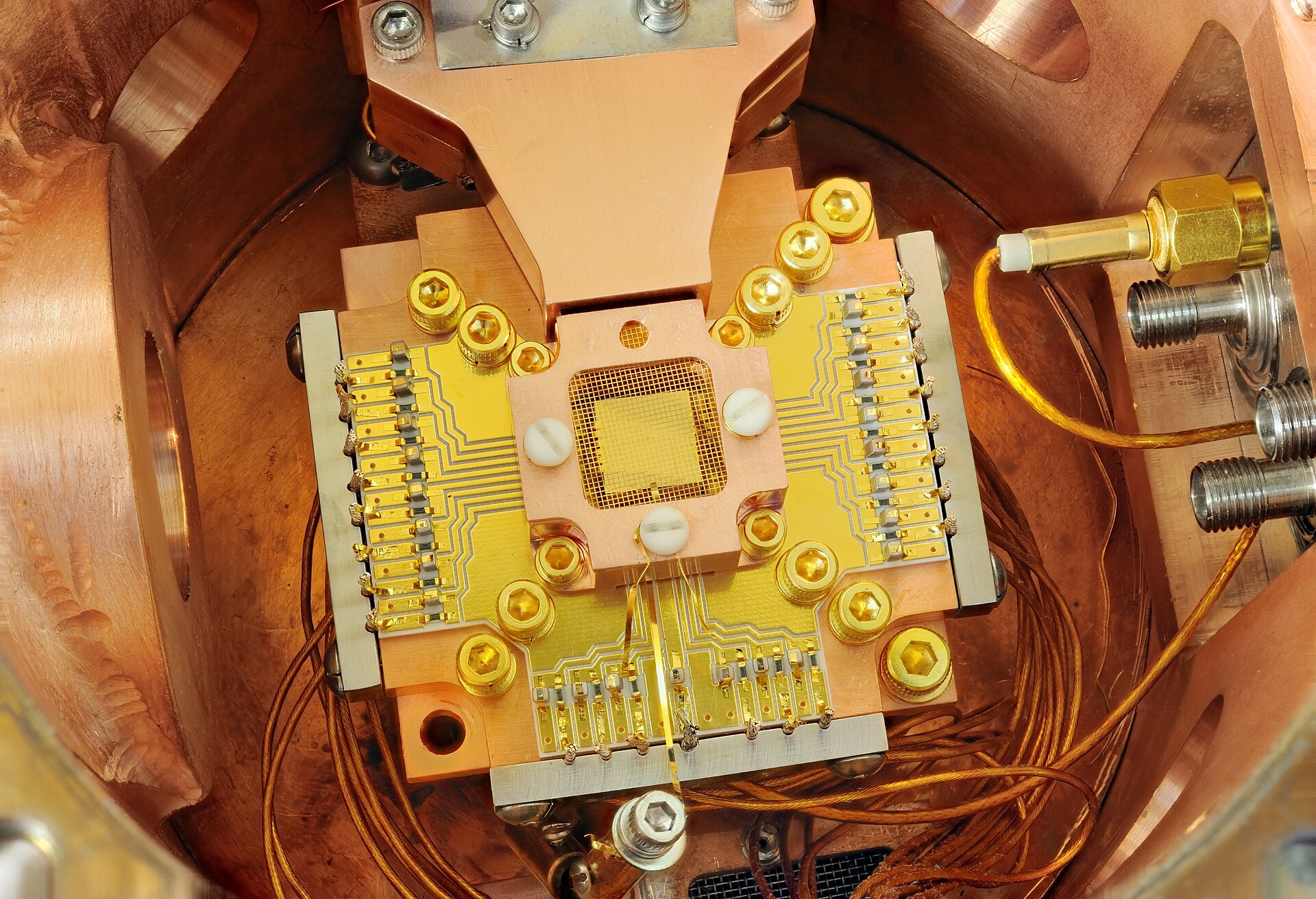
A NIST trapped-ion apparatus illustrates the precision control of charged particles; BASE’s antiproton transport experiment uses a distinct trap system.
Y. Colombe/NIST · Image source · Public domain

The route to a better test of fundamental physics can include a truck journey. On September 16, 2026, Nature published BASE’s demonstration of road transport with trapped antiprotons. Ninety-two particles survived a 7.5-kilometre route outside CERN’s Antimatter Factory without particle loss. The result follows a different milestone from July 2025: coherent control of a single antiproton spin. Together they show how quantum control and laboratory logistics can support the same scientific ambition. Neither result reports that matter and antimatter have different fundamental properties.
A portable trap demonstrated survival, not a new symmetry violation
CERN first announced the successful transport on March 24, 2026. The September paper establishes the detailed result in a peer-reviewed publication. A cryogenic, open Penning-trap system called BASE-STEP carried the particles away from the accelerator environment. The collaboration reported no measurable deterioration of the trap vacuum during transport. The experiment demonstrated a technical capability that future precision measurements can use; it did not itself supply a newly improved magnetic-moment comparison.
The distinction is similar to moving a reference clock to a quieter room. Successfully delivering the clock does not yet prove that its measurements will improve by the predicted amount. One must establish performance at the destination, recover the calibrated apparatus and run the actual comparison. The transport milestone matters because the destination can address a limitation that cannot easily be fixed by changing a few analysis parameters.
A noisy particle source can be an excellent source and an imperfect laboratory
CERN’s public explanation identifies magnetic-field fluctuations associated with the operating accelerator complex as a constraint on BASE precision. Producing and decelerating antiprotons requires specialized infrastructure, while measuring their properties favors a stable environment. These objectives can pull in different directions. A portable trap is a way to separate particle production from a later stage of measurement.
This separation is an experimental design principle with broad consequences. A laboratory should not be judged only by how many particles it can make. If the measurement requires phase stability over a long interval, intermittent field disturbances can dominate the uncertainty even when particle supply is excellent. Moving a rare specimen to the measurement environment can be more effective than endlessly improving a measurement beside the source. The transport system turns stored antiprotons into a resource that can potentially be delivered on demand.
Keeping charged antimatter away from matter
A Penning trap combines magnetic and electric fields to confine charged particles without a material container touching them. The magnetic field restrains transverse motion, while suitable electrode potentials provide confinement along the field. An antiproton that reaches ordinary matter can annihilate, so preserving the vacuum and stable fields is part of keeping the specimen intact, not merely part of improving a readout.
A useful classical picture is a charged particle spiraling around field lines while oscillating between electric potential barriers. The actual experiment must also account for coupled motion, imperfections and the requirements of cooling and detection. The trap is not a bottle with a mysterious antimatter-proof wall. Its usable volume is a carefully prepared electromagnetic environment. Road transport therefore tests a whole system of refrigeration, vacuum, power and mechanical stability rather than a single container component.
The earlier coherence milestone explains what the journey could enable
On July 23, 2025, BASE published coherent spectroscopy of a single antiproton spin. The experiment observed controlled spin dynamics and achieved coherence times exceeding 50 seconds. It used different trap regions to detect the spin state and interrogate it in a more homogeneous field. That separation matters because an environment helpful for reading a state can be unfavorable for preserving its phase.
Coherence means that the relative phase between quantum amplitudes remains predictable enough to support interference. It is more demanding than simply keeping a particle alive. A trapped antiproton may survive while fluctuating fields scramble its phase too rapidly for a precise interrogation. The two achievements should therefore be read on different axes: transport demonstrates preservation of a sample under motion; coherent spectroscopy demonstrates preservation and manipulation of a particular quantum relationship during a measurement.
Long interrogation helps only when the environment cooperates
An independent timing argument shows the attraction of longer coherence. Two oscillations differing by a small frequency gradually accumulate a relative phase. For a frequency difference of 0.02 hertz, the phase advances by one full cycle relative to the other oscillation in fifty seconds. Over a much shorter interval, that difference produces a smaller phase displacement. Tracking phase for longer can therefore distinguish closer frequencies.
This is a scale argument, not a promise that a fifty-second experiment measures every frequency to exactly 0.02 hertz. State preparation, contrast, measurement noise, repetition rate and fitting all matter. A fluctuating field can also imitate or obscure a frequency change. Longer coherence is useful only when the extra interrogation time adds controlled information. That is why suppressing environmental disturbances is connected to the transport program rather than being a separate convenience.
CPT comparisons require the right quantities and signs
BASE compares proton and antiproton properties to test the combined symmetry of charge conjugation, parity and time reversal, abbreviated CPT. Because their electric charges and magnetic moments have opposite signs, an appropriate symmetry comparison takes the predicted sign relationships into account. It is the relevant equality of magnitudes or signed ratios under the convention used by the experiment that must be tested, rather than the naive claim that both particles point in the same direction.
Finding no difference within an uncertainty restricts models that predict a measurable mismatch. It does not prove an exact identity at every possible precision. Conversely, an apparent difference must survive checks for unequal field conditions, instrument response and analysis bias before it can challenge the theory. The mathematical symmetry being tested is profound, but the experimental inference still depends on prosaic controls. A laboratory field fluctuation cannot be promoted into a violation merely because the desired signal would also shift a frequency.
The next test is reproducible delivery into a measurement
Transport success has several layers. A particle population can survive the journey, the receiving apparatus can accept it, and the subsequent experiment can recover its normal precision. Those are connected milestones, but none logically guarantees the next. A program that repeats each stage can measure reliability instead of inferring it from one successful trip.
For example, a hypothetical receiving trap might retain every transferred particle but require a long thermal recovery before an accurate frequency comparison. Another might recover quickly yet lose too many particles during transfer. Neither possibility contradicts the reported road demonstration. They define the practical questions that follow from it. My expectation is that this broader measurement of delivery performance will matter more for future laboratories than the route length alone, because useful scientific throughput depends on the whole sequence from extraction to calibrated interrogation.
A supply chain for precision is still a program to demonstrate
Heinrich Heine University’s September 16 release reports that the transported particles were subsequently stored and manipulated for more than a month. It describes the next objectives as transfer into an offline experiment at CERN and eventual transport to Düsseldorf, where a precision laboratory is being developed. These are future objectives relative to the published test, not completed intercity deliveries. The university rounded the demonstration route to approximately eight kilometres; the original paper specifies 7.5 kilometres.
My interpretation is that the important change is experimental flexibility. A portable supply could allow long, systematic measurement programs in places chosen for quiet fields rather than proximity to a decelerator. That potential still needs measured confirmation through repeated transports, controlled transfer into receiving traps and actual uncertainty budgets at the destination. BASE has now removed a major obstacle to that program. It has not removed the need to show that each promised gain survives contact with the full precision experiment.
Sources & further reading
Primary papers, project documentation, and research releases used in this article. Publication dates below refer to the sources themselves.
- Road transport of trapped antiprotonsNature / BASE CollaborationPublished Checked
- BASE experiment at CERN succeeds in transporting antimatterCERNPublished Checked
- Coherent spectroscopy with a single antiproton spinNature / BASE CollaborationPublished Checked
- A quantum leap for antimatter measurementsCERNPublished Checked
- BASECERNChecked
- World-first transport of antiprotons published in NatureHeinrich Heine University DüsseldorfPublished Checked
FOLLOW THE QUESTION
Explore physics