PHYSICS
Muon g−2 after the final Fermilab measurement: precision meets a moving theory baseline
The June 2026 final report documents Fermilab’s 127-ppb muon result, while updated strong-interaction theory changes how the famous discrepancy is read.
Research checked
Newest cited publication
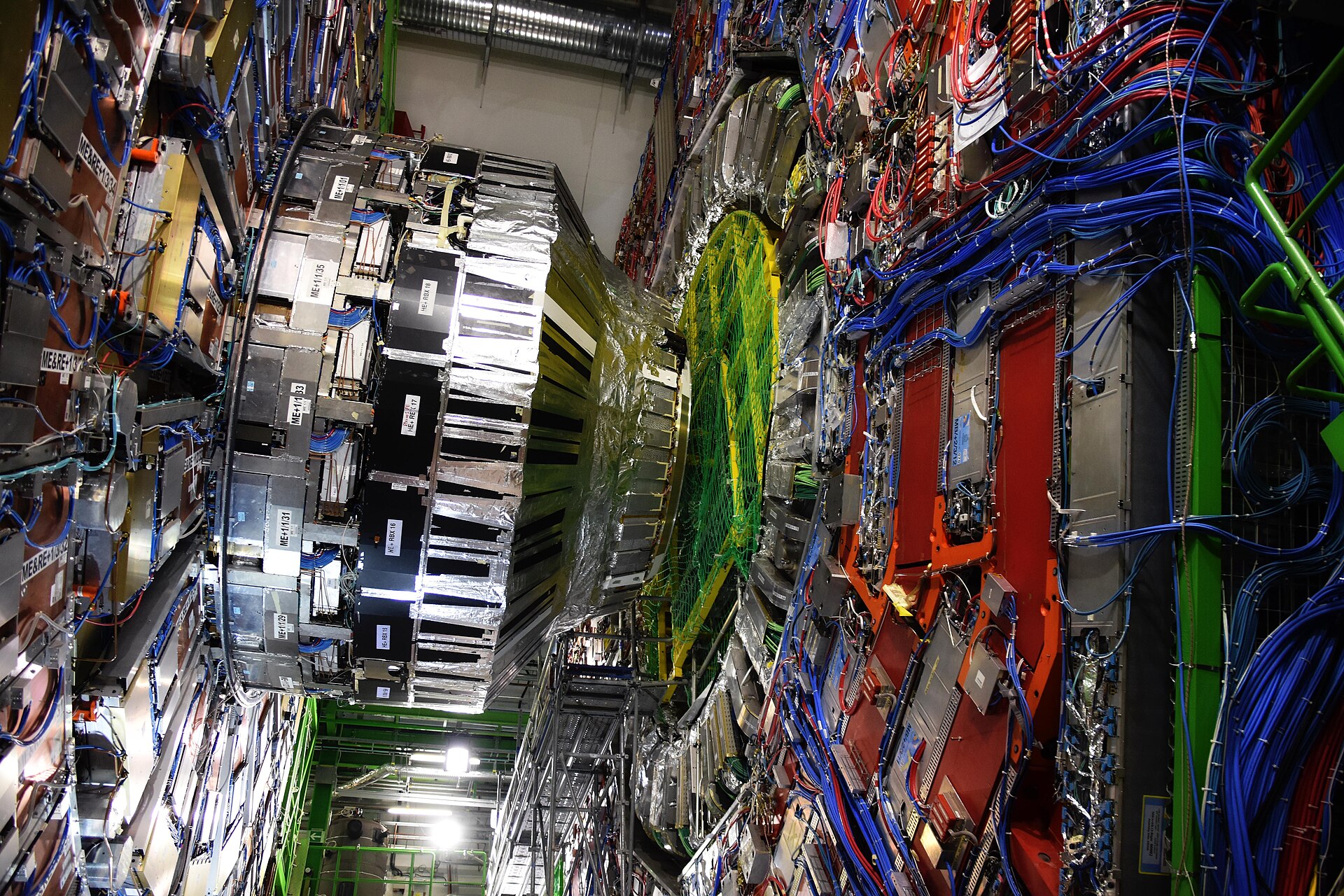
A large collider detector illustrates particle-physics instrumentation. Fermilab’s muon g−2 storage-ring experiment uses a different apparatus and measurement strategy.
SimonWaldherr · Image source · CC BY-SA 4.0

The final Fermilab muon g−2 result was announced on 3 June 2025. Its detailed final report arrived as a preprint on 15 June 2026, recording the experimental achievement and how its uncertainties were controlled. Meanwhile, the theoretical number used for comparison had changed. That combination makes this a useful case study in scientific precision: an experiment can become much more exact while a once-striking discrepancy becomes less compelling. The measurement did not move arbitrarily to meet theory. The question is how the prediction was assembled, which inputs remain disputed, and what a comparison between two uncertain numbers can establish.
What g−2 measures without the slogan
A magnetic moment describes how a particle responds to a magnetic field. The dimensionless factor g relates that response to its spin and other particle properties. For a pointlike spin-one-half particle in the simplest relativistic treatment, g equals two. Quantum interactions shift it slightly. The quantity conventionally measured is the anomaly, a, defined as (g − 2)/2. The word anomaly here names this small correction; it does not mean an experimental error or automatically indicate physics beyond the Standard Model.
A muon provides a sensitive probe because quantum corrections can involve particles and interactions that are not directly produced in the measurement. That is a theoretical sensitivity, rather than a detector taking a picture of a hidden particle. Different candidate theories can predict changes in the same final number. Measuring that number precisely therefore narrows possibilities, but a disagreement by itself would not uniquely identify a new particle’s mass, charge and coupling. Other measurements would still be needed to distinguish explanations that produce comparable corrections.
The experiment compares two kinds of clock
Fermilab stores polarized positive muons in a magnetic ring. Their spins precess, and the decay products provide a way to track that motion statistically. The magnetic field must be mapped and calibrated independently. The detailed final report expresses the anomaly through a ratio involving the anomalous spin-precession frequency and a shielded proton’s precession frequency, together with external constants. Framing the experiment as a frequency comparison makes its demands clearer: a very stable particle clock is insufficient if the field reference is poorly known.
Consider an independent analogy involving two oscillators. If their frequencies are both recorded against a common imperfect clock, some common errors can cancel in a ratio. Other errors survive when the oscillators sample different conditions. The storage ring has an analogous spatial challenge: the relevant field is the one actually sampled by the muon distribution. Beam position and motion therefore belong inside the uncertainty analysis. This is why careful field mapping, beam diagnostics and cross-checks are part of the result itself, rather than engineering details that can be separated from the physics.
127 parts per billion is a relative uncertainty
The 2026 report gives a final Fermilab combination with a relative uncertainty of 127 parts per billion. Including the preceding Brookhaven measurement gives an experimental world average at 124 parts per billion. Those numbers refer to the anomaly, not to the full g factor. The distinction matters whenever a small correction is quoted with enormous precision. A relative error must always identify the quantity in its denominator; otherwise apparently similar claims can describe very different absolute uncertainties.
For scale, 127 parts per billion equals 0.0000127 percent. This conversion follows by multiplying 127 divided by one billion by one hundred. Such precision does not imply that every component of the apparatus is individually known to precisely the same fractional accuracy. Some contributions are suppressed by the measurement’s design, some are constrained by calibration, and others combine through their sensitivities to the final quantity. The word final also has a bounded meaning: it concerns this experiment’s main magnetic-anomaly dataset, not a declaration that all future analysis or all future muon measurements must stop.
Statistical and systematic improvements also follow different scaling rules. In an ideal counting problem, reducing a statistical uncertainty by half takes about four times as many independent events. A fixed calibration bias does not shrink that way. Collecting more data can even make a previously negligible bias the leading limitation. This is why the most precise endpoint of a long experiment often requires new analysis of the apparatus as well as a larger sample, and why independent methods remain valuable even when their first uncertainty is larger.
Why the strong interaction sets the difficult baseline
The Standard Model prediction combines electromagnetic, weak and strong-interaction contributions. The numerical problem is uneven. Some pieces are calculated with extremely high accuracy, while low-energy strong dynamics dominate the uncertainty. Hadrons are composite particles, and their contribution cannot generally be estimated by pretending that freely moving quarks provide a complete low-energy description. The calculation has to connect the microscopic theory to the complicated behavior of strongly interacting matter. An accurate total requires trustworthy treatment of the difficult term, not just many extra digits in the easier ones.
Two important strategies approach hadronic vacuum polarization differently. A dispersive calculation uses measured production cross sections as input to mathematical relations. Lattice quantum chromodynamics instead evaluates the strong-interaction theory on a discretized spacetime and controls extrapolations toward the physical limit. These are not simply two brands of the same numerical fit. Their dominant vulnerabilities differ, making agreement between them especially informative. Experimental input disagreements matter for the first route; discretization, finite-volume corrections and extrapolation tests require attention in the second.
A revised prediction changes the question
The Muon g−2 Theory Initiative’s 2025 update adopted a consolidated lattice average for the leading hadronic-vacuum-polarization contribution. It also explained that tensions among dispersive inputs prevented a meaningful combined dispersive estimate. The revised Standard Model prediction lies close to the final experimental average: the paper reports their difference as 38 with uncertainty 63, in units of ten to the minus eleven. Dividing those two numbers gives roughly 0.6 standard deviations, so this stated comparison does not show a significant discrepancy.
This conclusion does not erase the theoretical disagreement over inputs. Instead, it distinguishes two questions that headlines often merge: does the recommended total prediction disagree with the measurement, and do all methods used to construct that prediction agree with one another? The answers can be no and no. A shared final uncertainty is not a vote that every intermediate result has been reconciled. Resolving method differences remains necessary if the theory is to approach the experimental precision and support a stronger future test.
Reading a discrepancy with its denominator attached
A simple uncertainty exercise explains why theory matters so much. Suppose an experimental result had uncertainty one unit and its prediction uncertainty four units. If they were independent, their difference would have uncertainty square root of seventeen, about 4.12 units. Cutting the experimental uncertainty in half would change that to about 4.03. Precision work on the experiment remains useful, but the comparison is then limited mostly by theory. These invented numbers are not a fit to muon data; they isolate the arithmetic of a common inference problem.
The productive next step is to reduce and cross-check the difficult theoretical contributions while preserving the experimental result as a stable reference. Independent measurements with different systematic effects can test the experimental side. Better cross-section data and independently controlled lattice calculations can test the predictive side. Any claimed new-physics significance should specify the prediction version, experimental combination and correlations used. Through the October 2026 cutoff, the final report strengthens the measurement’s documentation, while the updated theory comparison counsels a precise conclusion: extraordinary experimental accuracy has produced a demanding benchmark, not an unambiguous discovery of an unknown force.
Sources & further reading
Primary papers, project documentation, and research releases used in this article. Publication dates below refer to the sources themselves.
- Final Report on the Measurement of the Positive Muon Anomalous Magnetic Moment at Fermilab to 127 ppbMuon g-2 Collaboration / arXivPublished Checked
- The anomalous magnetic moment of the muon in the Standard Model: an updateMuon g-2 Theory Initiative / arXivPublished Checked
- Muon g-2 Announces Most Precise Measurement of the Magnetic Anomaly of the MuonUS Department of Energy / FermilabPublished Checked
FOLLOW THE QUESTION
Explore physics