PHYSICS
CMS weighs the W boson: why the 2026 precision result depends on calibration
CMS’s April 2026 W-mass publication turns muon kinematics into a precision electroweak test, with calibration and proton structure setting key limits.
Research checked
Newest cited publication
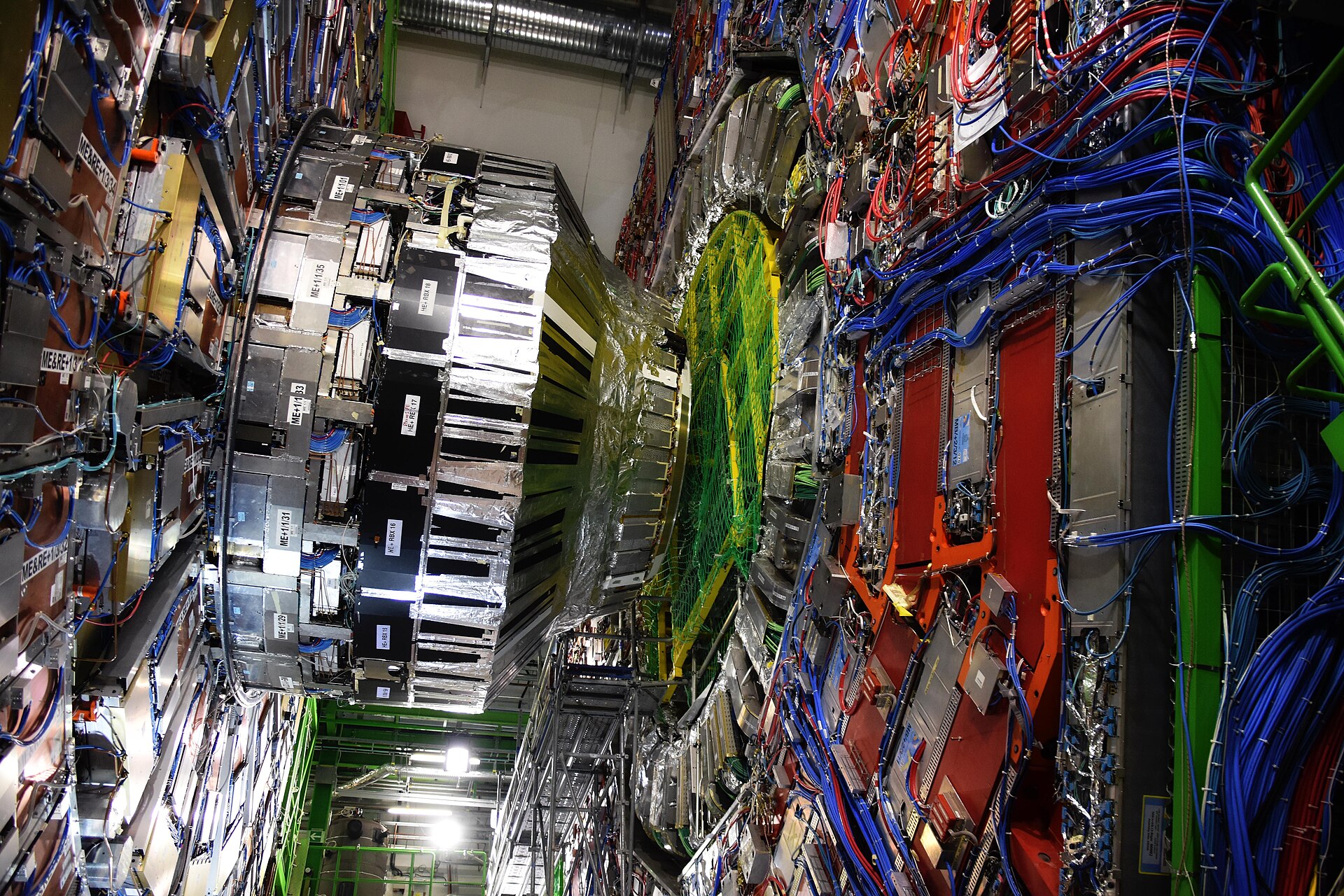
The CMS detector illustrates the layered instrumentation whose calibration is essential to reconstructing events and extracting a precise W-boson mass.
SimonWaldherr · Image source · CC BY-SA 4.0

The CMS W-boson mass measurement published in Nature on 8 April 2026 reports 80,360.2 ± 9.9 megaelectronvolts. The result was first presented in 2024; its 2026 publication should not be mistaken for a separate new dataset. It agrees with the Standard Model expectation used in the paper and differs from the high value reported by CDF in 2022. Yet the deeper achievement is methodological. CMS extracted a tiny mass sensitivity from the shapes of muon distributions in proton collisions. To understand the significance, it helps to follow what was actually measured and why calibration, proton structure and theory enter a result commonly described as simply weighing a particle.
A decay with an invisible participant
A W boson is unstable, so a detector does not place it on a balance. This analysis uses decays into a muon and a neutrino. The muon leaves a reconstructable track, while the neutrino escapes without a direct measurement. Unlike a simple two-visible-particle decay, the full invariant mass cannot be calculated event by event from two measured four-momenta. Instead, the statistical distributions of observable quantities retain information about the parent mass. A prediction for those distributions is compared with many events to infer the common mass parameter.
The basic kinematic intuition starts with an idealized W at rest. Neglecting the daughter masses, its two decay products each carry energy near half the W mass. A small parent-mass change shifts the characteristic daughter-momentum scale. Real collisions add motion, radiation, detector resolution and selection effects, so the clean picture becomes a distributed pattern rather than a sharp ruler mark. Those effects do not destroy the information. They explain why the measurement needs a detailed physical model and a fit instead of a straightforward average of reconstructed masses.
Millions of events make small shape changes visible
The published analysis uses 117 million selected W-to-muon-neutrino events from 2016 proton–proton collisions at 13 teraelectronvolts. CMS fits the muon’s transverse momentum, pseudorapidity and electric charge together. Transverse momentum is the momentum component perpendicular to the beam. Pseudorapidity parametrizes the track’s direction relative to that beam. Keeping charge and angular information helps the fit distinguish a mass-dependent distortion from effects caused by the proton’s quark composition or the W’s production and decay dynamics.
A useful independent analogy is estimating a musical instrument’s tuning from a recording containing both the instrument and a changing room response. Additional microphones can constrain the room while retaining the common pitch. Similarly, multiple kinematic distributions can constrain nuisance parameters while testing the shared mass. This works only when their predicted dependencies are sufficiently distinct and the allowed variations are realistic. A fit is not immune to bias because it contains many bins. Its credibility comes from calibration, alternative models and validation samples that challenge the same assumptions in different ways.
Blinding a mass analysis can protect against another subtle problem: analysts unconsciously favoring choices that bring an answer closer to expectation. A hidden offset does not improve detector resolution or calculate missing corrections. Its role is procedural, making the analysis choices less dependent on the desired outcome. More generally, a transparent precision result should distinguish choices fixed before examining the final value from checks performed after it becomes visible. That distinction helps readers judge whether an apparent agreement was a prediction or a selection criterion.
A small momentum error can imitate a mass shift
The total 9.9-MeV uncertainty combines a 2.4-MeV statistical contribution and a 9.6-MeV systematic contribution. Among the leading components, the paper attributes 4.8 MeV to muon momentum calibration and 4.4 MeV to parton distribution functions. These components do not mean that two independent physical masses were measured. They quantify how uncertainties in the analysis inputs propagate into the inferred common mass. Correlations matter when assessing how several components affect that final uncertainty.
The relative total precision is approximately 9.9 divided by 80,360.2, or 0.000123, equivalent to about 123 parts per million. An illustrative scale error of one part in ten thousand at an 80-GeV scale corresponds to about eight MeV. That calculation explains why tiny tracking and calibration effects cannot be ignored. It is not a claimed formula for the complete CMS response. The detector’s actual sensitivity varies with direction, charge, momentum and the fitting procedure, which is exactly why calibration must be tested across the relevant phase space.
The beam is a composite source, not a fixed initial state
A proton carries a distribution of quarks, antiquarks and gluons sharing its momentum. The parton distribution functions describe those distributions probabilistically. They influence which W charges are produced, how the W moves and which decay directions enter the detector. Their uncertainties can therefore change the same observed muon spectra that carry the mass signal. Fitting more than one distribution helps constrain these effects, but it does not make proton structure irrelevant. The theoretical and experimental sides of the analysis are coupled through the observables.
Z-boson decays provide an especially valuable validation route because two muons can be measured and their invariant mass reconstructed. CMS uses Z data to test analysis ingredients before extracting the W result. Such transfer has limits that must be investigated: the W and Z samples need not have identical kinematics or identical theoretical sensitivities. A persuasive closure test asks whether the method recovers known or independently measured behavior under conditions resembling the target analysis. Passing a test in a remote region would carry less weight than passing one where the principal uncertainties actually operate.
The hadronic measurement asks a complementary question
On 30 July 2025, CMS described another W-mass determination using hadronic decays of boosted W bosons. The reported value, 80.77 ± 0.57 gigaelectronvolts, is far less precise than the muon-channel result. It is still scientifically useful because it tests a different reconstruction chain. Quark decay products form jets of hadrons, and the environment contains abundant backgrounds and particles from additional collisions. Separating the W contribution requires substantial control over jet structure and event selection.
The numerical comparison is instructive. Converting 0.57 GeV into MeV gives 570 MeV, roughly 58 times the 9.9-MeV uncertainty. Thus the hadronic value should not be described as an equally sensitive referee of the precision mass disagreement. Its strength is complementary information about how the decay is reconstructed and modeled. A graph-based neural network helps isolate the W-containing sample, but classification performance alone cannot certify the mass. Any selection that reshapes the mass distribution must be incorporated and validated in the inference.
Agreement is a constraint with room left to improve
The W mass is connected to other measured quantities by the Standard Model’s electroweak structure. Quantum corrections make the relationship sensitive to additional interactions, which is why precision mass comparisons can probe effects beyond directly accessible production. The CMS paper quotes an electroweak-fit prediction of 80,353 ± 6 MeV. Relative to the direct result, the difference is 7.2 MeV. Combining the quoted errors as independent for a rough illustration gives about 11.6 MeV, so the scale of that difference is modest. A formal global fit must use the proper inputs and correlations.
Agreement with one prediction does not settle why another experiment obtained a different value. Resolving that tension requires transparent comparisons of calibration, definitions and theoretical modeling, together with further independent measurements. Nor does agreement exclude every possible new particle: some effects are too small or compensate in this observable. Through the October 2026 cutoff, the Nature publication provides a particularly precise and carefully documented constraint. Its lasting lesson is that a mass measured to a few parts in ten thousand is an inference built from a complete experimental system, not a number detached from the physics that makes the daughter particles visible.
Sources & further reading
Primary papers, project documentation, and research releases used in this article. Publication dates below refer to the sources themselves.
- High-precision measurement of the W boson mass with the CMS experimentCMS Collaboration / NaturePublished Checked
- DESY particle physicists measure up the W bosonDESYPublished Checked
- How to weigh the W boson using hadronsCMS CollaborationPublished Checked
FOLLOW THE QUESTION
Explore physics