PHYSICS
EAST Beyond the Density Limit: Separating a 2026 Plasma Regime from the Long-Pulse Record
EAST’s 2026 density-limit study and detached-edge result probe different plasma balances from its 1,066-second 2025 discharge, with distinct limits and tests.
Research checked
Newest cited publication
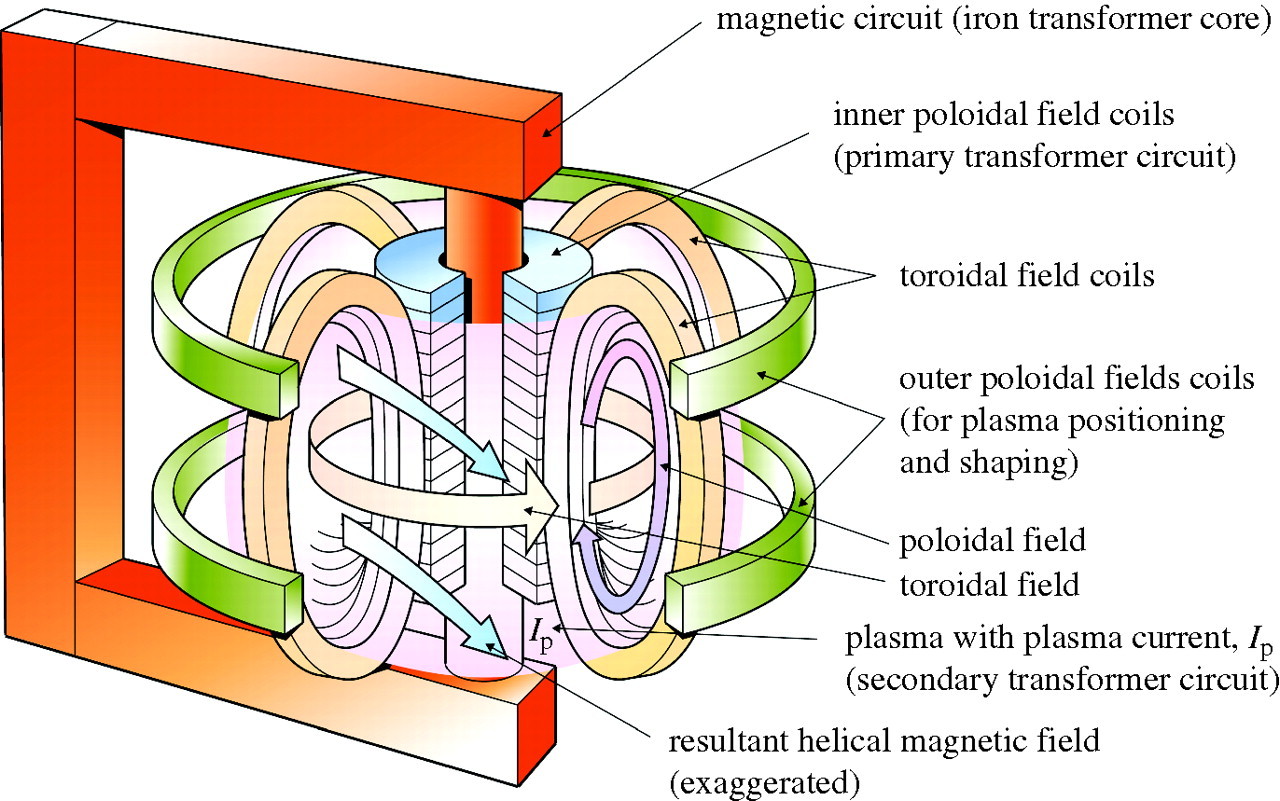
A tokamak diagram shows the basic magnetic-confinement geometry, providing background for the plasma-density and operating-regime questions studied on EAST.
Chris Llewellyn Smith and Steve Cowley · Image source · CC BY 3.0

Fusion headlines often combine the hottest temperature, longest pulse, and highest density a laboratory has ever reported. A plasma has to achieve useful conditions together, so that combination can be misleading. EAST, the Experimental Advanced Superconducting Tokamak, offers a timely example. Its January 2026 density-limit paper, March 2026 detached-edge report, and January 2025 long-pulse record address related but separate questions. Reading their experimental conditions carefully reveals genuine progress without manufacturing an all-purpose breakthrough. The central physics is a coupled balance among heating, particle supply, radiation, and transport at the boundary between a magnetized plasma and material surfaces.
What the density-limit experiment measured
The Science Advances paper dated January 1, 2026 reports line-averaged electron densities between 1.3 and 1.65 times the Greenwald density, compared with a typical EAST range of 0.8 to 1.0 in the authors’ account. The method combines electron cyclotron resonance heating during an otherwise Ohmic startup with the amount of neutral gas supplied before the discharge. Electron cyclotron resonance heating transfers microwave energy to electrons whose magnetic motion matches the applied wave.
Crucially, the paper defines its density limit as the maximum reached immediately before collapse in the analyzed discharges. Its representative evolution lasts seconds, and the parameter comparisons include measurements near the end of that short evolution. The label density-free refers to a regime of a particular plasma–wall theory; it does not mean unlimited density or a plasma that can never disrupt. The January 4 institutional release says applying the approach to high-confinement operation remained a next step. Those qualifications distinguish the actual experiment from a claim of sustained high-density ignition.
Why an empirical density limit can move
The Greenwald scaling relates a reference density to plasma current divided by the cross-sectional area associated with the plasma’s minor radius. It is an empirical organizing relationship, rather than a prohibition derived from charge conservation or another exact law. A ratio above one therefore calls for careful interpretation of regime and stability. It does not overturn the conservation laws that a plasma must obey.
For an invented example, take a plasma current of 0.5 megaamperes and a minor radius of 0.5 meters. Using the usual scaling gives a reference density of approximately 6.37 × 10¹⁹ electrons per cubic meter. A line-averaged value at 1.5 times that reference would be about 9.55 × 10¹⁹. These assumed dimensions are not the EAST shots. They show that the normalized ratio depends on current and geometry as well as on the measured density. Reporting only the ratio omits information needed to compare absolute conditions, while reporting only absolute density omits the operating context behind the benchmark.
The plasma boundary participates in the balance
The researchers interpret the density result using plasma–wall self-organization theory. In that framework, the plasma interacts with wall material, impurities can radiate energy, and changing boundary temperature can alter the feedback. The January release explains that controlling startup reduced impurity accumulation and energy losses. The experimental paper also observes that nominally similar settings can yield different outcomes as wall conditions evolve between discharges.
An independent feedback sketch helps clarify the idea. If extra radiation cools a region, and that cooling changes the supply of impurities, the eventual response depends on whether the change reduces or increases further cooling. A stabilizing loop damps a disturbance; an amplifying loop can drive a collapse. Neither loop is determined by density alone. Thus, gas amount and microwave power should not be interpreted as two magic numbers that reproduce a state regardless of prior history. Measuring the surface condition, impurity content, and radiated power is part of testing the theory, not merely housekeeping around the main plasma experiment.
The 1,066-second discharge answers another question
On January 20, 2025, EAST maintained a steady-state high-confinement plasma for 1,066 seconds, according to the operating institute’s January 21 report. This result extends the duration over which a favorable operating mode can be controlled. Converting the number gives seventeen minutes and forty-six seconds. It does not establish that the same discharge occupied the density regime studied in the January 2026 paper, nor that its energy came from self-sustaining fusion reactions.
To see why duration alone is insufficient, imagine two reservoirs. One loses little water but is drained after a short demonstration; another runs for an hour because a pump continually replaces a large outflow. The second has longer operation without necessarily having better retention. In a plasma, energy confinement time describes retention of thermal energy, whereas discharge duration describes how long the experiment maintains a state. Heating energy supplied over a long pulse is an input quantity. It cannot be relabeled as fusion energy output simply because the plasma remains hot.
A newer result puts useful turbulence at the edge
The institute’s March 31, 2026 report describes a separate regime combining partial divertor detachment, suppression of edge-localized modes, and a high-performance pedestal for minute-scale operation. A divertor channels escaping plasma toward material targets. Partial detachment reduces the direct heat burden there. The pedestal is the steep edge region associated with high confinement, while edge-localized modes are bursts that can deliver damaging transient loads.
The reported detached and turbulence-dominated pedestal regime uses carefully controlled light-impurity injection. Its proposed transport channel is temperature-gradient-driven trapped-electron turbulence, which relieves edge buildup without the large bursts. This illustrates an important distinction: suppressing every fluctuation is not always the objective. A manageable continuous outflow can be preferable to accumulating energy until an abrupt release. My interpretation is that this result makes the integration problem especially concrete. A cool-enough exhaust region and a hot-enough confined plasma need compatible transport between them, rather than independently optimized records that never share the same discharge.
The same total radiation can have different consequences
Where energy leaves is as important as how much leaves. Consider an invented ten-megawatt heating balance. If eight megawatts reaches a small material footprint, the local burden can be severe even though the total is manageable elsewhere. If some energy instead radiates over a larger surrounding area, the maximum local heat flux can fall. But if that radiation comes from cooling the region that must remain hot for good confinement, the benefit to the target can undermine the plasma.
This bookkeeping makes a clear diagnostic request. Measure radiation spatially, resolve the edge temperature profile, and measure target heat flux at the same time. A reduction in one thermometer’s reading is insufficient to show successful integration. The physics goal is a redistribution that preserves useful core conditions and avoids excessive local loads. That is why a detached-edge regime must be judged through a coupled balance rather than through either a low target temperature or a high core temperature alone.
What must hold together for density to help fusion?
For a simple deuterium–tritium mixture at fixed temperature and composition, reaction rate per volume scales with the product of the two fuel densities. Doubling both densities would multiply that local rate by four. This is an algebraic illustration, not a prediction for an EAST experiment. Higher density can also modify temperature, radiation, profiles, and confinement. A line-averaged electron density does not directly supply the full spatial overlap of reacting fuel populations.
The compelling next test is therefore simultaneous and time resolved: maintain a specified density profile, useful ion temperature, acceptable impurity level, stable boundary, and measured heating balance over an interval long enough to expose slow evolution. Investigators should report where each condition holds and how uncertainty propagates into inferred performance. The 2026 density and detached-edge studies offer different pieces of that problem, while the 2025 pulse provides a duration benchmark. Their value grows when the pieces can be combined experimentally. Until then, preserving the distinctions makes the research program easier to assess and its next success easier to recognize.
Sources & further reading
Primary papers, project documentation, and research releases used in this article. Publication dates below refer to the sources themselves.
- Accessing the density-free regime with ECRH-assisted ohmic start-up on EASTScience Advances / PubMed CentralPublished Checked
- EAST Tokamak Experiments Exceed Plasma Density Limit, Offering New Approach to Fusion IgnitionHefei Institutes of Physical Science, Chinese Academy of SciencesPublished Checked
- Chinese "Artificial Sun" Achieves New Record in a Significant Milestone Toward Fusion Power GenerationHefei Institutes of Physical Science, Chinese Academy of SciencesPublished Checked
- Researchers Demonstrate New Integrated Plasma RegimeHefei Institutes of Physical Science, Chinese Academy of SciencesPublished Checked
FOLLOW THE QUESTION
Explore physics