PHYSICS
Wendelstein 7-X’s Triple Product: Why Density Profiles Matter as Much as Duration
Wendelstein 7-X’s 2026 density-profile study and corrected 2025 long-pulse results reveal why confinement time, pulse length, and fusion gain must stay distinct.
Research checked
Newest cited publication
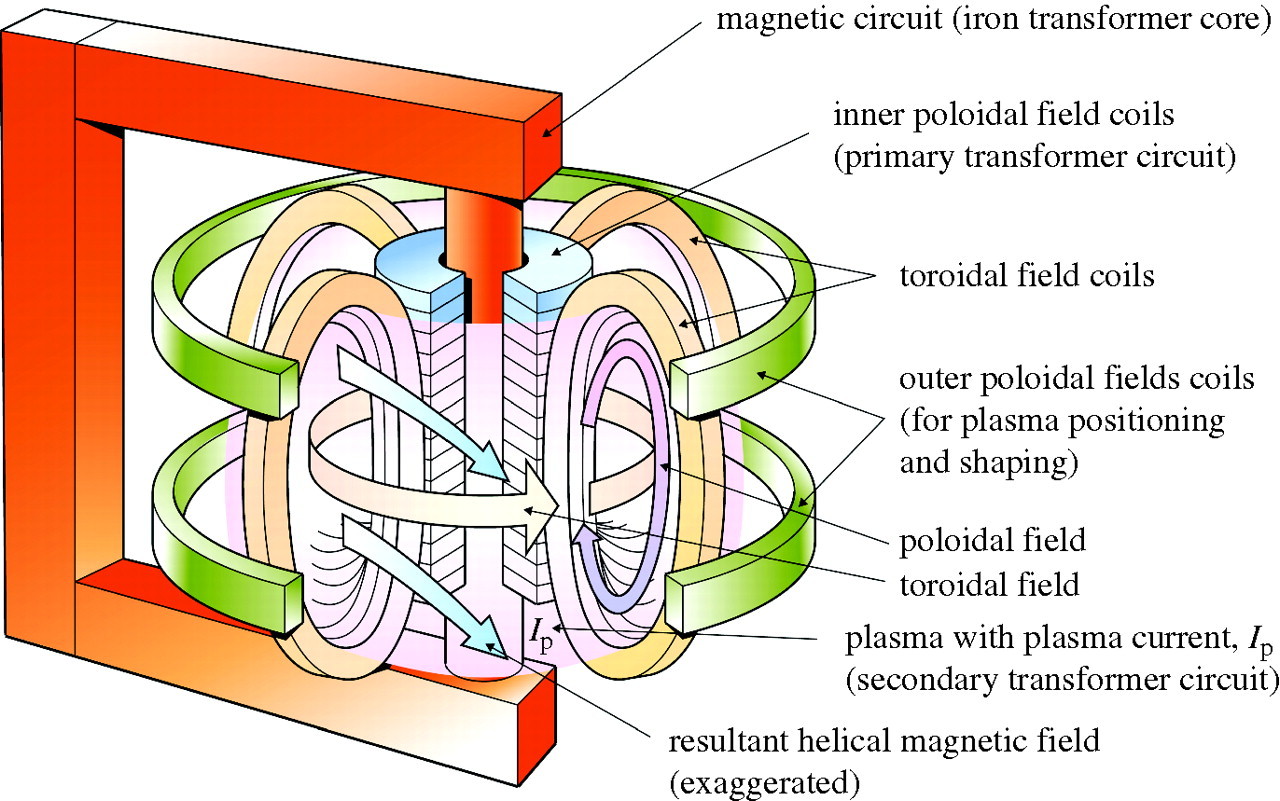
A tokamak confinement diagram introduces magnetic-confinement concepts. Wendelstein 7-X is a stellarator with a different field geometry.
Chris Llewellyn Smith and Steve Cowley · Image source · CC BY 3.0

Two impressive plasma results can come from the same experiment while measuring quite different achievements. Wendelstein 7-X sustained high performance for forty-three seconds in May 2025. A paper published July 1, 2026 analyzes another scenario with a particularly high triple product maintained for 1.9 seconds. Combining the largest number from each experiment would invent a result that neither demonstrated. Read separately, the findings tell a richer story: stellarator performance depends on controlling how particles and heat move across the plasma, while long operation also requires maintaining that favorable state. The bridge between the two is a problem in transport physics, not a stopwatch alone.
A short high-performance state and a longer sustained state
The July 2026 Physical Review E paper reports a triple product of (1.10 ± 0.15) × 10²⁰ per cubic meter, kiloelectronvolt, seconds, sustained for 1.9 seconds. It attributes the improvement to steep density gradients that suppress ion-temperature-gradient turbulence. In the reported scenario, neutral beam injection supplies central particles while transport maintains a useful density shape. The authors compare the performance with high-confinement operation in tokamaks of similar size.
The separate May 22, 2025 long-pulse result used continuous pellet refueling and microwave heating over forty-three seconds. IPP’s June 3 announcement was corrected on June 30 after previously unpublished JET results were brought to its attention. The corrected account describes Wendelstein 7-X and JET as joint leaders in maintaining comparable triple-product performance for long durations. That correction is part of the result’s present meaning. Repeating only the original exclusive-record wording would discard relevant evidence rather than provide a sharper headline.
What the triple product actually multiplies
The triple product combines fuel-particle density, ion temperature, and energy confinement time. It is useful because fusion must bring enough nuclei together at suitable energies while retaining heat long enough for reactions to matter. Each factor answers a different question. Density counts potential collision partners. Ion temperature characterizes their random kinetic energy. Confinement time describes the rate at which stored thermal energy would be lost relative to the energy stored.
Consider a deliberately invented plasma with density 2 × 10¹⁹ particles per cubic meter, ion temperature 2 kiloelectronvolts, and energy confinement time 0.5 seconds. Its product is 2 × 10¹⁹ in the corresponding triple-product units. Doubling density and doubling confinement time would increase the product fourfold if temperature remained fixed. That arithmetic is easy; holding the other quantities fixed is the physics challenge. Raising density can change radiation, collisions, heating efficiency, and turbulence. A proposed improvement has to survive those coupled responses before the multiplication becomes an experimentally meaningful gain.
Pulse duration is not energy confinement time
A heated room can remain warm all afternoon even though its insulation would let it cool quickly after the heater stops. Plasma pulse length and energy confinement time have a similar distinction. A long discharge can repeatedly replace the heat it loses. A short confinement time does not require a short pulse if heating and exhaust continue to balance. Conversely, a particularly well-insulated state can still end because a fueling or heating system reaches an operating limit.
An independent power-balance example makes the units explicit. Suppose a plasma stores one megajoule while losing five megawatts. Dividing stored energy by loss power gives 0.2 seconds, since a megawatt is a megajoule per second. Supplying five megawatts continuously could maintain that state for a minute without making the confinement time sixty seconds. The relevant experimental comparison must therefore specify stored energy, loss accounting, heating deposition, and how stationary the state is. Reporting a minute-long pulse without those quantities leaves the central thermal question unanswered.
Why adding a density gradient can reduce heat leakage
A density profile records how particle concentration changes from the plasma center to its edge. A temperature profile records how thermal energy changes over the same region. Both gradients help determine the stability of microscopic plasma fluctuations. The 2026 paper’s notable claim is that strong density gradients suppress a heat-transport channel associated with ion-temperature-gradient turbulence. It does not imply that every gradient is beneficial or that all turbulence disappears.
One way to understand the issue is to separate the amount of heat available from the routes by which it escapes. A steep temperature gradient can supply free energy to fluctuations, rather as a height difference can drive a flow. Changing the particle distribution can alter how the fluctuations exchange energy with the plasma and whether they grow. The result is not captured by treating the plasma as a material with one fixed thermal conductivity. A predictive calculation has to determine the fluctuations and the profiles together. My inference is that sustaining an advantageous profile is therefore a control target in its own right, beyond simply maximizing average density.
A product inherits the uncertainty of its ingredients
Princeton Plasma Physics Laboratory’s June 2025 account describes its contribution to diagnosis and control. IPP’s account specifically identifies PPPL’s X-ray spectrometer for ion-temperature measurements. This matters because the triple product is inferred from several measurements rather than read from a single gauge. Electron density, ion temperature, stored energy, and heating losses enter through different instruments and analyses. A central temperature, a volume average, and a line-integrated measurement are not interchangeable summaries.
If three independently measured factors each had five-percent relative uncertainty, multiplying them would give about 8.7-percent relative uncertainty under a simple quadrature estimate: the square root of three times five percent squared. Correlated errors would alter that calculation. A shared calibration bias could shift several factors together. This invented example explains why a comparison should preserve definitions and uncertainty, not merely rank rounded central values. Similar plasma size is also a relevant comparison condition, while magnetic geometry and heating composition can remain different. A useful benchmark makes these choices visible so that agreement is informative rather than accidental.
A central value cannot replace a spatial integral
Spatial profiles introduce another independent comparison problem. Imagine two equal-sized plasmas divided into a core and an outer region of equal volume. In the first, the density is two arbitrary units everywhere. In the second, it is three in the core and one outside. Both have the same volume-averaged density. If local reaction rate were proportional only to density squared with every other condition fixed, the first would have an average proportional to four, while the second would average five.
That simple twenty-five-percent difference comes from spatial concentration, not an increase in total particle count. Real plasmas also have varying temperature and composition, so their reaction integrals are more demanding. The example explains why a peaked profile contains information an average erases. It also explains why quoting only the peak can mislead: a very small high-density region need not dominate total performance. A fair comparison needs both the local state and the volume it occupies.
Long-pulse progress is not electricity production
IPP’s December 1, 2025 anniversary account presents Wendelstein 7-X as an experiment intended to test whether stellarators can support future power-plant operation. A hot, well-confined hydrogen plasma is a test of that concept; it is not a demonstration of net electrical output. The long-pulse announcement also reports energy turnover, meaning heating energy passed through the plasma and removed. Calling that quantity fusion energy would change its physical meaning.
The next decisive scientific question is whether favorable core profiles, sustained fueling, impurity control, and acceptable edge heat transport can coexist for progressively longer intervals. Success in one interval does not prove success in all of them at once. An informative experimental sequence would hold a target profile, vary heating or fueling in controlled ways, and compare the resulting heat flux with predictions before extending duration. The two existing achievements provide complementary constraints: one shows how strong core confinement can emerge, while the other shows how performance can be sustained. Keeping their identities separate makes their eventual combination a clear, measurable research goal.
Sources & further reading
Primary papers, project documentation, and research releases used in this article. Publication dates below refer to the sources themselves.
- Tokamak level performance in the optimized stellarator Wendelstein 7-X with stable peaked density profilesAmerican Physical Society / Physical Review EPublished Checked
- Wendelstein 7-X sets new performance records in fusion research [UPDATE]Max Planck Institute for Plasma PhysicsPublished Checked
- Wendelstein 7-X sets new performance records in fusion researchPrinceton Plasma Physics LaboratoryPublished Checked
- Ten years of Wendelstein 7-X – ten years of world-leading fusion researchMax Planck Institute for Plasma PhysicsPublished Checked
FOLLOW THE QUESTION
Explore physics