PHYSICS
LHCb’s baryon asymmetry: what the first CP-violation observation actually measured
LHCb’s 2025 baryon result and 2026 theory work reveal why a small decay asymmetry requires careful controls and does not solve the cosmic matter puzzle.
Research checked
Newest cited publication
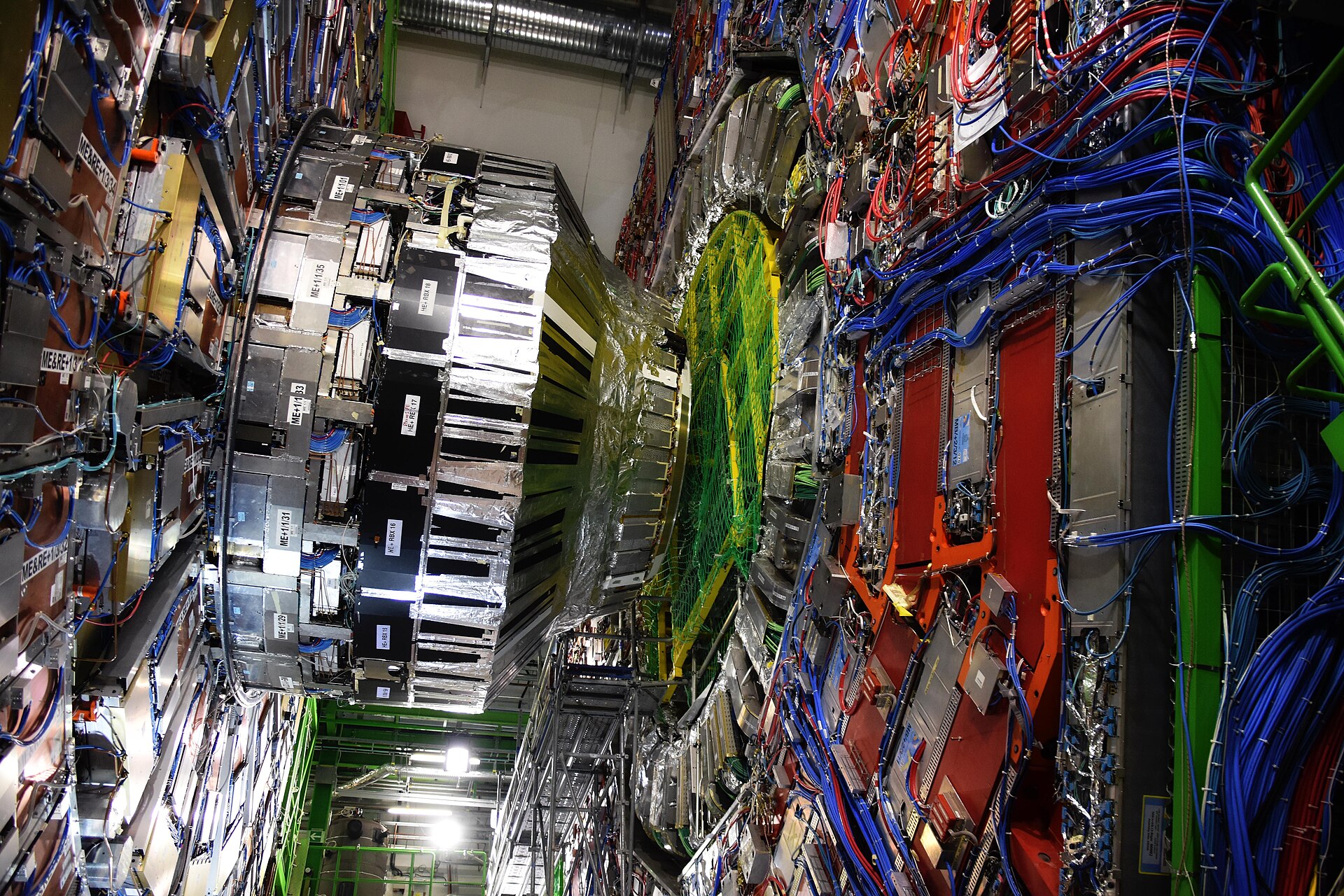
The CMS detector supplies LHC instrumentation context; the baryon CP-violation result discussed here was obtained by the separate LHCb experiment.
SimonWaldherr · Image source · CC BY-SA 4.0

A universe containing people rather than equal populations of people and antimatter people poses a serious question for physics. A laboratory decay measurement cannot answer that question on its own, but it can test one ingredient of the answer. LHCb’s paper, published in Nature on 16 July 2025 after its March preprint, established charge–parity violation in a baryon decay. Research continuing into 2026 concerns the dynamics behind that difference and other channels worth testing. The useful story is the chain from particle counts to a symmetry statement: each link explains both the importance of the observation and its limits.
A comparison between complete physical processes
Charge conjugation replaces a particle with its antiparticle. Parity reverses spatial coordinates. Combining the two operations gives charge–parity, usually shortened to CP. A CP test asks whether a process and its transformed counterpart follow the same probabilities. It does not ask whether a single antiparticle looks strange inside a detector built from ordinary matter. That distinction matters because experimental apparatus can treat opposite charges differently without the underlying decay violating CP. The comparison must refer to properly corrected physical rates, with equivalent definitions for both sides.
LHCb studied a heavy baryon called the neutral bottom lambda, whose quark content is up, down and bottom. The selected final state contains a proton, a negatively charged kaon and two oppositely charged pions. Its comparison process contains the corresponding antiparticles. Baryons carry a different internal organization from mesons, which pair a quark with an antiquark. Extending a symmetry test across those families makes the theory face new combinations of strong and weak interactions. It is not a claim that ordinary protons have been observed decaying, and the distinction prevents a dramatic but incorrect interpretation.
How to read an asymmetry of 2.45 percent
The reported CP asymmetry is 2.45 percent, with statistical and systematic uncertainties of 0.46 and 0.10 percentage points. Its definition is the difference between the two decay rates divided by their sum. An independent arithmetic example helps: if corrected rates were 1,024.5 and 975.5 in common arbitrary units, their difference would be 49, their sum 2,000, and the asymmetry 0.0245. The corresponding rate ratio would be about 1.050. Saying simply that one decay occurs 2.45 percent more often can therefore conceal which denominator is being used.
Combining the two quoted errors in quadrature gives approximately 0.471 percentage points, and 2.45 divided by that number is about 5.20. This reproduces the scale of the reported 5.2-standard-deviation result. It is an explanation of the uncertainty scale, not a replacement for the collaboration’s statistical analysis. A significance compares observations with a specified null hypothesis under a probability model. It is not the probability that the Standard Model is wrong, nor does it identify the physical origin of every contribution to the observed decay.
It is also important to separate a partial decay rate from a total lifetime. A particle can distribute its decays among many possible channels. Changing the relative likelihood of one selected channel need not mean that its entire population disappears faster overall. The result therefore tests a particular transition and its conjugate, not a universal rule that all matter persists longer than antimatter.
Why counting more baryons would not be enough
Imagine two checkout counters with different scanner efficiencies. More recorded purchases at one counter would not immediately establish a difference in customer demand. Particle detection creates a related inference problem. Production conditions, tracking efficiency, particle identification and selection can all influence a recorded yield. In proton–proton collisions the initial state itself is not symmetric between baryons and antibaryons. Comparing raw counts without accounting for that environment would mix an experimental preference with the decay property that physicists want to measure.
The experiment uses a reference decay containing a charmed lambda, chosen because appreciable CP violation is not expected there, to cancel much of the unwanted asymmetry. Matching the control sample’s kinematic properties helps the cancellation address comparable detector conditions. Independent detector configurations and subdivisions of the dataset provide additional checks. The key reasoning is transferable: a control measurement should respond to the nuisance effect while remaining comparatively insensitive to the sought signal. If control and signal populated completely different momentum regions, subtracting their asymmetries would be a much weaker argument.
A small average can hide substantial structure
The theoretical difficulty is not that the weak interaction lacks a description. It is that several quantum amplitudes can lead to the same observed particles, and strong interactions reshape how those amplitudes combine. Probabilities are obtained after adding amplitudes, so cross terms can survive. In a simple two-path example, changing the relative phase can move the total probability even when the magnitudes of both paths stay fixed. CP violation requires suitable phase relationships; merely having two diagrams on a page does not guarantee a measurable rate asymmetry.
A total average can also conceal opposite local effects. As an illustrative calculation, suppose equally populated regions had asymmetries of positive eight and negative six percent. Averaging would produce only one percent, despite both regions carrying larger differences. A theory paper first submitted in September 2024 and revised in June 2025, Establishing CP Violation in b-Baryon Decays, investigates related cancellations between angular components in other bottom-baryon channels. That result is a proposed dynamical explanation, not a measurement of the particular toy numbers above. It shows why angular distributions can be more informative than a single integrated total.
What the 2026 rescattering work adds
A preprint submitted on 13 January 2026 studies additional bottom-baryon decays through final-state rescattering. Rescattering means that particles produced along one route interact and feed another accessible final configuration. The authors introduce model parameters and predict branching fractions, CP asymmetries and interference effects for specified channels. This is primary theoretical work motivated by the new experimental territory. It should be read as a collection of testable calculations with assumptions, not as an additional LHCb discovery or a confirmation that every predicted large effect exists.
The interesting methodological question is whether one model can explain several measurements with the same parameter choices. Giving each channel unlimited adjustable freedom would make agreement easier but prediction weaker. A useful comparison instead exposes which inputs came from existing data, which uncertainties were propagated and which outcomes were genuinely predicted beforehand. New channels can then discriminate among explanations. This is also why disagreement with an approximate hadronic model would not automatically establish a new force: a calculation of complicated strong dynamics and the fundamental framework it approximates are different levels of the argument.
The cosmological question remains larger
CP violation is relevant to attempts to explain the universe’s matter excess, but finding it in a baryon decay does not reproduce the early universe. A cosmological mechanism must also address how the population changes, what happens away from thermal equilibrium and whether the generated imbalance survives later evolution. A laboratory asymmetry measures a specific process under specific conditions. Moving from that measurement to the abundance of matter requires a physical history and quantitative calculations. Similar vocabulary does not make the two observables interchangeable.
The next decisive work is consequently quite concrete: more precise rates, resolved angular and resonance information, reliable detector controls, and theoretical descriptions tested across multiple channels. A distinctive inconsistency across such comparisons could become evidence for additional physics. Agreement would still be valuable because it would explain a newly accessible part of the known theory. As of the 18 October 2026 research cutoff, the verified milestone here remains the 2025 observation, followed by active theoretical proposals. Its achievement is to open a baryon laboratory for symmetry tests while keeping the origin of cosmic matter an open question.
Sources & further reading
Primary papers, project documentation, and research releases used in this article. Publication dates below refer to the sources themselves.
- Observation of charge–parity symmetry breaking in baryon decaysLHCb Collaboration / NaturePublished Checked
- Establishing CP Violation in b-Baryon DecaysHan et al. / arXivPublished Checked
- Study of CP violation in Λ_b^0/Ξ_b^- → Λ(1520)M decays with the final-state rescattering mechanismFeng et al. / arXivPublished Checked
FOLLOW THE QUESTION
Explore physics