PHYSICS
XENONnT turns solar pp neutrinos into a five-sigma measurement
XENONnT’s August 2026 solar-neutrino result explains how xenon purity, electron recoils and background controls reveal the Sun’s lowest-energy signals.
Research checked
Newest cited publication
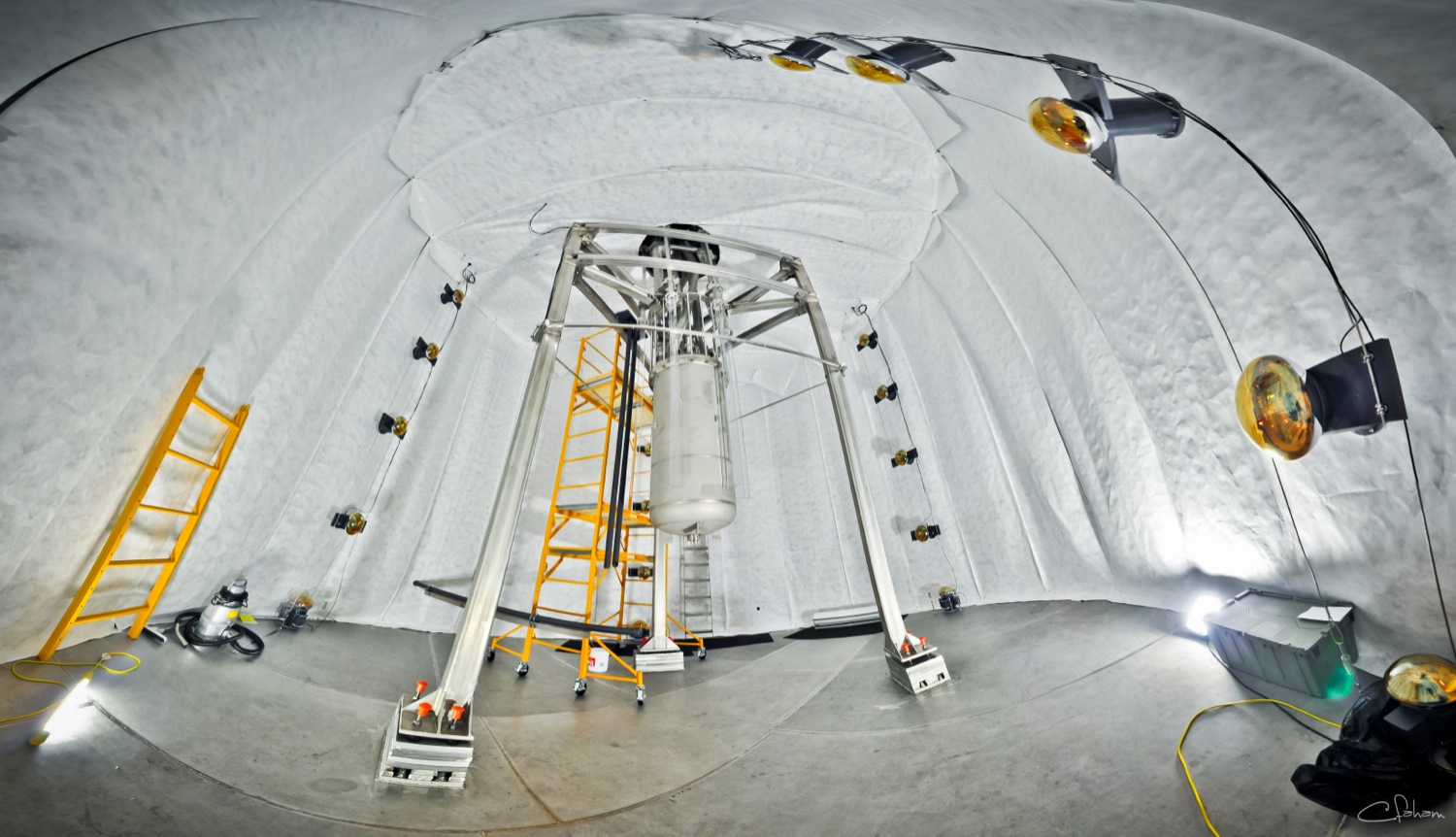
The LUX xenon detector illustrates the general use of liquid xenon in rare-event searches. XENONnT is a separate detector with its own solar-neutrino analysis.
Carlos Faham (Gigaparsec at English Wikipedia) · Image source · CC BY 3.0

The particles that make life difficult for a dark-matter search can become the subject of a different experiment inside the same instrument. On August 31, 2026, the XENON collaboration announced a five-sigma measurement of low-energy solar neutrinos scattering from electrons in XENONnT. The signal is dominated by neutrinos from proton–proton fusion in the Sun. This is a useful example of experimental progress changing the definition of background: once a detector becomes sufficiently clean, a previously hidden ordinary process becomes a measurable astronomical message.
Two thresholds describe two different energies
The preprint was submitted on August 29, 2026, ahead of the public announcement. It analyzed 2.46 tonne-years from the first two science runs, covering electron-recoil energies from 1 to 140 keV. That recoil window gives sensitivity to incoming neutrinos down to about 17 keV. The collaboration rejected its background-only hypothesis at 5.0 sigma and inferred a pp-neutrino flux of (10.2 ± 2.0) × 10¹⁰ per square centimetre per second. The central flux is higher than the Borexino comparison but differs by only 1.9 sigma, which is not a compelling contradiction.
The two energy thresholds must not be merged into one number. A neutrino can leave with much of its original energy after scattering, while the detector measures the energy transferred to an electron. A one-keV recoil threshold is therefore not a one-keV neutrino threshold. This distinction is essential when comparing instruments that detect different reaction products or use different target materials.
What a pp-neutrino measurement tells us
The proton–proton chain is the sequence of nuclear reactions that supplies much of the Sun’s energy. Its neutrinos interact so weakly that they can escape and travel to us. Measuring them probes ongoing nuclear activity through a messenger quite different from visible sunlight. XENONnT’s result concerns a low-energy component of that emission, rather than a new kind of neutrino or an observation that the Sun has changed its power source.
A helpful distinction is between detecting a population and measuring every property of its members. The measured recoil spectrum can support a statistical signal even though no individual event comes with a label declaring its solar origin. A flux estimate additionally requires interaction probabilities, detector efficiency and the assumed spectral composition. Changing one of those inputs can move the inferred flux without changing the recorded pulses. An astronomical interpretation is built from the detector measurement and the particle-physics model together.
A chamber that records both light and charge
XENONnT’s central instrument contains 5.9 tonnes of liquid xenon and operates underground at Gran Sasso. Energy deposition generates prompt scintillation light and freed electrons. An applied electric field drifts the electrons toward gaseous xenon, where they create a second light signal. The separation in arrival times gives depth; the second signal’s distribution across photosensors gives horizontal position. This reconstructs interactions in three dimensions.
Position is valuable because the outer xenon can shield the quieter central region. The light and charge yields also help distinguish interactions with electrons from interactions with nuclei. For this solar analysis, an electron interaction is the desired channel. A selection designed to reject electron recoils for a nuclear-recoil dark-matter search would discard much of the very population now being measured. A detector’s hardware defines possibilities, while its analysis decides which possibility is being pursued.
Cleaning the target changes which questions are possible
A 2025 XENONnT study reported a radon-222 activity concentration of 0.90 microbecquerels per kilogram, with statistical uncertainty 0.01 and systematic uncertainty 0.07 in the same units. Material selection and continuous cryogenic distillation were central to reaching that level. Radon is troublesome because its decay products can produce electron recoils, which resemble the channel used to detect these neutrinos.
The scale is easier to understand by working through an idealized calculation. One becquerel means one decay per second. At 0.90 microbecquerels per kilogram, one tonne would have 0.00090 radon decays per second, or roughly 78 per day. That is not the accepted background count in the neutrino analysis: subsequent decays, energy cuts, branching fractions and event efficiencies all matter. The calculation simply shows why a concentration that sounds almost zero can still matter when the target is large and the observation lasts many months.
The signal has to be distinguished from a spectrum of impostors
Reducing contamination is only one part of the task. Lead isotopes in radon decay chains, krypton, material gamma rays and other components contribute to the electron-recoil spectrum. A fit can mistake an underestimated ordinary component for an extra signal if their spectra look sufficiently alike. The 2026 analysis therefore depends on background constraints as well as raw cleanliness.
Consider a fictional counting experiment with an observed excess of twenty events. If the expected background is known within one event, the excess is much harder to dismiss than if the background uncertainty is thirty events. Real spectral analyses use more information than this one-number example, but the principle remains. Independent calibrations and distinctive features outside the most sensitive signal window help establish what the background must be doing. More exposure alone cannot repair an incorrect background shape.
Significance and precision improve at different speeds
Five sigma refers to the incompatibility of the fitted background-only description with the data under the stated analysis. It does not imply that the flux is known with five-digit precision. The quoted flux uncertainty is about twenty percent of its central value. A strong rejection of zero signal and a comparatively broad estimate of signal strength can coexist without inconsistency.
An everyday statistical analogy is measuring the height of a distant mountain. One can be extremely sure that a mountain rises above the horizon while still having a substantial uncertainty in its height. In the detector, nuisance parameters such as component rates and energy response can weaken the precision of the amplitude even after the data establish that an additional population is needed. Readers should therefore ask separately whether a signal is established, whether its size is precise, and whether its interpretation is unique.
When more target mass stops being the whole answer
Suppose an idealized experiment observes a fixed signal-to-background ratio and all uncertainties arise from independent counting fluctuations. Four times the mass-time would give four times as many expected signal and background events, while the characteristic fluctuation scale would grow only by a factor of two. That often means roughly twice the statistical discrimination. It does not promise four times the precision.
Now introduce an uncertain contaminant whose spectrum closely resembles the signal. If its fractional uncertainty remains unchanged, its absolute uncertainty also increases with exposure. Eventually, extra target mass contributes less than improving the independent constraint on that contaminant. This is an illustrative scaling argument, not a forecast for a particular XENONnT run. It explains why the engineering and calibration story belongs beside the headline significance when judging how far a solar measurement can improve.
The same neutrino can be signal or background
Electron scattering and coherent neutrino–nucleus scattering probe different interactions. The latter involves the nucleus and is especially relevant to the nuclear-recoil channel used in many dark-matter searches. XENONnT’s public announcement places the new electron-scattering result beside its earlier solar nuclear-recoil work. Their complementarity expands the instrument’s purpose; it does not make the two measurements interchangeable.
My reading is that this marks a change in how future xenon observatories should be evaluated. A larger target offers more opportunities to observe rare processes, but improvements in purity, calibration and inference determine which opportunities become useful measurements. The proposed next generation remains a future program, not a detector that has already delivered better results. For the present instrument, the clearest achievement is concrete: an August 2026 analysis extracted a pp-dominated solar signal from backgrounds that earlier generations struggled to suppress.
Sources & further reading
Primary papers, project documentation, and research releases used in this article. Publication dates below refer to the sources themselves.
- First Measurement of Solar Neutrinos through Elastic Neutrino-Electron Scattering at the keV ScaleXENON Collaboration / arXivPublished Checked
- XENONnT: First Measurement of Low-Energy Solar Neutrinos Scattering off ElectronsXENON CollaborationPublished Checked
- Time Projection ChamberXENON CollaborationChecked
- Radon Removal in XENONnT down to the Solar Neutrino LevelXENON Collaboration / arXivPublished Checked
FOLLOW THE QUESTION
Explore physics