PHYSICS
Euclid’s 2026 Bulge Release Shows Why a Sky Survey Is More Than Its Headline
Euclid’s June 2026 release maps the crowded Galactic bulge. Its connection to microlensing explains why survey images and dark-energy results are different products.
Research checked
Newest cited publication
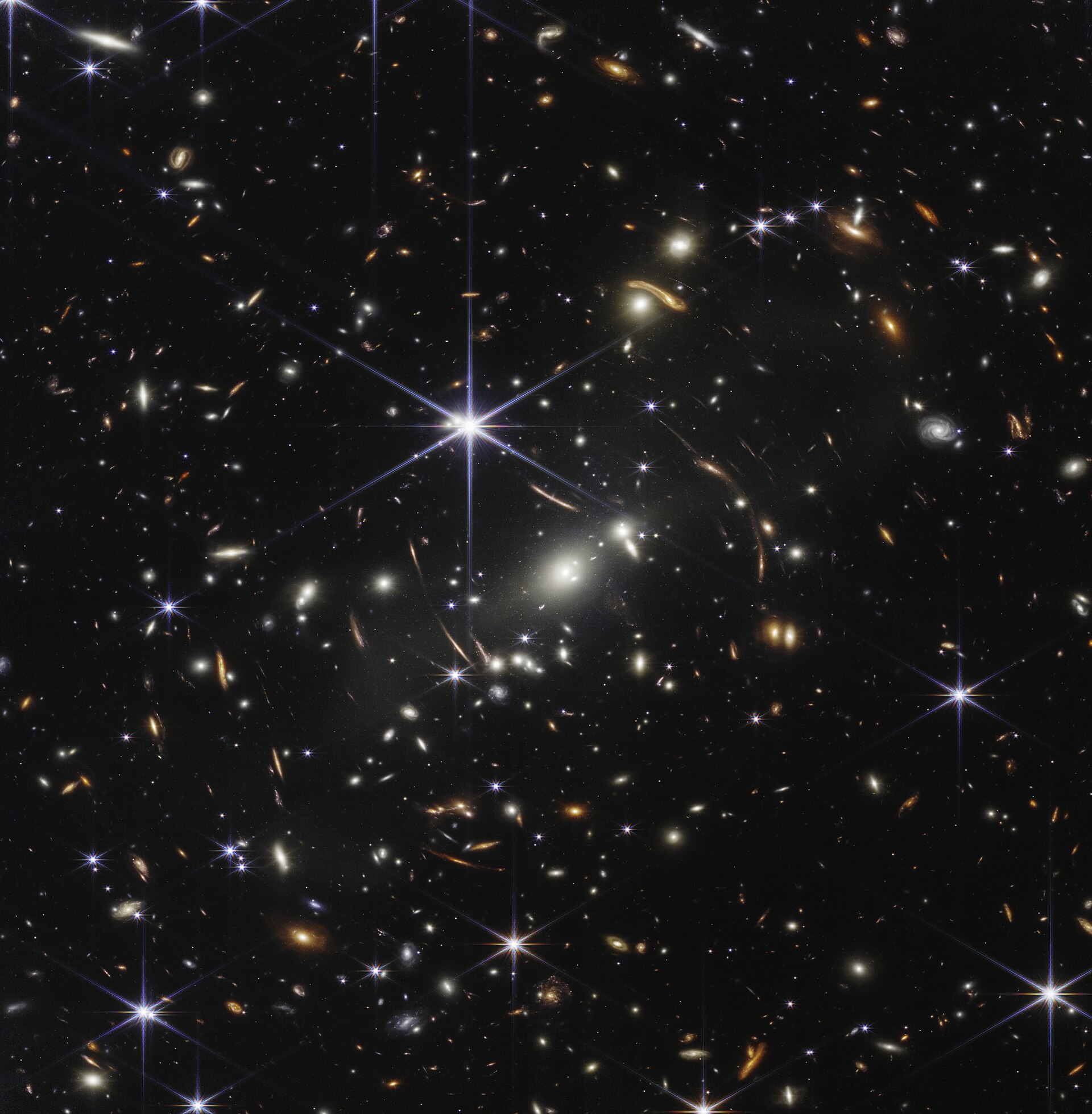
A Webb deep field provides context for galaxies and gravitational lensing; the Euclid release discussed here is a separate survey with its own images and selection rules.
NASA, ESA, CSA, and STScI · Image source · Public domain

A telescope built to study the dark universe can produce an extraordinary map of our own galaxy without yet delivering its central cosmological inference. Euclid's second Quick Release, published on June 24, 2026, is a good example. It contains a high-resolution visible-light survey of the Milky Way's inner bulge, observed in March 2025. The release is scientifically useful, especially for future microlensing work, but its archive description explicitly distinguishes these data from products suitable for the mission's core cosmology objectives. Reading that distinction carefully makes the achievement more interesting. It reveals how an observatory's capabilities connect questions about individual stars and planets to questions about cosmic structure.
The date of publication is not the date of observation
The European Space Agency's dataset record identifies Q2 as the Euclid Galactic Bulge Survey: nine adjoining fields spanning 4.8 square degrees, observed on March 23, 2025, over about a day. The release therefore has at least two dates that matter. The observation date establishes when the sky was sampled; the June 24, 2026 publication date establishes when the product became available. Neither date, by itself, tells us when every scientific use of the data will be completed.
A helpful comparison is an environmental sensor campaign. Recording air quality, calibrating the detectors, releasing a dataset, and publishing a regional trend analysis are separate milestones. Confusing them can make an ordinary release sound like a new discovery or make a valuable calibration dataset appear unimportant. Astronomical archives work the same way. A public release supplies an object that researchers can examine and challenge. The downstream scientific conclusions still need measurements, modeling, uncertainty estimates, and an appropriate comparison.
Sixty million stars do not mean sixty million isolated sources
ESA describes the public bulge image as containing more than 60 million stars. The remarkable property is not merely the count, but Euclid's ability to resolve sources across an exceptionally crowded area. Nearby points of light overlap through an instrument's point-spread function, the pattern made when an ideal point source is imaged. Distinguishing overlapping stars requires sufficient spatial resolution and a model of that response. More collected photons cannot always compensate for an inadequate ability to separate neighbors.
Imagine reading a densely printed page after applying a blur. Increasing the brightness of the page reduces some noise, but adjacent letters may remain merged. Knowing the font helps infer what was printed, although it does not create information that the image never recorded. Stellar photometry faces an analogous compromise between data and modeling. A sharper reference image can identify which stars contributed to a blended signal seen later with another instrument. That is a practical route from an impressive mosaic to a better physical measurement.
A reference image becomes useful when a star changes brightness
In gravitational microlensing, a foreground star and an observer pass through a favorable alignment with a more distant source. The foreground object's gravity changes the apparent brightness of the background star. A planet can introduce a smaller disturbance in the lensing pattern. An individual brightening is not generally a resolved image of the planet. It is a time-dependent signal whose shape must be compared with lensing models and possible alternative explanations.
A single high-resolution reference observation is especially valuable when paired with a time series. The time series tells researchers that something changed; the reference image helps identify what produced the light and which nearby objects may have contributed. As the foreground and background objects move relative to one another, additional observations may help separate them. The physical information comes from this combination. The Q2 image is therefore an enabling measurement, not a declaration that every planet in the field has already been found or weighed.
The wrong baseline changes an apparent magnification
Consider an illustrative unresolved pair in arbitrary flux units. The background source contributes 10 units, while an unrelated neighbor contributes 20. If a lens doubles the background source's brightness, the observed total rises from 30 to 40. The combined image brightens by only one third, although the lensed star itself doubles. Without a model of the blend, an analyst could infer the wrong magnification and consequently prefer the wrong lens parameters. These numbers are invented to explain the issue, not taken from a Euclid event.
Now suppose a sharper reference image separates the two contributions. It does not, on its own, determine a planet's mass. It does remove one ambiguity from interpreting the later light curve. This distinction is useful whenever a mission release advertises enabling future measurements. Enabling work can reduce uncertainty in a specific nuisance quantity while leaving other unknowns intact. Physical mass estimates still depend on additional information about geometry, motion, and the relation between the lens and source.
Arcs around galaxies ask a different question
Euclid also searches for strong gravitational lenses in which a galaxy or galaxy cluster distorts a more distant galaxy into arcs or multiple images. In April 2026, ESA announced a Space Warps citizen-science project involving new Euclid images. That program should not be confused with the Galactic bulge release. Both exploit gravitational deflection, but they involve different source populations, angular scales, selection effects, and scientific analyses. The shared word lensing does not make their data products interchangeable.
The earlier March 19, 2025 quick release included a catalog of approximately 500 galaxy-galaxy strong-lens candidates. Candidate is the operative term: unusual morphology can motivate follow-up without uniquely establishing a lens model. An arc-like star-forming structure or an accidental alignment can resemble a lens. Human inspection and automated classifiers help prioritize cases, while additional measurements test the interpretation. A large candidate list is a discovery resource whose reliability and completeness must be measured before it becomes a precision population sample.
Finding spectacular systems can bias the sample
The Euclid Q1 ensemble-classification paper studies how multiple classification methods can help discover strong lenses and prepare for later releases. It makes the selection stage a scientific object in its own right. An algorithm that finds obvious rings extremely well may still miss less symmetric systems. That weakness matters if the goal is to infer properties of the entire lens population. High apparent accuracy on an appealing gallery is not the same as a calibrated selection function for statistical astronomy.
For a simple independent example, imagine a survey in which every large ring is detected but only half of small arcs are found. If the catalog contains equal numbers of the two, the underlying population need not be equally divided. Correcting the counts requires knowing those detection probabilities, and uncertainty in the probabilities must propagate into the final result. Injected simulated lenses and carefully constructed validation samples can help, provided they span the appearance of real systems rather than merely resembling the training set.
Ask which inference the product is designed to support
The Q2 archive explicitly describes its level of processing as useful for many astronomical purposes while excluding the mission's core cosmological objectives. That is a scope statement, not a defect. Precision cosmology requires coordinated treatment of shape measurements, distances, instrumental calibration, masks, and astrophysical effects. A beautiful release can satisfy a different and legitimate purpose. Readers should check the accompanying product documentation before translating a large star count or image footprint into a dark-energy constraint.
My inference is that the most enduring value of the 2026 bulge release may lie in combinations: sharper source identification for later time-domain work, better characterization of crowding, and comparisons across observing epochs. These are possibilities enabled by the data, not completed findings asserted here. Euclid's broad survey capability allows one instrument to serve several physical programs. Respecting the differences between those programs makes it easier to recognize when a future paper has advanced from a useful image to a tested claim about planets, mass distributions, or cosmic expansion.
Sources & further reading
Primary papers, project documentation, and research releases used in this article. Publication dates below refer to the sources themselves.
- Euclid Quick Release (Q2)European Space AgencyPublished Checked
- Euclid data release: Q2Euclid ConsortiumPublished Checked
- ESA’s Euclid captures the Milky Way’s crowded heartEuropean Space AgencyPublished Checked
- Euclid Space Warps: help spot galaxies bending spacetimeEuropean Space AgencyPublished Checked
- Euclid opens data treasure trove, offers glimpse of deep fieldsEuropean Space AgencyPublished Checked
- Euclid Quick Data Release (Q1). The Strong Lensing Discovery Engine E -- Ensemble classification of strong gravitational lenses: lessons for Data Release 1Euclid Consortium researchers / arXivPublished Checked
FOLLOW THE QUESTION
Explore physics