PHYSICS
Oxygen and neon at the LHC: the 2026 search for energy loss in small quark–gluon droplets
June 2026 light-ion results connect jet imbalance, neutral-pion suppression and nuclear geometry, testing how small a strongly interacting droplet can be.
Research checked
Newest cited publication
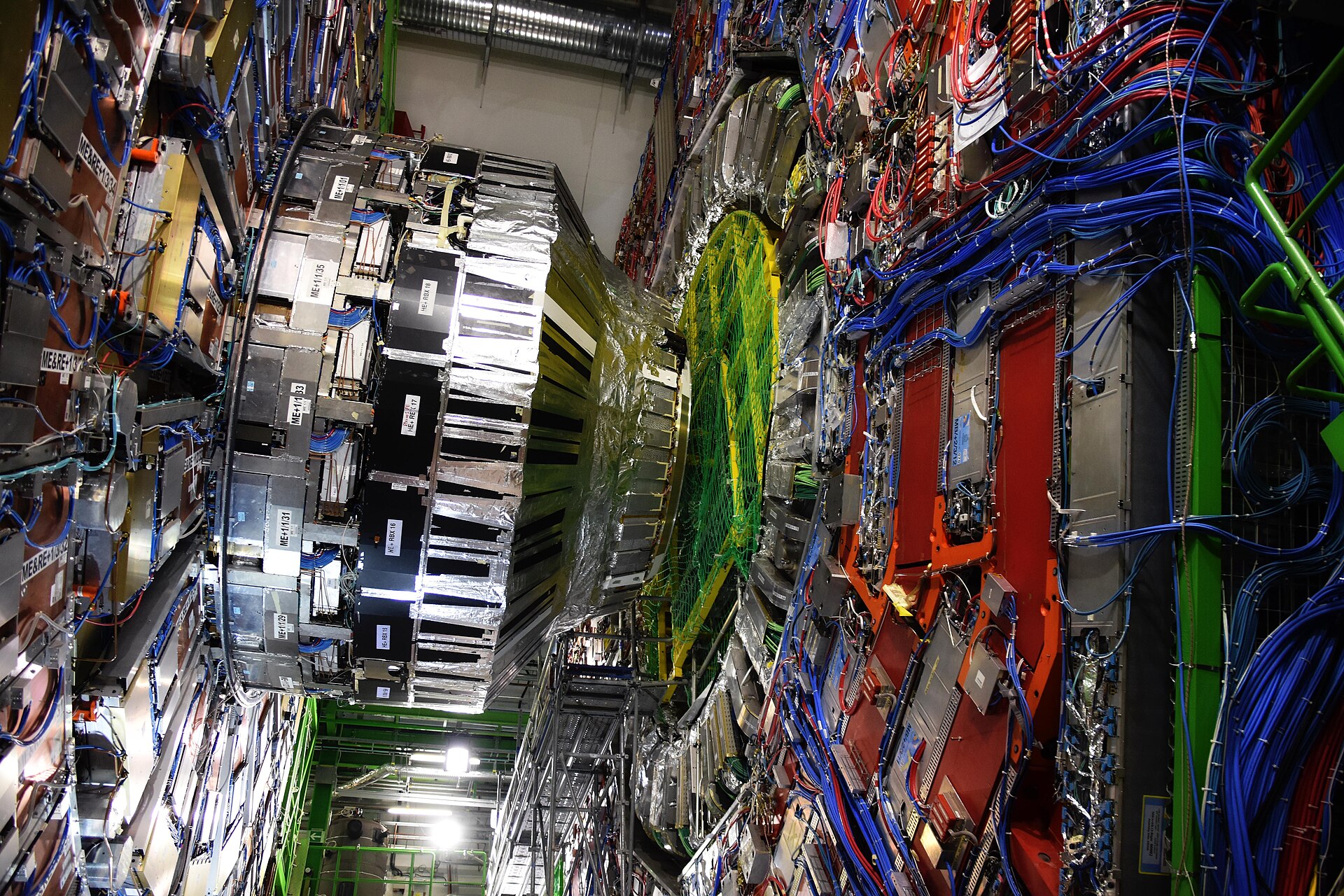
The CMS detector supplies LHC instrumentation context for measurements of particles emerging from ion collisions; it is not an image of a quark–gluon droplet.
SimonWaldherr · Image source · CC BY-SA 4.0

Oxygen and neon collisions collected during the LHC’s short 2025 light-ion run have become a substantial 2026 test of strongly interacting matter. ATLAS and ALICE submitted new energy-loss studies on 18 June 2026, while earlier flow measurements continued through a September 2026 revision. The results concern a boundary question: how small can a collision system become while still producing the collective and energy-loss behavior associated with quark–gluon plasma? Answering requires more than a familiar-looking pattern. The experiments compare different projectiles, particle species and reference collisions so that a possible hot-medium effect can be separated from changes already present inside cold nuclei.
A controlled bridge between familiar collision systems
Quark–gluon plasma is a state in which quarks and gluons are not confined inside the separate hadrons familiar from ordinary matter. Large-nucleus collisions have provided a rich laboratory for studying it. Proton collisions create a much smaller system, making interpretation of some collective-looking signatures more contested. Oxygen and neon provide intermediate projectiles whose size and nuclear structure can be varied. This is not a miniature lump of matter that can be taken out of the detector: its properties are inferred from the particles emitted as the collision evolves and cools.
Changing the projectile is a powerful experimental strategy because it changes more than the total collision rate. Geometry affects the path through the produced medium, the number of participating nucleons and the initial shape of the energy distribution. A successful physical description should explain how observables vary across these changes. One system alone can leave several explanations degenerate. A series of related systems creates additional constraints, particularly when theoretical inputs are kept consistent instead of independently retuned for every comparison.
Flow and jet quenching interrogate different scales
Anisotropic flow describes preferred directions in the momentum distribution of emitted particles. If a collision begins with an uneven spatial profile, collective expansion can convert that geometry into an uneven momentum pattern. The ALICE flow paper first appeared on 8 September 2025 and was revised on 28 September 2026. It measures elliptic and triangular flow in oxygen and neon collisions at 5.36 TeV per nucleon pair, comparing the data with hydrodynamic calculations that incorporate nuclear structure. The agreement supplies an important test of how geometry is transmitted through the evolving system.
Jet quenching asks a different question. A fast quark or gluon initiates a shower of particles that is reconstructed as a jet. If it loses energy while traversing the produced medium, the energetic final distribution can change. Collective flow probes the organized motion of much of the event; quenching probes the interaction of an energetic disturbance with its environment. Observing both in a coherent system-size program is more restrictive than observing either alone. Their relationship must still be demonstrated quantitatively rather than inferred from the fact that both are discussed under the plasma label.
The ATLAS measurement follows an imbalance
ATLAS compares pairs of nearly opposite jets using xJ, the lower jet transverse momentum divided by the higher. Its June 2026 paper finds that the distribution departs increasingly from the proton–proton reference as oxygen and neon collisions become more central. More central collisions correspond, statistically, to a larger nuclear overlap. The collaboration’s 28 June briefing reports jet-quenching observations in central samples above five standard deviations. That is a measured change in a defined jet-balance distribution, interpreted as medium-induced partonic energy loss.
An independent example clarifies what xJ records. Jets with transverse momenta 100 and 90 in the same units have xJ equal to 0.90. If one instead has 100 and 65, the ratio becomes 0.65. The ratio detects unequal energy scales, but an individual imbalanced pair is not proof of quenching: ordinary radiation, detector resolution and event selection can also create imbalance. The evidence comes from the distribution across many events, its comparison with references, and its dependence on collision geometry. One unusually lopsided event would not establish a new medium.
Centrality itself is inferred from measured activity rather than observed as a direct overhead photograph of two nuclei. Its relation to impact geometry has fluctuations and model dependence, especially for small systems. Consequently, comparisons must ask whether selecting unusually active events also changes the hard-process sample. This is a reason to test several observables and selection strategies, rather than treating every centrality class as a perfectly sharp geometric category.
ALICE tests whether the incoming nuclei explain the suppression
ALICE reconstructs neutral pions and compares production in oxygen–oxygen and proton–oxygen collisions with proton–proton baselines. Its June 2026 preprint introduces the double ratio ROO divided by RpO squared. Here R denotes a nuclear modification factor: a properly normalized production ratio relative to the reference. The reported suppression of the double ratio reaches 4.9 standard deviations relative to expectations without energy loss. Calling this 4.9 rather than rounding it to a discovery threshold preserves the distinction between the reported evidence and a convenient headline.
The squared denominator has a physical motivation. In a simplified factorized picture, proton–oxygen constrains the modification associated with one nuclear incoming side, while oxygen–oxygen contains two such sides. Dividing by the corresponding squared correction can largely cancel that initial-state contribution. This is a controlled approximation, not an algebraic guarantee that every nuclear effect disappears. The analysis also deals with different collision energies and the construction of the appropriate reference. Its value is that it explicitly attacks an alternative explanation for suppression instead of assuming all missing energetic particles must have crossed a hot plasma.
October 2026 adds a warning about nuclear structure
A separate ATLAS result publicized on 1 October 2026 reports position-dependent modifications of parton distributions inside lead nuclei, using photonuclear interactions in ultra-peripheral collisions. The briefing quotes a six-standard-deviation difference between the selected event classes. This is not an oxygen-plasma measurement, and it should not be presented as one. Its relevance here is methodological: nuclear matter can alter the incoming quark and gluon distributions, and those changes need not be uniform across a nucleus. Baseline assumptions therefore deserve direct tests.
The lead result does not supply a ready-made correction for oxygen or neon. Different nuclei, kinematic regions and event selections require their own analysis. Instead, it reinforces why complementary references are valuable. If a candidate explanation rests on the initial nucleus, it should confront proton–nucleus and geometry-sensitive measurements. If it rests on an evolving final medium, it should explain the dependence on path length and particle type. Separating those possibilities prevents a qualitative resemblance from carrying more evidential weight than the measured comparison can support.
The onset of plasma behavior needs a map, not one magic size
There may be no universally useful answer expressed only as a number of nucleons. What an energetic probe experiences depends on the medium’s density, lifetime, geometry and microscopic interactions. Two systems producing similar particle multiplicities can begin with different shapes. Two probes created in one system can traverse different path lengths. A useful theory should predict a family of observations under those changes. The challenge is to describe where a fluid-like treatment works, where energetic particles lose measurable energy, and which assumptions remain necessary in each regime.
Through 18 October 2026, the verified light-ion results make that mapping more concrete. Jet-pair imbalance and neutral-pion suppression provide complementary energy-loss evidence, while flow measurements test the geometry response. They do not measure every transport property or establish that all smaller proton systems behave identically. More differential comparisons, independent channels and improved treatment of cold-nuclear effects can narrow those remaining questions. The strongest outcome is a consistent account that explains the successes and the limits of the same physical picture across projectiles, rather than a declaration that one striking plot has settled every meaning of a tiny quark–gluon droplet.
Sources & further reading
Primary papers, project documentation, and research releases used in this article. Publication dates below refer to the sources themselves.
- Observation of centrality-dependent dijet transverse momentum imbalance in O+O and Ne+Ne collisions at √sNN = 5.36 TeV with the ATLAS detectorATLAS Collaboration / arXivPublished Checked
- Smallest droplet of the early Universe: ATLAS observes “jet quenching” in oxygen and neon collisionsATLAS CollaborationPublished Checked
- Evidence for parton energy loss in oxygen–oxygen collisions at √sNN = 5.36 TeVALICE Collaboration / arXivPublished Checked
- Evidence of nuclear geometry-driven anisotropic flow in OO and Ne–Ne collisions at √sNN = 5.36 TeVALICE Collaboration / arXivPublished Checked
- ATLAS gets an edge on nuclear structureATLAS CollaborationPublished Checked
FOLLOW THE QUESTION
Explore physics