PHYSICS
Supersolidity moves from atomic gases to light–matter systems
Room-temperature polariton results and 2026 exciton theory sharpen the distinction between an imposed stripe pattern and spontaneous supersolid order.
Research checked
Newest cited publication
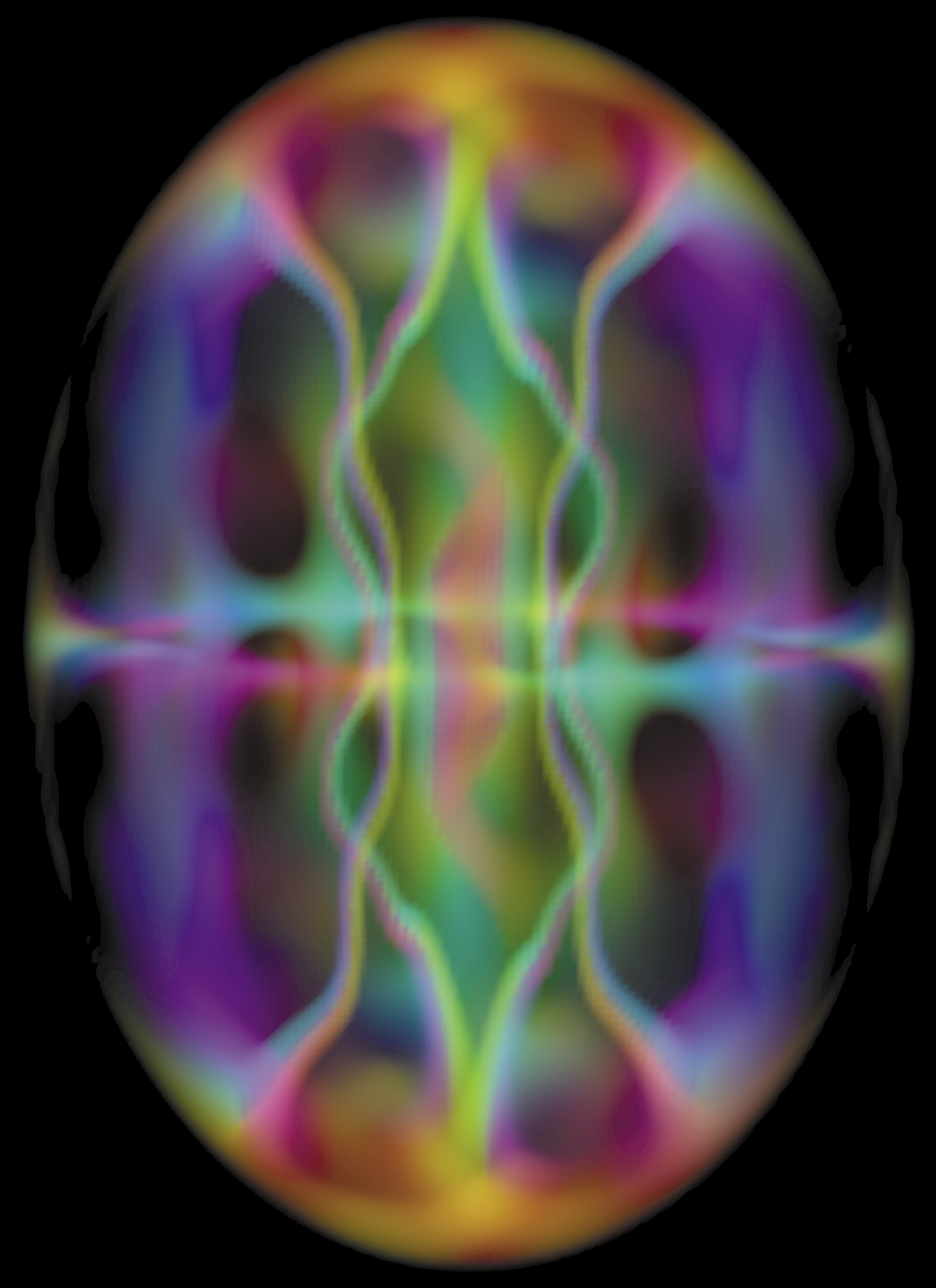
A simulated vortex pattern in a Bose–Einstein condensate provides context for collective quantum states; it does not show the light–matter supersolid reported here.
NIST · Image source · Public domain

A striped image is not enough to establish a supersolid. Ordinary illumination can make stripes, and a fabricated grating can impose a periodic pattern on almost anything placed above it. The scientific question is whether a many-body system chooses spatial order while also maintaining a shared quantum phase. Research in 2025 and 2026 has extended this question from ultracold atoms to hybrid light–matter excitations called polaritons. A room-temperature experiment published in March 2026 is particularly interesting because its evidence includes what happens when apparently beautiful stripes disappear after averaging many images. The disappearance can reveal the freedom of the ordered state rather than the failure of the experiment.
Two kinds of order must be established
A crystal has an arrangement that distinguishes one position from another. A coherent condensate has a collective phase relationship that can extend across its spatial extent. A supersolid combines these types of order in the relevant many-body description. The older 2017 Nature experiment on atoms coupled to two optical cavities is useful background: it reported continuous translational-symmetry breaking along one direction and examined the possible positions of the resulting pattern. The important point is freedom to select among equivalent configurations, rather than simply occupying a lattice whose location was fixed externally.
Imagine laying striped wallpaper on a wall. Its bright bands occur where the installer put them, so their existence demonstrates the installer’s pattern rather than spontaneous ordering. Now imagine a medium that can choose any horizontal offset for otherwise identical bands. Each experimental run might settle at a different offset without changing the defining conditions. That freedom is one part of what makes symmetry breaking scientifically meaningful. The analogy is deliberately limited: wallpaper has no condensate phase, and a classical pattern-forming fluid can also choose a position. To establish the quantum-fluid aspect, one needs independent information about coherence and dynamics. The density picture cannot carry both arguments on its own.
Light and material excitation become one collective mode
The Nature study published on 5 March 2025 reported evidence for emerging supersolidity in a photonic-crystal polariton condensate. Its platform used a low-loss bound state in the continuum in a waveguide and measured both density modulation and coherence. The result concerned an exciton–polariton system maintained by pumping and subject to loss, not free photons in empty space becoming an ordinary solid. This distinction preserves the interesting physics: a material excitation supplies interactions, light supplies optical access, and the hybrid system offers direct ways to examine collective patterns.
A polariton arises when an optical mode and a material excitation exchange energy strongly enough that describing them separately becomes inconvenient. A simple model uses two coupled oscillators. If they nearly share a frequency, the coupled motion splits into two normal modes, each containing contributions from both original oscillators. That model explains the word hybrid without requiring a picture of a photon physically glued to an electron. In semiconductor systems, the material component can involve an exciton, a bound electron–hole excitation. Its interaction properties make collective behaviour possible, while the emitted light gives experimenters access to the system. The weights of the two components matter, so an observation should specify its platform instead of treating all light–matter fluids as interchangeable.
A room-temperature experiment tests phase selection
On 16 March 2026, Nature Nanotechnology published a room-temperature implementation combining a halide-perovskite crystal with a nanograting. Increasing the optical pumping produced side modes and a striped condensate pattern. Crucially, individual images selected different stripe phases, so the density modulation was strongly suppressed when many shots were averaged. Interferometric coherence measurements and a non-rigid lattice supplied additional evidence. These observations support the authors’ supersolid interpretation in a driven polariton platform; they are not a demonstration that a block of material flows without friction in an everyday mechanical test.
The averaging effect can be understood with a small calculation. Write an illustrative density as an average value plus an oscillation proportional to cos(kx + φ), where k sets the stripe spacing and φ chooses its offset. If the offset is uniformly distributed from run to run, the average of the cosine term is zero. Each image can have a pronounced pattern while the combined image looks smooth. If instead the apparatus pins φ to one value, the modulation survives averaging. Real measurements require finite-sample statistics, imperfections and drift controls, but this elementary example explains why random phase selection can be evidence of freedom that a fixed grating would not provide.
Room temperature does not mean thermal equilibrium
A driven condensate continually receives energy and loses excitations. Its stationary appearance can therefore coexist with ongoing currents of energy and particles through the system. This changes how familiar equilibrium ideas should be applied. The room-temperature label describes the operating environment, while the distribution of the particular collective modes is set by pumping, scattering and decay as well as temperature. A laser is an everyday reminder that an ambient-temperature device can sustain highly organised optical motion without its emitted field simply being a thermal sample of the surroundings.
This difference creates useful experimental choices and interpretive obligations. Pump shape can influence where condensation occurs; disorder can favour particular stripe positions; loss can alter collective excitations. A convincing analysis compares conditions that preserve or remove the proposed mechanism and separates a spontaneously selected pattern from one directly written by the drive. The 2026 room-temperature study’s single-shot and coherence measurements address parts of that problem. Further claims about transport, excitation spectra or robustness require their own evidence. The term supersolid is most useful when attached to the tested observables and symmetry structure, rather than allowed to imply every property of an ideal equilibrium quantum fluid.
A newer theoretical route orders spin rather than total density
A Physical Review B paper published on 10 August 2026 proposed a light-induced exciton spin supersolid in atomic double layers. Its theoretical model uses optical driving to reshape the exciton states and predicts a spin-density-wave condensate with collective modes associated with broken symmetries. This is a theoretical result, distinct from the March polariton experiment. It broadens the menu of possible order: the quantity that oscillates in space can be spin density, even when a simple image of total particle density would not tell the whole story.
For an explanatory example, consider two internal components whose densities rise and fall in opposite directions. One could have density n plus a small cosine modulation, while the other has n minus the same modulation. The total density is then constant, but their difference oscillates. A camera sensitive only to total density misses the order entirely. A component-sensitive measurement can reveal it. This arithmetic does not prove a spin supersolid; coherence, interactions and the model’s stability still matter. It shows why selecting the right observable is essential, and why different experimental claims can use the same broad phase name while requiring substantially different measurement strategies.
What would make the next result decisive
The comparison between these platforms suggests a practical reading method. First ask what is ordered: total density, spin density or another field. Then ask what selects the pattern’s position and how its freedom was measured. Finally ask how coherence and collective response were established. A static interference pattern answers only some of these questions. A theoretical phase diagram answers a different set from an experimental image. Keeping those boundaries visible makes it possible to appreciate the newest results without inflating them into a single universal claim about solid light.
The next useful experiments could deliberately change pinning, perturb the pattern and measure how it relaxes, or examine collective excitations while independently tracking coherence. Those are proposed tests, not achievements being attributed to every cited platform. Their attraction is that they distinguish competing explanations using controlled changes. Supersolidity is becoming a family of experimentally accessible symmetry problems rather than a single exotic substance to be collected. The 2025 and 2026 light–matter results matter because they make the underlying choices visible: what can order, what stays coherent, and how an open system selects a pattern while remaining dynamically connected across its extent.
Sources & further reading
Primary papers, project documentation, and research releases used in this article. Publication dates below refer to the sources themselves.
- Hybrid perovskite–nanograting photonic architecture enables supersolidity at room temperatureNature NanotechnologyPublished Checked
- Emerging supersolidity in photonic-crystal polariton condensatesNaturePublished Checked
- Supersolid formation in a quantum gas breaking a continuous translational symmetryNaturePublished Checked
- Light-induced exciton spin supersolid in atomic double layersPhysical Review BPublished Checked
FOLLOW THE QUESTION
Explore physics