PHYSICS
Altermagnetism Is Becoming a Test of Local Symmetry
Atomic imaging and neutron experiments in 2026 sharpen the case for altermagnetism in MnTe while showing why local structure and probe geometry matter.
Research checked
Newest cited publication
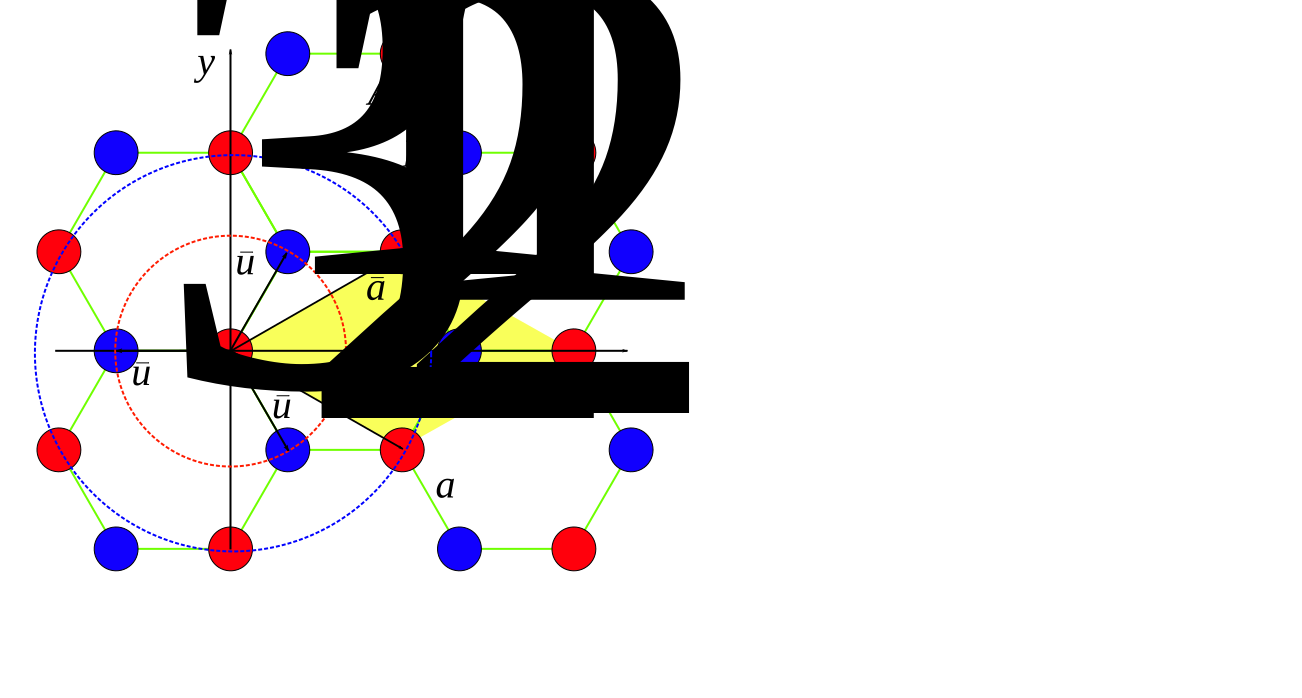
The symmetry of a graphene lattice provides a simple structural reference point. Altermagnetic order depends on the different crystal and spin symmetries described in the article.
Ququ · Image source · CC BY-SA 3.0

A magnet can have almost no overall magnetic moment and still distinguish electrons with different spin orientations. Altermagnetism turns that possibility into a symmetry question: how are oppositely ordered magnetic sublattices related to one another, and what does that relationship allow in momentum space? By October 2026, the interesting challenge is increasingly experimental precision. Researchers are testing local distortions, magnetic domains and probe selection rules, because a real crystal can depart from the ideal symmetry used to predict its behavior.
Zero net moment leaves several possibilities open
Imagine two equally populated sets of atomic moments pointing in opposite directions. Adding the arrows gives zero, but that sum discards their locations and surroundings. The crystal operation that maps one set onto the other can determine whether electronic states remain spin-degenerate or split as a function of momentum. An altermagnetic arrangement can therefore combine compensated collinear order with a directional spin splitting. Describing it only as a magnet without magnetization misses the structural information that makes the classification useful.
A measurement of almost zero total moment cannot identify that arrangement on its own. A conventional antiferromagnet, oppositely oriented domains or a mostly nonmagnetic sample could give a similar average. Researchers need evidence about the atomic magnetic order and the electronic or excitation spectrum. That evidence is especially important when tiny residual moments appear. Those moments might arise at an interface or from defects rather than from the intended bulk order, and their effect on an electrical measurement can be disproportionate to their small volume.
Clean films establish what is being compared
A study submitted on 24 October 2025 by Qihua Zhang and colleagues examines high-quality manganese telluride films grown close to ideal stoichiometry. Neutron diffraction finds antiferromagnetic order with a Néel temperature of 307 kelvin. Polarized neutron reflectometry finds a very small net moment that may be associated with the interface. Photoemission near the high-symmetry nodal plane is consistent with the weak splitting expected there. This is a characterization baseline, not a claim that every momentum direction should exhibit a large splitting.
The nodal-plane qualification is essential. A direction-dependent signal can vanish precisely where symmetry requires it to vanish. Measuring only that direction and declaring the effect absent would be as misleading as measuring only its strongest direction and assuming it is uniform. Crystal orientation, photon geometry and domain population must be recorded alongside the spectrum. The film-growth work matters because it reduces uncertainty about whether an unexpected signal comes from the targeted magnetic state or from chemical inhomogeneity and structural imperfections.
The atomic lattice is not always the ideal lattice
A preprint submitted on 26 May 2026 and revised two days later reports atomic-scale observations in MnTe using scanning transmission electron microscopy and electron magnetic chiral dichroism. Guodong Ren and colleagues find polar distortions together with magnetic order and argue that local symmetry is lower than the ideal uniform description. Their analysis allows additional angular components of spin splitting and, in sufficiently lowered symmetry, a component associated with net magnetization. The report is a preprint; its local structural interpretation should not be flattened into the claim that all MnTe has one revised magnetic structure.
This distinction between an average crystal and a local environment is familiar across materials physics. Diffraction can describe the dominant repeating lattice while an interface, defect or polar displacement changes a small region. An electron crossing that region encounters the local symmetry, not an ideal drawing averaged over an entire wafer. For a future device, such departures may become useful controls. Before calling them controls, however, researchers must establish that the distortions can be deliberately created, spatially located and reversibly changed without uncontrolled changes in composition.
A magnon can become harder to see without disappearing
A second 2026 preprint, submitted on 9 July, studies the spin-wave spectrum of MnTe under an in-plane magnetic field. Tobias Weber and colleagues combine inelastic neutron scattering with linear spin-wave theory. They report that rotating the Néel vector strongly changes measured spectral intensity while leaving the magnon energies and linewidths essentially unchanged over the studied regime. The field is sufficient to overcome weak orientational anisotropy while remaining small compared with the dominant exchange scale. The result separates the orientation of the ordered spins from the stronger interactions setting their collective oscillation frequencies.
A useful analogy is observing a vibrating string from different directions. A component of its motion can become difficult to see even though the string continues vibrating at the same frequency. Neutron scattering has its own momentum and polarization projections, so the analogy is incomplete, but the interpretive lesson carries over: lower intensity need not mean weaker order, fewer excitations or shorter coherence. Tracking peak position, width and integrated intensity separately prevents a geometrical selection effect from being mistaken for a dramatic change in the underlying dynamics.
A materials library still needs experimental sorting
A first-principles study submitted on 5 January 2026 extends the search to magnetically intercalated transition-metal dichalcogenides. Ezra Day-Roberts and colleagues identify symmetry conditions and candidate compounds with calculated spin splittings reaching about 100 millielectronvolts at the Fermi level. Intercalation inserts magnetic atoms into the layered host. These calculations offer a way to prioritize synthesis and spectroscopy; they do not demonstrate that every predicted ordering pattern is stable, chemically accessible or switchable in a fabricated sample.
A candidate must pass several separate tests. Its atoms must occupy the intended sites, its magnetic order must match the symmetry assumption, and its relevant electronic states must lie where an electrical current can access them. A large predicted splitting away from the chemical potential may be less useful for transport than a smaller, well-controlled effect at the states that actually conduct. Temperature stability and interface compatibility add further constraints. Those practical questions are part of the physics because they determine which microscopic properties survive when two materials are joined.
A directional signal can cancel in an average
As a mathematical illustration, imagine a spin splitting that varies like the cosine of twice an in-plane angle. It is positive along one axis, negative along the perpendicular axis and zero along diagonal directions. Averaging uniformly around the circle gives zero even though most directions have a nonzero splitting. This toy angular pattern is not a complete electronic model of MnTe and does not calculate its magnetization. It simply separates a direction-resolved quantity from its angular average, two things a broad statement about spin splitting can easily conflate.
Real experiments add band occupancy, momentum resolution and multiple domains to that elementary picture. If two domains rotate the angular pattern relative to one another, a measurement with a large beam can suppress contrasts visible to a local probe. Mapping enough momentum directions and documenting the illuminated region therefore matters as much as quoting the largest observed splitting. A null result is informative only when the expected symmetry and the measurement’s sensitivity are specified together.
What a convincing control experiment would show
For a controlled spintronic element, the next persuasive result would connect a deliberately chosen perturbation to both a verified order parameter and a measurable electrical output. Repeated switching would need to preserve the magnetic state, avoid chemical drift and separate heating from the intended response. Measurements on different domain populations could establish whether the output averages away or remains robust. A local structural probe could then test whether the same region responsible for the current response actually has the predicted symmetry.
The 2026 developments make this field more interesting precisely by making the ideal picture less automatic. Compensation, directional splitting, polar distortions and magnon visibility are related but distinct observations. Keeping them distinct allows experiments to disagree productively: a small residual moment or a disappearing spectral peak can become a clue instead of a contradiction. The current evidence supports a richer program of symmetry-resolved materials research. Claims of lower-power computing or universally superior memory require operating devices and quantitative comparisons that these characterization studies do not themselves provide.
Sources & further reading
Primary papers, project documentation, and research releases used in this article. Publication dates below refer to the sources themselves.
- Examining the Spin Structure of Altermagnetic Candidate MnTe Grown with Near Ideal StoichiometryarXivPublished Checked
- Atomic-Scale Observation of Symmetry Breaking in Altermagnetic MnTearXivPublished Checked
- Magnetic Field Control of the Néel Vector and Magnon Visibility in Altermagnetic MnTearXivPublished Checked
- An altermagnetic materials library in intercalated transition-metal dichalcogenidesarXivPublished Checked
FOLLOW THE QUESTION
Explore physics