PHYSICS
NICER’s 2026 Radius Results and the Problem of Seeing a Neutron Star
A September 2026 NICER analysis links pulsar hot spots to dense matter, showing why emission geometry and background modeling shape neutron-star radii.
Research checked
Newest cited publication
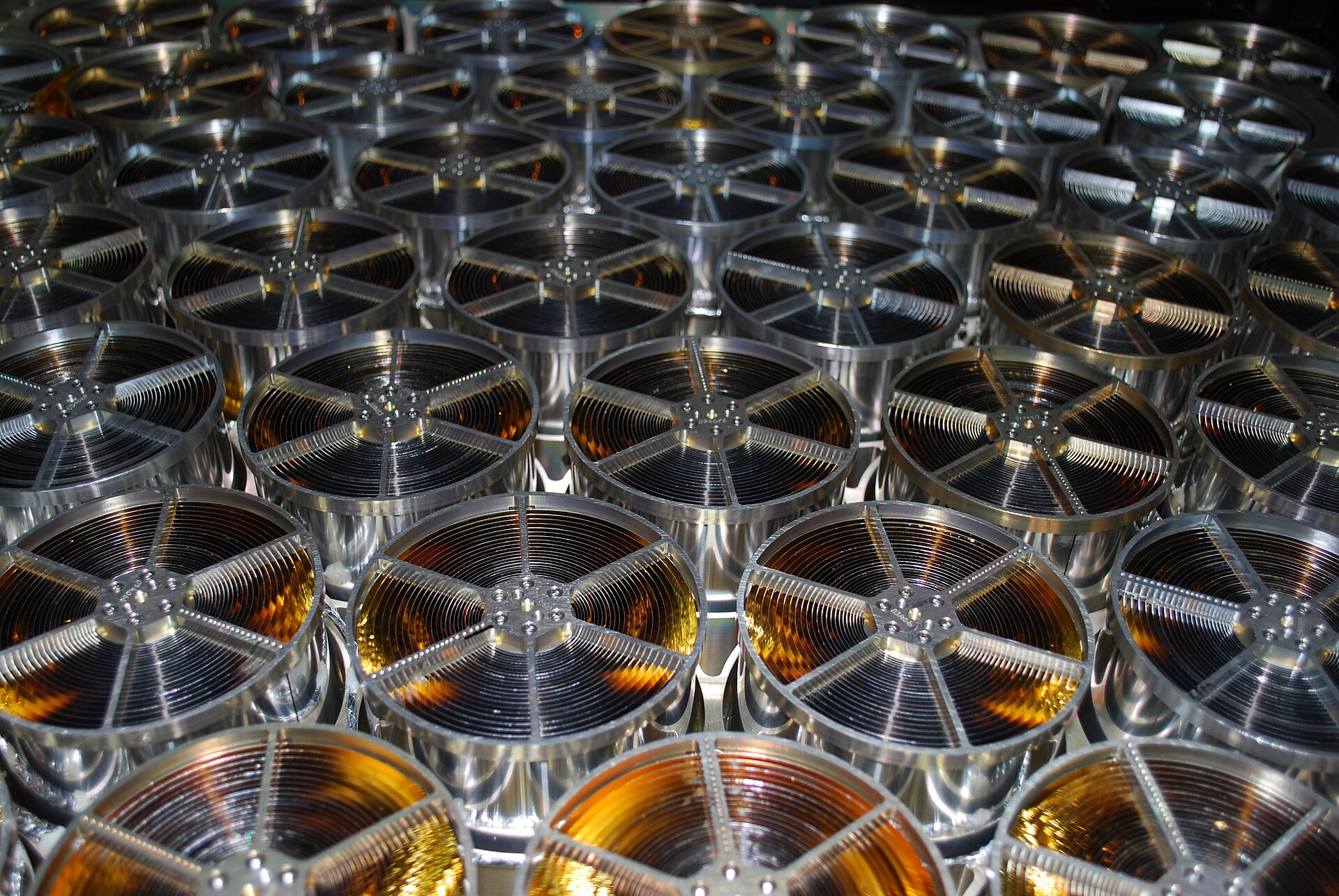
NICER’s 56 X-ray concentrator optics illustrate the instrument behind the neutron-star observations; radius estimates also depend on the pulse-shape and hotspot models discussed in the article.
NASA/Goddard/Keith Gendreau · Image source · Public domain

A neutron star's radius is a bridge between an astronomical observation and the behavior of matter beyond ordinary nuclear density. But NICER does not resolve a neutron star's edge as a visible disk. It records X-ray photons whose energies and arrival phases encode a rotating brightness pattern. On September 1, 2026, a new analysis of PSR J0614-3329 reported a radius range conditional on a three-hot-spot model. Together with recent work on other pulsars, it highlights a central question for precision astronomy: when a measurement comes through an elaborate physical model, which parts of the conclusion are demanded by the photons, and which depend on assumptions about what produced them?
A radius is inferred from a rotating light curve
NICER, the Neutron star Interior Composition Explorer, uses the changing X-ray brightness of a rotating pulsar to infer its properties. A heated region moves into and out of view, but strong gravity bends the paths of photons, allowing radiation from parts of the star that would otherwise be hidden. Relativistic rotation also alters observed energies and brightness. A pulse profile is therefore sensitive to the star's compactness, surface geometry, viewing angle, emission pattern, and rotation, all filtered through the detector response.
One simplified calculation shows the gravitational scale involved. For a hypothetical nonrotating star with 1.4 solar masses and a radius of 12 kilometers, GM divided by Rc squared is about 0.172. The corresponding Schwarzschild surface redshift is about 0.235. These are illustrative values, not fitted parameters for the September pulsar result. They mean that strong-gravity effects are large enough to carry measurable information about mass and radius. They also explain why an ordinary lighthouse analogy is incomplete: gravity changes both which emitting regions are visible and the energy of the light received, so brightness variations must be modeled as relativistic radiation rather than a rotating flat spotlight.
What the September 2026 paper reports
The September 1 preprint by M. Coleman Miller and collaborators studies the 318-hertz pulsar PSR J0614-3329, whose radio information places its mass near 1.4–1.5 solar masses. Its preferred model among those explored has three circular thermal hot spots. The reported symmetric 68-percent credible interval for the equatorial circumferential radius is 9.88–12.77 kilometers. At the October 18 research cutoff, the arXiv record describes this work as submitted to The Astrophysical Journal. It should therefore be discussed as a preprint, rather than automatically assigned the status of a completed journal publication.
The radius term also deserves care. Circumferential radius is defined from the circumference around the equator divided by two pi, rather than from an imagined Euclidean ruler laid through curved space. For a spinning star, the equator and pole need not have identical geometry. A statement about an equatorial radius should retain that definition when compared with another analysis. Likewise, the credible interval describes uncertainty within the specified inferential setup. It is not a guarantee that changing the surface-emission model, instrument treatment, or prior information would leave the interval identical.
An earlier measurement provides a comparison, not a contradiction
A separate PSR J0614-3329 study, first posted on June 17, 2025 and published in December 2025, combined NICER and XMM-Newton observations. Its preferred analysis found a radius of 10.29 kilometers with a 68-percent interval extending from 9.43 to 11.30 kilometers. That work explored non-antipodal emitting regions and used radio timing information to constrain mass. The newer preprint's interval overlaps this earlier interval. Quoting only their central values would throw away precisely the uncertainty needed to interpret the comparison.
Overlap alone is not a complete consistency test either. The analyses share a source and some observations, so they are not two fully independent experiments. Different model families can also put different probability weight inside an overlapping range. A sound comparison examines which photons were included, how background was estimated, how surface regions were parameterized, and how inference convergence was established. It may be useful to reanalyze both pipelines on a common data set with intentionally matched assumptions. That is an author-proposed diagnostic, not a claim that such a controlled comparison has already resolved every difference. Agreement across model families is evidence worth cultivating; it should be measured rather than presumed.
Another pulsar shows why an omitted component matters
Recent work on PSR J0437-4715 makes the emission-model issue concrete. A paper first posted on December 9, 2025 and subsequently appearing in The Astrophysical Journal Letters in 2026 included a modulated nonthermal component alongside thermal spots. The authors reported improved model evidence and cautioned that leaving this component out could bias radius inference. Its headline model gave a 68-percent radius interval of 11.8–15.1 kilometers. This is a different pulsar, so its radius interval should not be treated as a second measurement of PSR J0614-3329.
The general failure mode resembles fitting two musical instruments with a model containing only one. The fitter may alter the allowed instrument's parameters to absorb sound produced by the missing instrument. In a pulsar analysis, the adjustment can occur through spot size, temperature, geometry, or compactness, because those quantities all affect the observed signal. More data can make the wrong model fit more precisely while leaving it wrong. A physically plausible extra component must still earn its place through predictive checks and model comparison; unlimited flexibility can absorb noise. The purpose of testing alternatives is to identify which radius information survives a realistic account of the radiation.
How radius information reaches the equation of state
An equation of state specifies how pressure responds to energy density and composition. Given one such relation, relativistic stellar-structure equations predict which masses and radii are possible for stable stars. Observations work in the opposite direction: they constrain the allowed mass–radius combinations and therefore narrow the space of candidate pressure relations. A single pulsar does not directly identify the particles in its core, because different microscopic models can produce similar macroscopic stars over a limited mass range.
For scale, the hypothetical 1.4-solar-mass, 12-kilometer star used earlier has an average density of about 3.8 times ten to the seventeenth kilograms per cubic meter. That estimate follows from mass divided by the volume of a sphere and deliberately ignores rotational deformation. It is not the central density, which depends on the stellar solution. The distinction explains why measuring a radius does not amount to measuring one pressure at one known core density. Combining pulsars of different masses, independent mass constraints, and gravitational-wave tidal information can probe different parts of the relation. The inference should carry forward the full measurement uncertainty, rather than selecting a favorite radius and treating the rest of the distribution as unphysical.
Background treatment is part of the physical conclusion
The September 2026 study also reports difficulty when jointly fitting NICER and XMM-Newton data under a standard assumption about the XMM-Newton background: its best combined models systematically underpredict those observations. That is a consequential modeling diagnostic, not a direct discovery of an exotic core state. An instrument's background affects how much of the measured flux is assigned to the star. A phase-independent contribution can also change the inferred fraction of radiation that varies with rotation, which in turn affects the geometry and compactness interpretation.
NASA's mission page records an August 2026 update that NICER science observations remained suspended after a pointing-actuator anomaly first noted in June 2025. New analysis papers can still emerge from existing observations; their dates should not be mistaken for proof of newly collected photons. The immediate scientific opportunity is careful comparison of archived data, background treatments, emission models, and independently determined stellar properties. A compelling dense-matter conclusion would persist across those checks and sharpen when new independent information is included. NICER's recent results show why radius measurement is both powerful and demanding: the path from photon timestamps to nuclear physics runs through a model that must remain visible, testable, and open to improvement.
Sources & further reading
Primary papers, project documentation, and research releases used in this article. Publication dates below refer to the sources themselves.
- The Radius of the Neutron Star PSR J0614-3329 from NICER DataarXiv; M. C. Miller and collaboratorsPublished Checked
- A NICER view of the 1.4 solar-mass edge-on pulsar PSR J0614-3329arXiv; Lucien Mauviard and collaboratorsPublished Checked
- The Radius of PSR J0437-4715 from NICER DataarXiv; M. C. Miller and collaboratorsPublished Checked
- The Neutron Star Interior Composition Explorer MissionNASA HEASARCChecked
FOLLOW THE QUESTION
Explore physics