PHYSICS
NIF’s 8.6-Megajoule Shot: The Physics Between Ignition and Useful Energy
LLNL’s 2026 account of its April 2025 NIF shot explains how cleaner implosions support alpha heating, while target gain and net electrical gain remain distinct.
Research checked
Newest cited publication
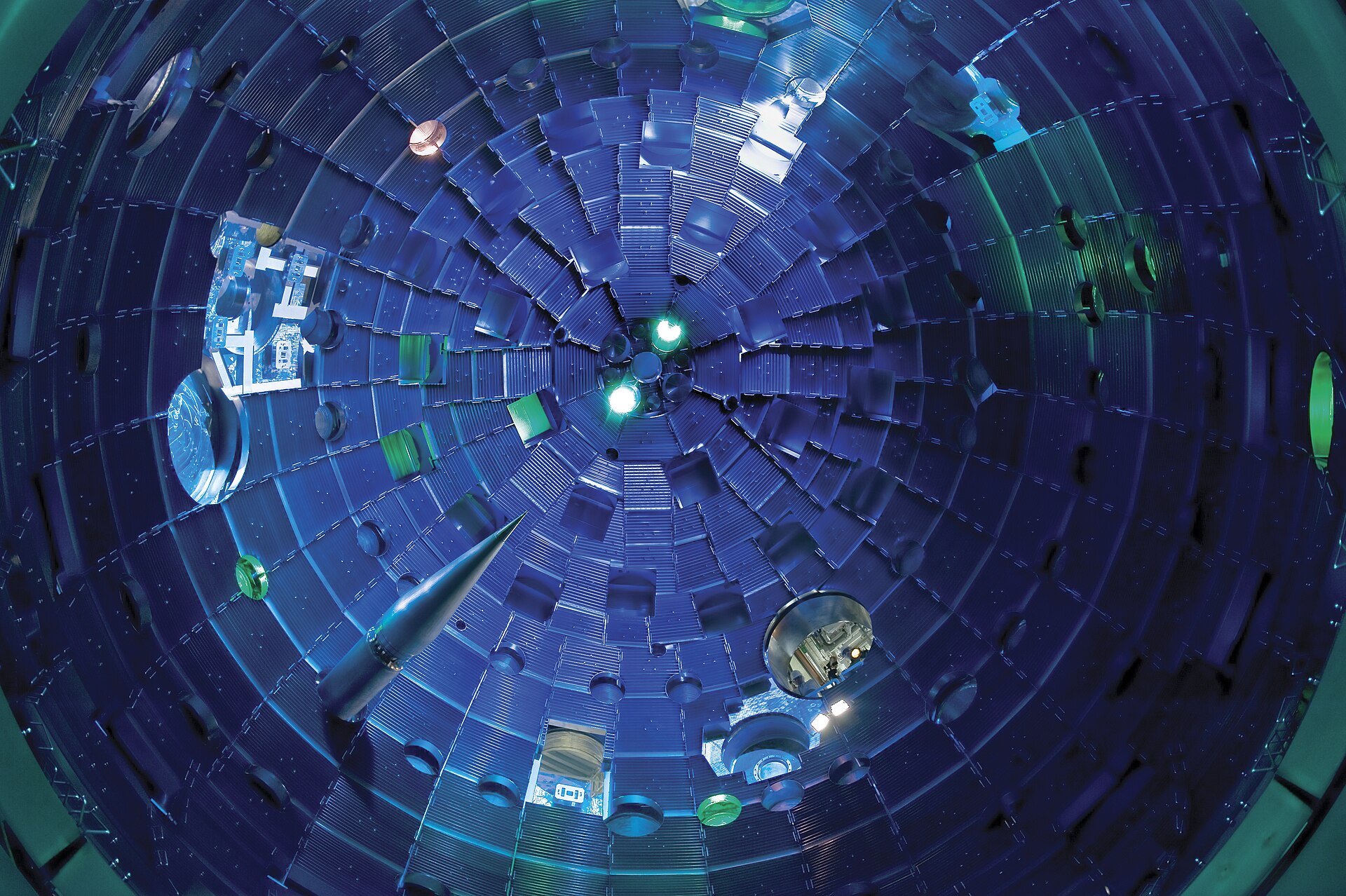
The National Ignition Facility’s target chamber provides experimental context for laser-driven inertial confinement. Target gain and alpha heating require the measurements explained in the article.
Lawrence Livermore National Security · Image source · CC BY-SA 3.0

The number 8.6 megajoules marks a real experimental achievement, but its denominator matters. Lawrence Livermore National Laboratory’s National Ignition Facility produced that fusion yield on April 7, 2025 using 2.08 megajoules of laser energy delivered to the target. An April 15, 2026 laboratory account explains a target-design improvement that helped the implosion perform better. The scientific story concerns compression, unwanted mixing, and the feedback by which fusion reactions heat more fuel. It is also a lesson in energy accounting: a successful target can amplify the laser energy it receives while the wider facility still falls far short of generating electricity.
Identify the experiment before interpreting the gain
The laboratory’s ignition overview lists an 8.6-megajoule yield with measurement uncertainty of ±0.45 megajoules for the April 7, 2025 shot. Dividing the central yield by the 2.08-megajoule laser input gives a target gain of approximately 4.13. The April 2026 account discusses the role of continuously graded tungsten doping in a high-density-carbon capsule. It reports a material improvement intended to reduce the mixing of capsule material into the fuel.
Those dates should remain visible. The experiment occurred in 2025; the explanatory laboratory article appeared in 2026. A later account does not turn the measurement into a new 2026 yield record. It can still provide new scientific context for interpreting an existing result. Here the useful context is that the capsule must perform several competing tasks: absorb a radiation drive, accelerate inward, avoid excessive fuel preheating, and keep material interfaces sufficiently clean for compression to produce the conditions needed for strong fusion burn.
Why an implosion can confine a plasma briefly
NIF uses indirect-drive inertial confinement fusion. Laser beams heat the interior of a small surrounding enclosure, the hohlraum, which produces an x-ray radiation field. The radiation drives material away from the capsule surface. The reaction to that outward flow pushes the remaining capsule inward, compressing the fuel. Inertia supplies a brief opportunity for reactions before the compressed assembly expands and loses its favorable conditions.
A familiar pressure vessel maintains confinement with a durable wall. An imploding capsule instead creates confinement through motion and a carefully timed pressure history. This changes the central optimization problem. The fuel must reach suitable conditions before the inward motion stagnates, and its energy must remain concentrated long enough for self-heating to grow. More energy delivered at an unhelpful time can produce a worse trajectory. An independent mechanical analogy is stopping a moving mass: the same total impulse can produce different motion if it arrives early, late, or asymmetrically. A successful implosion therefore depends on timing and shape as well as on integrated energy.
Ignition is a competition between heating and losses
The laboratory explains ignition through alpha heating. Deuterium and tritium fusion produces a helium nucleus, called an alpha particle, and a neutron. Alpha particles can deposit energy in the dense fuel, increasing the rate of further reactions. The hot region also loses energy through radiation, conduction, and expansion. Strong self-heating develops when the deposition competes successfully with those losses during the brief confinement interval.
A simple feedback model clarifies the threshold without pretending to simulate NIF. Suppose a hot region generates ten arbitrary units of additional fusion heating but loses twelve over a short interval. It cools. If a change in compression or cleanliness raises the deposited heating to fifteen while losses remain twelve, its temperature can rise instead. That rise can increase the next interval’s reaction rate, creating amplification. Actual fusion reactivity, stopping, and losses have complicated temperature and density dependence. The toy arithmetic only shows why a modest change near a threshold can cause a much larger change in output than a linear efficiency picture would suggest.
A correction can create a second problem
The April 2026 target account describes an instructive tradeoff. Tungsten in the capsule helps absorb harder x rays that could preheat fuel and degrade compression. Abrupt changes in dopant concentration, however, introduce material interfaces that can promote instability and mixing. A continuous dopant gradient aims to keep the radiation benefit while reducing those abrupt density changes. The laboratory reports that the record shot was only the second ignition experiment using that target approach.
Mixing matters physically because capsule material changes the hot fuel’s composition and energy loss. It can also interfere with the clean compression that concentrates energy where fusion needs it. A useful independent analogy is insulating a vessel with a material that works thermally but creates a weak seam. Improving the insulation alone is not enough; its spatial arrangement matters too. The analogous experimental question is whether observed improvements follow the proposed instability reduction across multiple controlled shots, with other changes accounted for. High-resolution simulations provide a mechanism to test, while repeated diagnostics must establish how well that mechanism describes the real implosion.
A target gain is not a power-station balance
The target-gain calculation compares fusion output with laser light delivered to the target. It does not include the electrical energy needed to produce that light, operate supporting systems, or prepare the experiment. Nor does fusion energy immediately equal electrical energy: a hypothetical power plant would have to capture energy and convert part of it to electricity. The 2024 laboratory account of the original December 2022 ignition paper explicitly identifies its result as target gain, preserving that measurement boundary.
As a deliberately hypothetical example, suppose a future driver converted twenty percent of its electricity into target light, a target multiplied that light energy by ten, and thermal conversion returned forty percent of the fusion energy as electricity. Multiplying 0.20 by 10 by 0.40 gives 0.80: only eighty percent of the driver electricity would return, before other loads. Break-even in that simplified chain occurs at a target gain of 12.5; additional loads would raise the requirement. None of those assumed efficiencies describes NIF. The example explains why gain needs a clearly stated boundary and why an impressive target result cannot alone certify a practical energy system.
A large instantaneous power does not imply continuous supply
Energy and power answer different questions here. A megajoule is an amount of energy; a megawatt describes a rate of one megajoule per second. For an independent scale comparison, a hypothetical ten-megajoule release repeated once per minute averages one sixth of a megawatt. Repeating the same release ten times per second would average one hundred megawatts. Neither repetition rate is a claim about NIF operation.
The calculation shows why an extremely short pulse can have enormous instantaneous power and modest time-averaged output. It also shows which additional measurement a claim about sustained power would require: the demonstrated repetition history, alongside complete energy inputs and recovery. From the plasma-physics perspective, repeated pulses would have to reproduce the necessary compression and self-heating despite variations between targets. A maximum yield is therefore one coordinate of performance; the distribution of reproducible outcomes is another.
The next comparison should test a prediction
Using only the stated fusion-yield uncertainty and treating the laser input as exact for this calculation, the target-gain uncertainty is 0.45 divided by 2.08, or about 0.22. That gives approximately 4.13 ± 0.22 under this restricted propagation. Input uncertainty and correlations would need to be included for a complete result. The calculation illustrates an important habit: preserving the uncertainty does not diminish the achievement; it defines the precision with which competing explanations can be distinguished.
LLNL’s July–August 2025 discussion of future ignition separates achieved results from proposed higher-energy capabilities and predicted yields. The scientific opportunity is to make such predictions increasingly discriminating. A useful test would forecast how yield, compression, and mixing should change when the dopant profile or drive is varied, then compare those quantities with independent diagnostics. My inference is that reliable control of the self-heating threshold matters more than a single maximum yield for understanding the plasma. The April 2025 result and April 2026 explanation provide evidence that capsule-scale transport and instability physics can substantially affect burn, while leaving facility efficiency and sustained energy production as distinct problems.
Sources & further reading
Primary papers, project documentation, and research releases used in this article. Publication dates below refer to the sources themselves.
- Target Breakthrough Enabled Fusion Record at NIFLawrence Livermore National LaboratoryPublished Checked
- Achieving Fusion IgnitionLawrence Livermore National LaboratoryChecked
- The Future of IgnitionLawrence Livermore National Laboratory / Science & Technology ReviewChecked
- LLNL’s breakthrough ignition experiment highlighted in Physical Review LettersLawrence Livermore National LaboratoryPublished Checked
FOLLOW THE QUESTION
Explore physics