PHYSICS
A Majorana parity qubit is progress, but topological protection needs another test
A July 2026 preprint reports coherent parity control in short Kitaev chains. Readout, localization and scalable topological protection remain distinct tests.
Research checked
Newest cited publication
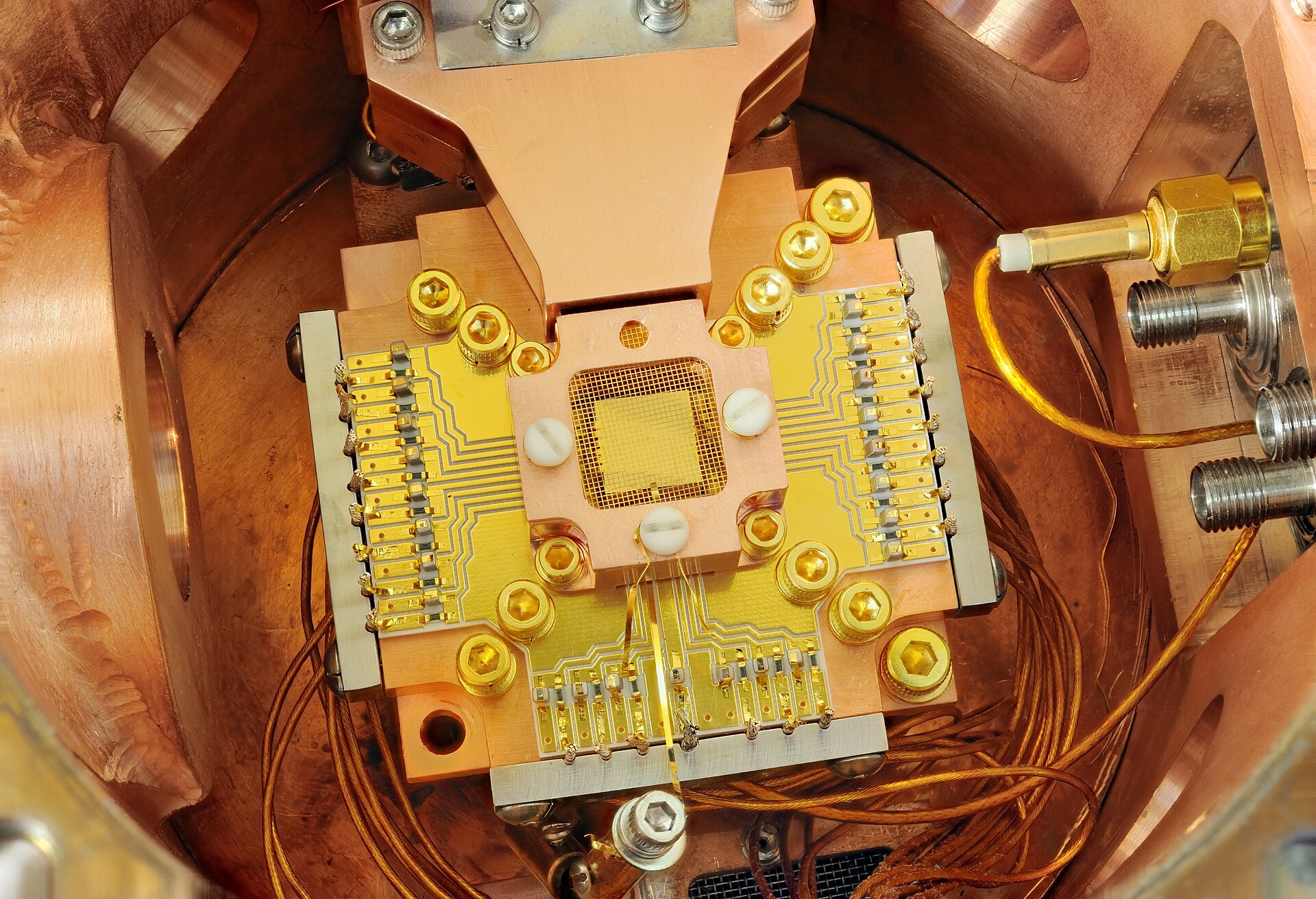
A trapped-ion apparatus illustrates precise quantum control. The semiconductor Majorana-parity device discussed in the article is a separate hardware approach.
Y. Colombe/NIST · Image source · Public domain

The word Majorana can refer to a mathematical description, a candidate excitation in a device, or an ambition for a future quantum computer. Those meanings are easily collapsed into a single announcement. A preprint submitted on 10 July 2026 makes a more specific claim: coherent control of a parity qubit formed from coupled, minimal Kitaev chains. The result belongs to a broader experimental effort that includes single-shot parity readout and tests of localization. It is worth understanding on its own terms. Controlling a short-chain qubit would be progress even before anyone establishes the exponentially improving protection promised by a long topological system.
What information does a parity qubit store?
Fermion parity records whether the number of fermionic excitations is even or odd. It does not require knowing the exact number. Ordinary arithmetic gives a useful analogy: adding two to an integer preserves its parity, while adding one flips it. In superconducting devices the physical description is richer because electron-like and hole-like contributions mix, but parity remains a meaningful label. A Majorana-based encoding aims to place relevant information in a relationship between separated parts of the system, reducing what a strictly local disturbance can learn or change.
Two separated modes do not automatically provide a freely controllable qubit. Constraints on total parity determine which states are physically connected by the available operations. Coupled chains provide multiple configurations within a fixed overall parity sector, allowing a controllable exchange of encoded population. This is one reason experiments discuss several parity manifolds rather than treating every even and odd state as interchangeable. The label used to describe a state and the operations available to manipulate it have to be considered together.
Why a minimal chain is scientifically valuable
A Kitaev chain is an idealized superconducting system whose end modes can become increasingly isolated as the chain grows. Laboratory versions built from quantum dots coupled through superconductors make the ingredients tunable. A two-site or three-site device is small enough for researchers to vary individual energies and couplings in detail. Such short systems can reproduce characteristic end-mode behavior, but their protection is limited. The familiar phrase poor man's Majoranas marks that limitation rather than certifying a miniature version of every property of a long topological wire.
A simple design exercise shows why size matters. Suppose a stored degree of freedom lives mostly at opposite ends of an object. If their wavefunctions overlap, a perturbation can couple the two ends through that overlap and shift the encoded energy. Making the object longer may reduce the coupling, provided its interior remains in the appropriate gapped phase. Merely drawing two dots farther apart does not guarantee this behavior: the intermediate material, disorder and unintended states can open additional paths for information to leak between the ends.
Readout must touch the relationship being stored
The study Single-shot parity readout of a minimal Kitaev chain appeared in Nature in February 2026, after an initial July 2025 preprint; its accepted manuscript was updated on 6 October 2026. The authors use quantum capacitance to distinguish parity in real time and report switching lifetimes exceeding a millisecond. Their complementary charge sensing tests support the distinction between a probe that couples the relevant modes and a local probe that does not resolve the same information. This is evidence about a readout primitive, rather than a demonstration of a complete protected computation.
Readout has an unavoidable tension. A storage scheme tries to conceal information from uncontrolled environmental probes, while the experimenter must deliberately expose enough information to a controlled instrument. A locked container is useful only if it can be opened reliably by its owner. The quantum version adds back-action: a measurement changes the state according to what it resolves. Good readout therefore needs more than two separated peaks on a plot. Researchers must understand assignment mistakes, disturbance, integration time and how often the parity changes before the instrument finishes collecting its signal.
What coherent parity oscillations add
The July 2026 preprint reports oscillations when two minimal chains are coherently coupled. The authors find equal oscillation frequencies in their even and odd total-parity sectors at the tuned Majorana operating point, and study how coupling and dot detuning alter the behavior. As of the research cutoff of 18 October 2026, the cited arXiv record identifies this as a preprint. Its interpretation should therefore remain attributed to the authors, rather than being promoted into independent confirmation of a general-purpose topological processor.
Oscillation is a stronger type of evidence than a static transport feature because it probes controlled dynamics. Nevertheless, oscillations alone do not uniquely reveal the microscopic identity of everything producing them. Many coupled quantum systems exchange population coherently. The persuasive case comes from several predictions agreeing at once: parameter dependence, symmetry relations, readout response and alternative-model tests. An experiment becomes more informative when researchers ask where the agreement should fail, rather than presenting only the operating point where the traces look most striking.
A local perturbation probes the encoding differently
A separate primary study, first posted on 18 April 2025 and published in Nature Communications in 2026, couples an additional quantum dot to phase-controlled few-site chains. It uses the response to that extra probe to investigate mode localization. This addresses a different question from time-domain control. A device can exhibit a reproducible oscillation yet still have an encoded energy that is overly sensitive to a local gate. Conversely, evidence that an end mode is well localized does not establish a sufficiently accurate collection of qubit gates.
An independent way to think about the distinction is to imagine evaluating a musical instrument. Producing a clear tone tests that it can oscillate; keeping the pitch stable while someone touches the case tests sensitivity to disturbance. Neither measurement replaces the other. For a qubit, the corresponding questions involve population transfer, phase evolution and noise-induced transitions. Their answers depend on which physical parameter fluctuates, how quickly it fluctuates and whether the disturbance respects or changes total parity.
The next evidence should test protection as a trend
Topological protection is a scaling claim with physical conditions. One would like to see unwanted coupling or error sensitivity diminish as the encoded components become more separated, over a meaningful parameter range and without closing the protecting energy gap. A useful benchmark would distinguish improved protection from an unusually precise single calibration. It would also report coherence alongside control speed and readout quality. A very slow, gentle operation can look stable while still exposing the state to too much accumulated noise during an actual circuit.
My inference from these papers is that the field is assembling a sequence of increasingly discriminating experiments: characterize modes, probe their locality, read parity, manipulate a state and then establish reliable protection under larger-scale operations. These steps need not all advance in the same apparatus at the same speed. Calling them separate achievements gives researchers clearer credit and readers a clearer picture. The short-chain results are interesting because they make the next questions experimentally accessible, not because they remove the need to ask them.
Parity lifetime and phase coherence should also be distinguished. A device can remain in the same parity sector while its relative phase wanders enough to ruin an interference experiment. Conversely, a clean oscillation over a short interval does not establish that parity remains stable during a much longer computation. One can illustrate the distinction with two clocks that keep running but gradually lose synchronization: neither clock has stopped, yet their relative timing is no longer useful. The corresponding laboratory measurements need different pulse sequences and analysis. Reporting a parity-switching lifetime beside a coherence time is therefore more informative than choosing whichever duration happens to be longer and calling it the qubit lifetime.
Sources & further reading
Primary papers, project documentation, and research releases used in this article. Publication dates below refer to the sources themselves.
- Majorana parity qubit in coupled minimal Kitaev chainsarXivPublished Checked
- Single-shot parity readout of a minimal Kitaev chainarXivPublished Checked
- Probing Majorana localization of a phase-controlled three-site Kitaev chain with an additional quantum dotarXivPublished Checked
- Unpaired Majorana fermions in quantum wiresarXivPublished Checked
FOLLOW THE QUESTION
Explore physics