PHYSICS
Molecular coherence turns internal complexity into a control resource
A 2026 polyatomic-coherence result joins molecular-tweezer advances in entanglement and multilevel control, revealing why rich internal structure needs careful traps.
Research checked
Newest cited publication
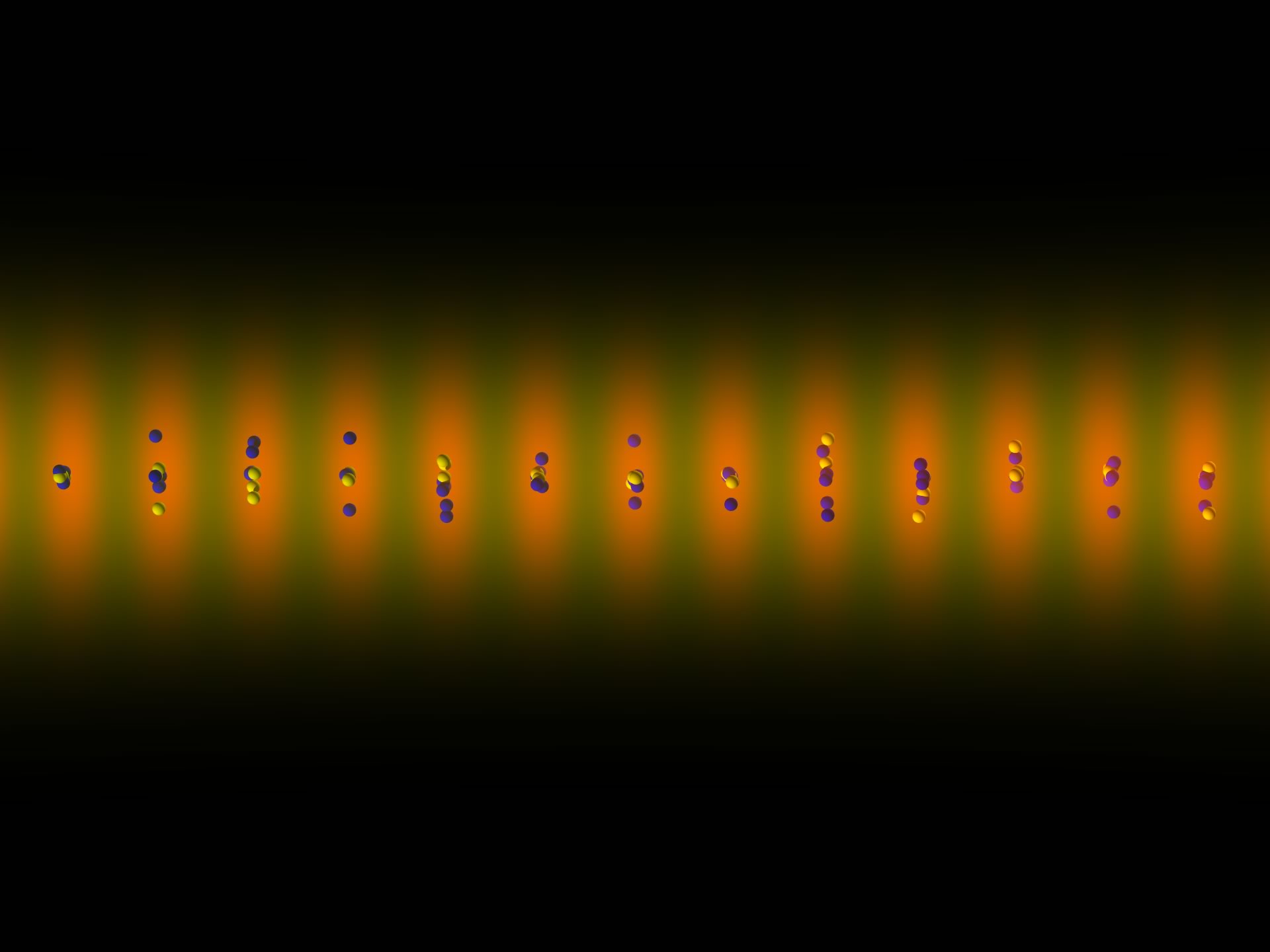
An optical-lattice visualization illustrates confinement and control of quantum particles. The molecular-coherence experiment uses the distinct optical trapping and internal-state methods described in the text.
NIST · Image source · Public domain

Molecules offer an appealing bargain for quantum experiments: more internal structure provides more ways to store and manipulate information, but it also provides more ways for the environment to spoil it. Rotations, vibrations and spin states create a large set of accessible levels. Making those levels useful requires choosing which pairs or groups remain coherent under actual laboratory conditions. A February 2026 result on optically trapped calcium hydroxide adds a new example of that engineering problem. Alongside recent molecular-tweezer entanglement and multilevel experiments, it shows that the main challenge is no longer simply holding a molecule. It is controlling which aspects of its complexity participate in a measurement and which remain quiet.
The newest example uses a bending-mode doublet
The Nature paper published on 11 February 2026 reported optically trapped CaOH molecules prepared in parity-doublet states associated with a vibrational bending mode. The measured bare coherence time was 0.8 ± 0.2 seconds. The team used molecular spectroscopy to cancel ambient electric fields and characterised parity-dependent trapping shifts. This was a coherence experiment in optically trapped polyatomic molecules; it should not be described as a completed molecular quantum computer, or automatically equated with every single-molecule tweezer apparatus discussed below. The useful advance is a demonstrated internal-state superposition and an identified set of environmental limits.
Parity labels how a quantum state transforms when spatial coordinates are inverted. Two closely related states with opposite parity can respond differently when an electric field mixes them. That sensitivity can be helpful for precision measurements but troublesome for storage. The experimental task is therefore conditional: suppress the fields that create unwanted relative-phase drift while retaining access to deliberate control. This is a broader lesson about quantum hardware. A property that makes a sensor responsive can make a memory fragile. The same molecule may be useful in both roles, provided the state encoding and operating conditions are chosen to match the question being asked.
The light that holds a molecule also shifts its levels
An optical tweezer confines a particle using the interaction between its induced electric response and a tightly focused light field. Different internal states generally have different responses. If the trapping intensity changes, their energies can shift by different amounts, altering the frequency of the transition between them. A molecule moving inside a trap samples intensity variations even when the laser’s average power is stable. This is why strong confinement does not automatically produce good coherence: holding position tightly and preserving an internal phase are related but separate design tasks.
The magic-wavelength study published in Nature on 15 January 2025 engineered tweezers for rubidium–caesium molecules so that the relevant rotational states had nearly matching light shifts. It reported long-lived two-molecule entanglement and carefully distinguished the directly measured Bell-state fidelity from a larger value obtained after correcting detectable leakage errors. That distinction is central. A correction can diagnose how well the desired subspace behaves, but it does not erase losses from an operating device. Magic here means a favourable differential response for selected states and conditions, not universal insensitivity to every perturbation or unlimited coherence for every level in the molecule.
A small frequency error can erase an ensemble fringe
A simple Ramsey experiment illustrates the problem. The first pulse prepares a superposition of two internal states. During a waiting interval, their relative phase advances at the transition frequency. A second pulse converts that phase into a population difference that can be measured. If each repetition has an unrecorded frequency offset, the experiment averages over different phases and the fringe contrast shrinks. An illustrative offset of one hertz accumulates a full extra cycle in one second. A tenth of a hertz accumulates about 0.63 radians in the same interval. These values are elementary examples, not measured noise numbers for the cited experiments.
This reasoning also clarifies the meaning of a coherence time. A fitted contrast-decay time summarises a specified sequence and noise environment. Adding a refocusing pulse can suppress slowly varying detuning, producing a different time from a bare Ramsey sequence. Discarding shots where a molecule is lost changes which ensemble is being described. Neither practice is inherently wrong, but comparisons need the definitions. A reader should ask whether the reported coherence is unrefocused, whether survival is included, and what fit was used. That information determines whether a long time supports a proposed gate sequence, a memory interval or a particular measurement protocol.
Interactions must be controlled as well as preserved
The molecular iSWAP experiment appeared online on 13 November 2024 and in a January 2025 Nature issue. It used individually trapped sodium–caesium molecules and their dipolar interactions, reporting a Bell-state fidelity of 94 ± 3 percent in trials where both molecules were present. The authors also toggled interactions by transferring population between internal states and measured a logical truth table for an iSWAP gate. The publication date matters: this is an important recent foundation, not a newly announced 2026 gate. Its postselection condition matters just as much when interpreting the fidelity.
For a basic interaction model, consider two particles that can exchange a single internal excitation. The states with the excitation on the left and on the right mix coherently. At one interaction duration, the excitation is shared; at another, it has moved across. An iSWAP operation attaches a specific quantum phase to that exchange. This is more than an ordinary probability of hopping because later pulses can make the two pathways interfere. The gate must therefore control timing, separation, internal-state preparation and phase. Molecular motion can disturb the coupling strength, so cooling and position control are not merely conveniences added before the logic begins; they help determine whether the logic is repeatable.
Three rotational states open a different kind of control
A Nature Communications paper published on 4 August 2025 extended coherent control beyond a selected pair of levels. Using molecules in near-magic optical tweezers, the authors demonstrated second-scale spin-1 dynamics encoded in three rotational states and performed multiparameter estimation. Their prediction that similar coherence could be extended across ten rotational states was an outlook based on further improvements, not a ten-state experimental demonstration. This distinction makes the three-state result more informative: it identifies a demonstrated starting point and a specific path that still needs to be tested.
A three-level object cannot be treated simply as a two-level bit with an extra unused label. It has more possible populations, relative phases and unwanted couplings. Two independent relative phases are needed to describe a coherent superposition of three occupied levels after removing the overall phase. That added structure can represent a spin-1 model or provide several connected sites in a synthetic dimension, where internal states play the role of positions in an engineered network. The benefit comes with calibration work. A trap favourable to one transition may shift another differently, and a pulse intended for one link may affect a neighbouring one. Richer hardware becomes useful when these relationships are measured rather than assumed.
A useful molecular array needs an error budget
Putting the results together suggests several independent axes of progress. Polyatomic parity states expand the available encodings. Magic trapping suppresses specific shifts. Dipolar gates demonstrate controlled interactions. Multilevel experiments show that internal complexity can be used deliberately. None of these alone settles how a large array will operate after preparation errors, loss, cross-talk and repeated measurements are included. The scientific opportunity is that the mechanisms are increasingly concrete enough to be compared and improved separately, rather than hidden behind a single headline number of trapped particles.
The next convincing demonstrations should report both the quality of surviving states and the probability that the full sequence succeeds. They should track coherence while neighbours are driven, verify whether interaction strengths remain stable after rearrangement, and distinguish storage errors from gate errors. Those are proposed evaluation criteria rather than claims about completed tests in every cited paper. Molecular quantum science is interesting precisely because it does not reduce to making a complicated atom. It allows an experimenter to choose among rotations, vibrations and symmetries as functional resources. The recent results show that those choices can work, while making clear how much careful environmental and control engineering each choice requires.
Sources & further reading
Primary papers, project documentation, and research releases used in this article. Publication dates below refer to the sources themselves.
- Parity-doublet coherence times in optically trapped polyatomic moleculesNaturePublished Checked
- Long-lived entanglement of molecules in magic-wavelength optical tweezersNaturePublished Checked
- Entanglement and iSWAP gate between molecular qubitsNaturePublished Checked
- Long-lived multilevel coherences and spin-1 dynamics encoded in the rotational states of ultracold moleculesNature CommunicationsPublished Checked
FOLLOW THE QUESTION
Explore physics