PHYSICS
Magic-state distillation moves from a circuit diagram to an experiment
A 2025 logical-state distillation experiment and 2026 noise analyses reveal why universal quantum computation needs resource quality, yield and honest assumptions.
Research checked
Newest cited publication
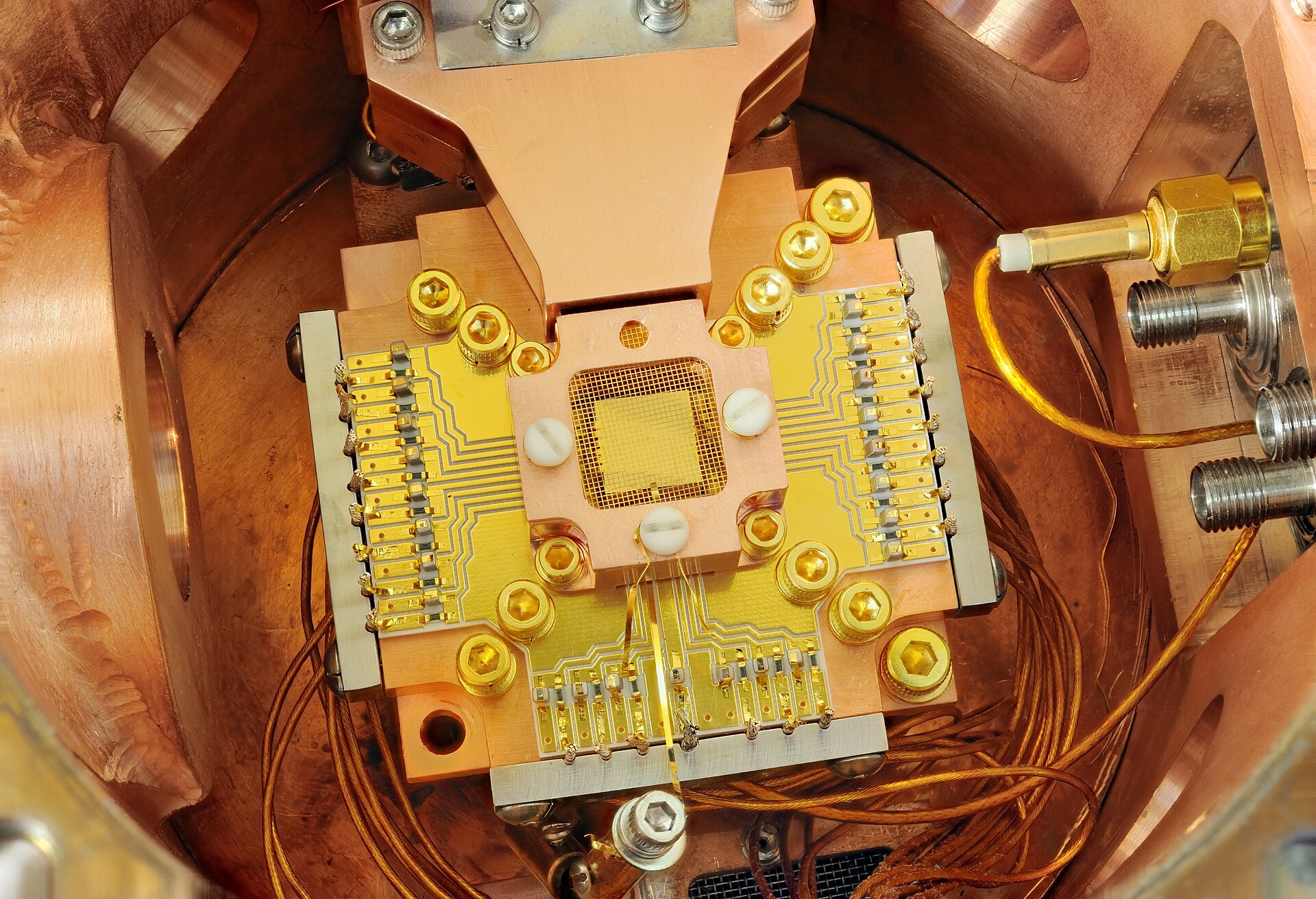
A trapped-ion apparatus provides experimental quantum-computing context; the distillation protocol and the exact platform used for its demonstration are identified in the text.
Y. Colombe/NIST · Image source · Public domain

A quantum computer can protect a state and still lack the ingredients needed for a useful universal calculation. Some operations are comparatively natural within an error-correcting code, while others require specially prepared resources. These resources are called magic states. An experiment published in Nature on 14 July 2025 distilled better logical magic states from lower-quality inputs using neutral atoms. Two 2026 theoretical studies sharpen the practical question that follows: how much does the improvement cost when the measurements and physical noise are themselves imperfect? The answer concerns factories, rejection rates and assumptions as much as it concerns a single high-fidelity state.
The missing resource is outside an easy gate family
Clifford operations form a particularly structured family of quantum gates. They are valuable for encoding, entangling and measuring many stabilizer states, yet circuits restricted to suitable Clifford operations and stabilizer inputs admit efficient classical simulation. Universal quantum computation needs additional ingredients. A magic state is a quantum state outside that restricted resource set, prepared so that consuming it through a gate-teleportation procedure supplies a desired operation. The name describes its mathematical role, not a mysterious physical substance.
A useful analogy is a workshop with reliable assembly tools but no way to manufacture a certain precision component. If the component can be supplied separately and consumed during assembly, the workshop gains a capability that its ordinary tools cannot produce alone. In the quantum case the component must arrive with controlled amplitudes and phase. An incorrectly prepared resource can inject an error directly into the logical computation. Protecting the assembly tools therefore does not remove the need to inspect and improve the special inputs.
Distillation exchanges quantity for conditional quality
A distillation protocol combines several imperfect resource states, performs a structured circuit and uses measurement outcomes to decide whether to accept an output. Under the protocol's assumptions, certain error patterns trigger rejection, while sufficiently few harmful patterns survive undetected. The accepted population can therefore have a lower error probability. This does not violate the rule against copying an unknown quantum state: the protocol consumes multiple independently supplied resources and generally keeps fewer outputs than inputs.
Consider a deliberately simplified quality-control exercise. Five components enter a process, and a test accepts a candidate output only when several consistency checks succeed. If the checks reliably catch most single-component faults, accepted outputs can be better than individual inputs. But the test may reject many batches, and correlated defects can fool it. This analogy cannot calculate a quantum protocol's fidelity; it explains why both acceptance probability and the structure of surviving errors matter. A reported output quality without yield leaves the production rate undetermined.
What the neutral-atom experiment establishes
The 2025 Nature study demonstrates distillation with magic states encoded in distance-three and distance-five color codes. The researchers use dynamically reconfigurable atom arrays to perform operations on several logical blocks in parallel and observe output logical fidelity above the input logical fidelity. The corresponding preprint first appeared in December 2024, so the experiment's journal publication in 2025 should not be described as a new 2026 hardware result. It establishes a building block of fault-tolerant computation rather than an unlimited supply of perfect states.
Encoding the inputs is significant because errors can occur during the distillation circuit itself. A physical demonstration that merely filters noisy unencoded states addresses a different resource budget from a logical implementation that must preserve code protection while manipulating the inputs. Still, increasing code distance does not by itself tell the reader the cost per useful output. That cost also includes initial preparation, ancillary blocks, repeated checks, rejected runs and any waiting needed to synchronize successful outputs with the consuming computation.
A theoretical warning about the inspection machinery
The paper Fragility of Magic State Distillation under Imperfect Measurements, published online on 22 September 2026 as peer-reviewed accepted research in npj Quantum Information, analyzes a noisy-projector model of stabilizer measurement. For the studied class of protocols, measurement strength has its own threshold, distinct from the quality threshold of the input states. The authors also find that imperfect measurements can alter the asymptotic target and degrade distillation efficiency. This is a theoretical result under specified assumptions, not evidence that every experimental factory necessarily fails.
The warning is easy to motivate independently. A manufacturing filter improves quality only if its decision mechanism is sufficiently trustworthy. When the detector overlooks a bad batch, the output error survives selection. When it mistakenly rejects a good batch, throughput falls. Quantum measurement can additionally disturb the resource in ways that are not equivalent to flipping a classical acceptance bit. The relevant measurement model therefore matters. A threshold calculated for one imperfection cannot automatically be transferred to another apparatus with a different combination of assignment error, back-action and correlated faults.
Cheap resource estimates depend on the noise being special
Unfolded distillation, published in npj Quantum Information in February 2026 after a July 2025 preprint, explores a different opportunity: qubits whose phase-flip errors greatly outnumber their bit-flip errors. Its headline modeled configuration uses 53 qubits and 5.5 error-correction rounds for an estimated output error of three in ten million, with a phase-flip probability of 0.1 percent and a noise bias of at least approximately five million. Those are resource estimates for a proposed scheme, not measured specifications of the neutral-atom experiment.
Noise bias is useful only if the circuit preserves the relevant advantage. A memory may strongly suppress one error type while a needed gate converts it into another or introduces a new fault channel. Consequently, comparing proposed factories requires the same physical assumptions and accounting conventions. Fifty-three qubits in a favorable model and hundreds in a less favorable model do not establish a universal efficiency ranking. A responsible comparison asks which gates, connections, resets and measurements the model treats as available, and whether their imperfections maintain the assumed asymmetry.
A useful factory has a rate, a cost and a failure budget
Here is an independent throughput calculation. If a hypothetical factory consumes five inputs per attempt, accepts 80 percent of attempts and delivers one output on success, its average consumption is 5 divided by 0.8, or 6.25 inputs per accepted output. If each attempt takes one millisecond with no overlap, its average delivery rate is 800 outputs per second. These invented values ignore buffers and correlated failures. They illustrate why a small change in acceptance can become a large architectural issue when an algorithm consumes many resource states.
My assessment is that the experimental and theoretical papers point toward the same practical standard: specify the output error, acceptance probability and full production cost together. A convincing larger demonstration should maintain these quantities over many runs and show that the produced states improve a subsequent logical operation. Magic-state distillation has now become a hardware question with measured outputs, while the 2026 analyses expose conditions that a factory must satisfy. Progress is best judged by how reliably the complete production-and-consumption process works, rather than by treating a single fidelity number as the whole machine.
The consuming algorithm determines how low the factory error must be. If a hypothetical circuit uses one million resource states and each has an independent harmful-error probability of one in a million, the chance that none fails is approximately the exponential of minus one, or 36.8 percent. That simple calculation ignores error cancellation, detection and correlations, but it shows why a seemingly excellent individual state can still be inadequate at scale. The correct target depends on the total algorithmic failure budget. A factory optimized for a short demonstration and one designed for a million-step calculation are solving quantitatively different problems, even when their underlying distillation circuit has the same name.
Sources & further reading
Primary papers, project documentation, and research releases used in this article. Publication dates below refer to the sources themselves.
- Experimental demonstration of logical magic state distillationNaturePublished Checked
- Fragility of Magic State Distillation under Imperfect Measurementsnpj Quantum InformationPublished Checked
- Unfolded distillation: very low-cost magic state preparation for biased-noise qubitsnpj Quantum InformationPublished Checked
- Universal Quantum Computation with ideal Clifford gates and noisy ancillasarXivPublished Checked
FOLLOW THE QUESTION
Explore physics