PHYSICS
Neutral-atom logical qubits learn to expose missing atoms
A June 2026 experiment turns detectable leakage into useful error information, showing why knowing where a quantum error occurred can change the code.
Research checked
Newest cited publication
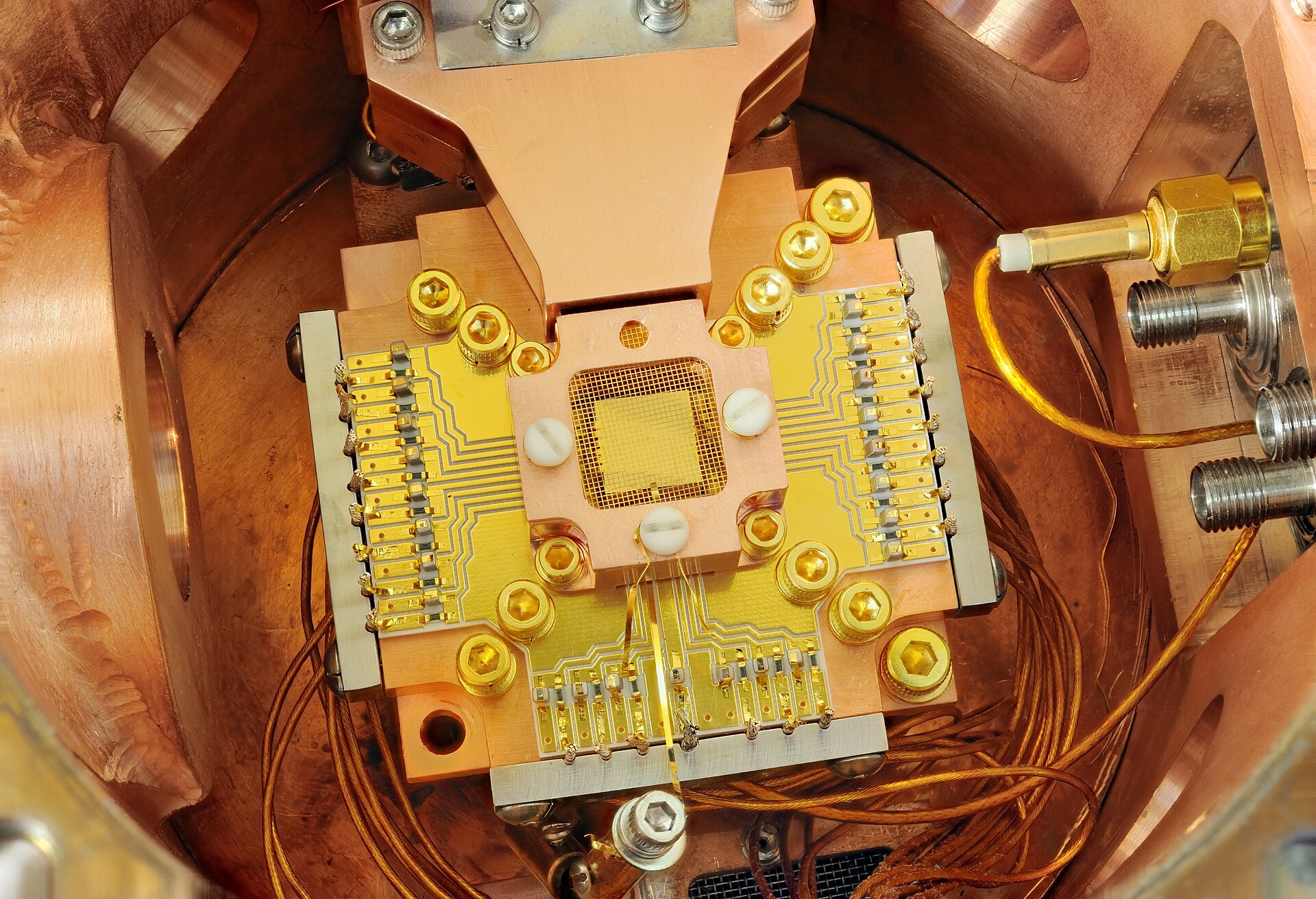
A NIST trapped-ion experiment supplies quantum-control context; the logical-qubit work discussed here instead uses neutral atoms and erasure information.
Y. Colombe/NIST · Image source · Public domain

An error message can be useful information. If a storage system knows exactly which entry went missing, reconstructing a file can be easier than discovering which apparently normal entry was silently corrupted. A quantum experiment published in Nature Physics on 12 June 2026 applies that principle to logical qubits made from metastable ytterbium atoms. The researchers demonstrate erasure-aware decoding and adaptive teleportation circuits. The important advance is not that the atoms cease making mistakes. It is that some mistakes announce their locations, giving the correction system information that an ordinary noisy qubit would withhold.
An erasure carries an address
In quantum error correction, an erasure is an error at a known location. Its precise effect may remain unknown, but its address is available. An unlocated error makes a decoder solve two problems at once: identify the affected location and infer a compatible correction. A located error removes part of that ambiguity. This distinction concerns information available to the decoder, not the emotional severity of the event. Losing an atom can be more visible, and in the right code easier to handle, than a small undetected phase rotation on an atom that remains in its trap.
A classical toy example makes the information advantage concrete. Suppose two binary data values are accompanied by their parity. If the second data value is erased and its position is flagged, the surviving value and parity determine it. If an unknown entry silently flips, the same short record may be ambiguous. Quantum codes face stronger constraints because they protect incompatible observables, so this example is not a proposed quantum code. It simply isolates the value of knowing an error's location before reconstruction starts.
Engineering errors that can be noticed
The June study encodes information in nuclear-spin states within a metastable electronic level of ytterbium-171. Some physical faults move population outside that chosen manifold. A separate check can detect that departure without resolving the logical amplitudes of every healthy qubit. The proposal behind this approach was published in August 2022; its favorable threshold estimates were simulations under a specified noise model. The 2026 experiment tests logical circuits with the physical encoding, rather than turning the older numerical forecast into a measured universal threshold.
Metastable means long lived, not eternal. The encoding creates a useful asymmetry between intended states and certain unwanted destinations. It cannot make every conceivable fault detectable. A phase error that stays inside the chosen manifold may leave no erasure flag. A missed detection can disguise an erasure, while a false alarm can discard usable information. The experimental challenge is therefore to shape a large and relevant fraction of the noise into a recognizable form while keeping the monitoring procedure gentle enough for the qubits that are still working.
Why a small code can correct a located fault
The researchers use a code labeled four, two, two: four physical data qubits encode two logical qubits with distance two. In general code language, a distance-two quantum code cannot correct an arbitrary unknown single-qubit error. It can detect such an error and can correct a single erasure when the location is known and the code conditions are satisfied. The experiment exploits precisely this distinction during decoding using mid-circuit erasure information. It does not demonstrate that the same four-qubit block corrects every possible one-qubit Pauli fault.
The distance rule can be understood as a distinguishability requirement. A code must keep different logical possibilities separated even after the allowed disturbance. For an unknown error, two competing explanations may place the fault in two different locations, increasing the ambiguity. Knowing the damaged location restricts the competing explanations. That is why the same physical redundancy can support different guarantees under different error models. Saying that a code has improved performance is incomplete unless the reader also knows what the experiment assumed about errors and which side information was available.
Feed-forward makes the flag operational
The June paper also reports logical teleportation between code blocks with ancillas selected conditionally on erasure checks. Teleportation here transfers an encoded state through entanglement, measurement and a classically tracked correction; it does not transport matter instantaneously. Conditional selection is meaningful because the apparatus changes what it does after learning which resources remain usable. This moves erasure information from a label attached after a run into a control input that affects the ongoing circuit.
An illustrative scheduling problem helps explain the benefit. Suppose a procedure can use either of two prepared helpers, and a check reveals that one has failed. Selecting the other can preserve the computation without demanding that the failed helper be repaired immediately. In a quantum machine, however, the helpers may already be entangled and each extra measurement or wait can introduce noise. A successful adaptive circuit must account for these dependencies. The existence of a spare atom alone is not sufficient; the state-transfer protocol and the decision timing must work together.
Erasure conversion is a strategy, not one device design
Earlier experimental work on cesium atoms, first posted in May 2024 and published in PRX Quantum, demonstrated circuit-based leakage detection using an ancilla. That provides a useful comparison with the metastable-ytterbium route. One approach uses a physical encoding that makes important faults optically distinguishable; another uses a circuit to map presence information onto a helper qubit. They share a goal but have different gate, measurement and disturbance budgets. Success in one apparatus does not establish the other apparatus's operating fidelity.
The shared principle suggests a productive engineering question: which errors are expensive because they happen often, and which are expensive because they are hard to identify? Improving the raw gate fidelity attacks the first problem. Improving fault visibility attacks the second. The optimal balance depends on the code and computation. Frequent checks might reveal losses quickly but consume time; infrequent checks might save time while allowing a leaked state to affect later gates. These competing costs make detection latency and false-negative rates relevant system parameters.
Repeated monitoring can amplify even a small false-alarm probability. In an illustrative model with independent checks and a false-alarm probability of one in a thousand per check, the probability of at least one false alarm after a thousand checks is 1 minus 0.999 raised to the thousandth power, approximately 63.2 percent. A practical machine need not abandon the whole calculation after every false alarm, so that number is not a prediction of failure. It explains why resource replacement and decoder behavior must be included in the model. A detector can look excellent in a single-check table while still consuming substantial spare capacity over a long circuit.
What should an erasure-aware machine demonstrate next?
A broader neutral-atom architecture study, published online in November 2025 and appearing in Nature's January 2026 volume, combines repeated correction, logical operations and qubit reuse. It shows why loss handling belongs inside an architecture rather than outside the computation. Long circuits continuously consume clean ancillary resources and must remove entropy. A machine that only prepares an impressive initial array can still run out of usable atoms or accumulate leaked population before finishing the intended workload.
My assessment is that the next convincing tests should compare equivalent logical tasks with and without the erasure information, using the full cost of checks, replacement and classical decisions. Larger-distance experiments should then ask how the logical error changes as the block grows, including events with multiple losses and unflagged faults. The June result matters because it demonstrates a real informational advantage inside logical circuits. Turning that advantage into a scalable computer requires showing that the additional knowledge remains accurate, timely and affordable while the computation continues.
Sources & further reading
Primary papers, project documentation, and research releases used in this article. Publication dates below refer to the sources themselves.
- Logical qubits with erasure conversion using metastable neutral atomsNature PhysicsPublished Checked
- Erasure conversion for fault-tolerant quantum computing in alkaline earth Rydberg atom arraysNature CommunicationsPublished Checked
- Circuit-based leakage-to-erasure conversion in a neutral atom quantum processorarXivPublished Checked
- A fault-tolerant neutral-atom architecture for universal quantum computationNational Institute of Standards and TechnologyPublished Checked
FOLLOW THE QUESTION
Explore physics