PHYSICS
Mechanical resonators bring quantum control to collective motion
Recent optomechanics separates high-purity preparation, feedback theory and transferred noise squeezing, showing what collective quantum motion really requires.
Research checked
Newest cited publication
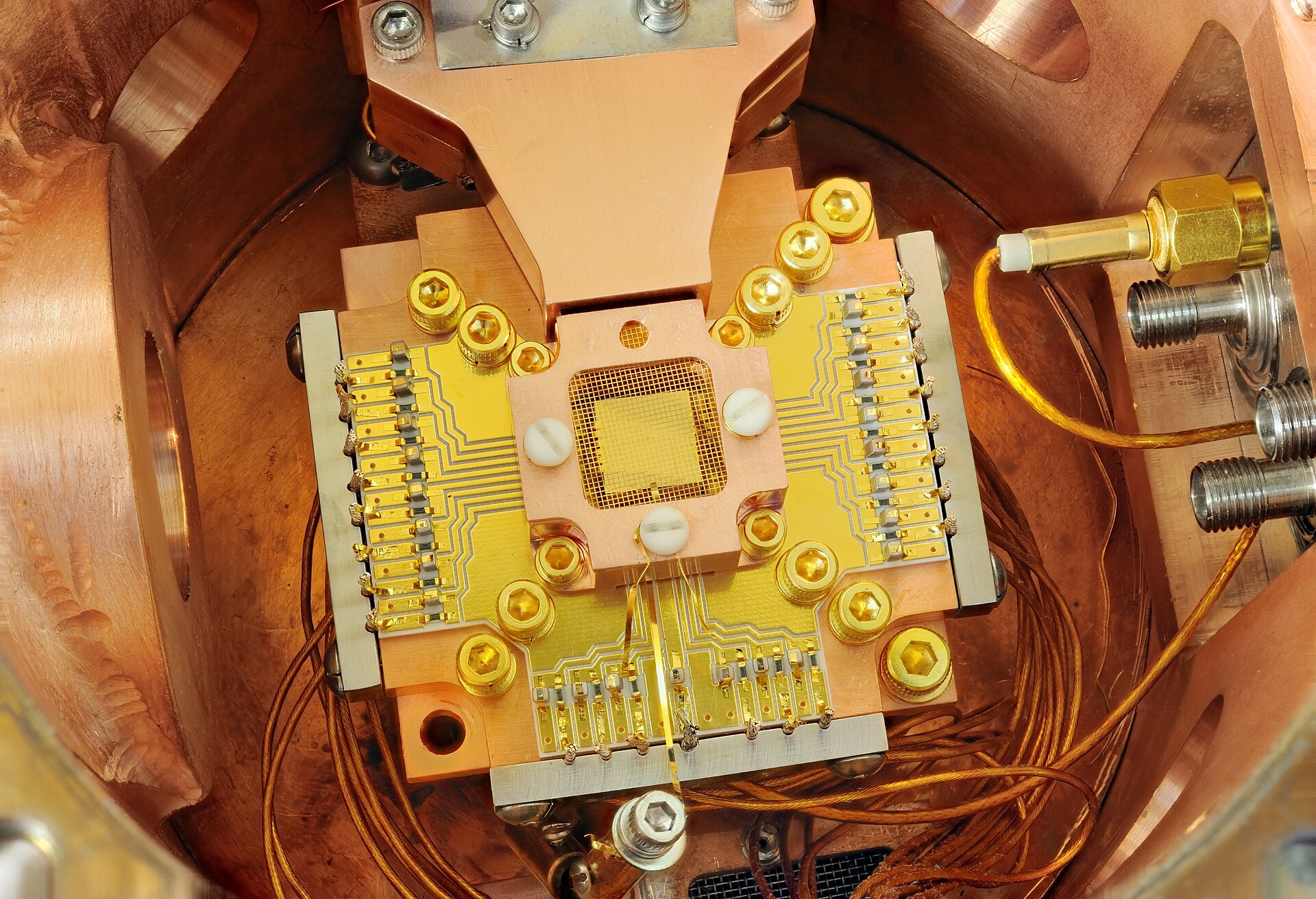
A precision quantum-control apparatus provides laboratory context; the mechanical resonator and optomechanical coupling discussed in the article belong to a different experiment.
Y. Colombe/NIST · Image source · Public domain

A mechanical object can be warm while one carefully selected motion is close to its quantum ground state. That statement sounds contradictory only if temperature is treated as a single label for every degree of freedom. Optomechanics uses light, or related electromagnetic control, to measure and influence vibrations and rotations. Recent experiments have purified a levitated particle’s angular motion, while 2026 work has examined how feedback can reshape fluctuations and how noise squeezing can be transferred between mechanical modes. These developments are connected, but they are not the same result. Following the distinctions reveals how researchers turn collective motion into a controlled quantum system without claiming that a visible object has become a cartoon version of Schrödinger’s cat.
The state belongs to a mode of motion
The Nature Physics study published on 6 August 2025 cooled a megahertz-frequency librational mode of an optically levitated silica nanoparticle using coherent scattering into an optical cavity. Sideband thermometry gave an inferred mean occupation near 0.04 quanta under optimal conditions, corresponding to about 92 percent thermal-state purity. Libration is a small angular oscillation, so the result concerns a selected rotation-like mechanical mode. It does not state that every internal vibration of the particle, or the entire laboratory, reached an extremely low temperature. The experiment operated in a room-temperature environment while actively controlling this motion.
A useful analogy is a large orchestra in which one sustained musical tone is damped without silencing every instrument. The actual physics is quantum and the damping is engineered, but the distinction between one collective coordinate and the whole object remains helpful. A normal mode describes an organised pattern involving many constituent particles. Its amplitude and conjugate momentum can be treated as oscillator variables even though the material contains many microscopic degrees of freedom. Preparing that mode well creates a resource for further operations. It does not imply that unrelated modes have been prepared identically, so every claim needs to identify which motion was measured and how it was isolated.
A mean occupation is not a purity without assumptions
For a thermal state of a single harmonic oscillator, purity is one divided by twice the mean phonon occupation plus one. Substituting 0.04 gives 1 divided by 1.08, about 0.926, consistent with a rounded 92-percent figure. This independent arithmetic helps explain the quoted relationship. A phonon is the quantum of energy in the selected mode, not a tiny material particle that can be scooped out. Lower mean occupation means fewer excitations above the ground state on average, while purity describes how concentrated the statistical quantum state is.
The thermal-state qualification is essential. Mean energy alone does not determine the purity of an arbitrary quantum state. A perfectly known excited state can be pure even though its occupation is not small; an incoherent mixture can share an energy expectation with a very different coherent state. Similarly, a squeezed state redistributes fluctuations between conjugate variables and cannot be fully described by a single temperature. Reporting a phonon number is therefore strongest when accompanied by the state model, calibration and independent checks used to infer it. The 2025 experiment is a preparation milestone, not permission to infer every possible nonclassical property from one small occupation number.
Measurement carries both information and disturbance
An earlier Nature experiment published on 14 February 2024 used an ultralow-noise cavity with an engineered membrane to demonstrate room-temperature quantum optomechanics. It observed optical squeezing and used the continuous measurement record to prepare conditional mechanical states. This provides a complementary route to the levitated-particle approach: improve the mechanical isolation and optical readout of a supported resonator, rather than removing its support. The reported conditional state depends on the information gathered during measurement, which is different from asserting that every unobserved repetition occupies the same known mechanical state.
In a continuous position measurement, weak observations gradually reduce uncertainty about the motion. But the photons that supply the information also exert fluctuating forces. Better detection means that more of the disturbance can be tracked through the measurement record; lost light leaves less information available to the observer. A conditional state is the best state estimate given that record. Averaging over all records generally produces a broader unconditional state. Feedback can act on the estimate to make the actual ensemble behave more uniformly, but it has finite delay, finite bandwidth and measurement noise. These differences are operational: they affect whether the prepared motion can be used by a later experiment that does not retain the original detector record.
The 2026 feedback result is a theoretical design tool
Mechanical squeezing via feedback control, published as accepted peer-reviewed research in npj Quantum Information on 19 August 2026, analyses continuous measurement and feedback. The authors find that feedback-induced spring softening can enhance position squeezing, while spring hardening can enable momentum squeezing in another regime. This is theoretical work about achievable state preparation under specified measurement and control conditions. It is not a new experimental photograph of a macroscopic quantum superposition. The result is useful because it identifies control choices that could relax barriers to particular kinds of nonclassical mechanical states.
A harmonic oscillator’s stiffness sets the relation between applied force and displacement. Changing that stiffness also changes the natural scales used to compare position and momentum fluctuations. A feedback force based on a noisy measurement is not equivalent to a passive spring: the force and the measurement error can be correlated. A calculation that ignores those correlations can misjudge the resulting state. This gives a practical reason to analyse the full control loop rather than list the detector resolution and actuator strength separately. In an implementation, the same analysis would have to include delays and unmodelled noise. The theoretical promise becomes an experimental claim only when those real effects are measured and the predicted variance reduction survives the calibration.
Transferred noise squeezing is a distinct demonstration
Communications Physics published an experiment on 24 April 2026 that generated mechanical noise squeezing in one mode and transferred it to another through a shared microwave cavity. Correlations between their quadratures supported the transfer interpretation. The device operated at room temperature. The article’s noise-squeezing observation should not be casually rewritten as proof of below-vacuum quantum squeezing, entanglement or a mechanical cat state. Reducing fluctuations relative to an initial thermal reference and beating the quantum ground-state variance are different thresholds. A method can be valuable for sensing while remaining on the classical side of the latter threshold.
To understand squeezing geometrically, describe an oscillator by two quadratures, analogous to its cosine and sine components. An unsqueezed noisy state has comparable uncertainty in both. A squeezed distribution narrows along one direction and generally broadens along another. Rotating the measurement phase selects which direction is observed. Transferring the narrow direction to another oscillator requires a controlled coupling and a phase relationship; simply observing two quieter traces is insufficient to identify the mechanism. Measuring cross-correlations helps test whether the target’s change originates from the control mode. A separate calibration against the appropriate quantum reference would be needed before assigning a quantum advantage to the noise ellipse.
Macroscopic scale needs a precise description
These experiments motivate careful use of the word macroscopic. A mode may involve the collective motion of many atoms while its quantum displacement scale remains extremely small. A large mass, a large separation between superposed states and a long coherence time describe different features. None follows automatically from the others. Ground-state preparation is especially useful because it reduces the uncertainty that can conceal later operations, but preparation alone is not a demonstration of spatially separated branches or a test ruling out every proposed modification of quantum mechanics.
A strong next experiment would connect preparation, manipulation and verification in one well-characterised sequence. It would state which mode was controlled, how environmental heating was measured, whether the state was conditional, what quantum benchmark was used, and how readout errors were separated from actual motion. These are evaluation criteria, not claims that all the cited platforms have completed the same programme. The latest work is compelling because different pieces are becoming independently testable: a high-purity angular mode, a feedback strategy and an experimentally transferred fluctuation resource. Together they make collective quantum mechanics an increasingly concrete control problem, with clear milestones between a quiet oscillator and a verified nonclassical mechanical state.
Sources & further reading
Primary papers, project documentation, and research releases used in this article. Publication dates below refer to the sources themselves.
- High-purity quantum optomechanics at room temperatureNature PhysicsPublished Checked
- Mechanical squeezing via feedback controlnpj Quantum InformationPublished Checked
- Simultaneous generation and transfer of mechanical noise squeezingCommunications PhysicsPublished Checked
- Room-temperature quantum optomechanics using an ultralow noise cavityNaturePublished Checked
FOLLOW THE QUESTION
Explore physics