PHYSICS
When a quantum simulator outruns a computer, who checks the answer?
Recent 2026 studies compare quantum simulation with classical resources and neutron data, while verification theory explains what an advantage claim must establish.
Research checked
Newest cited publication
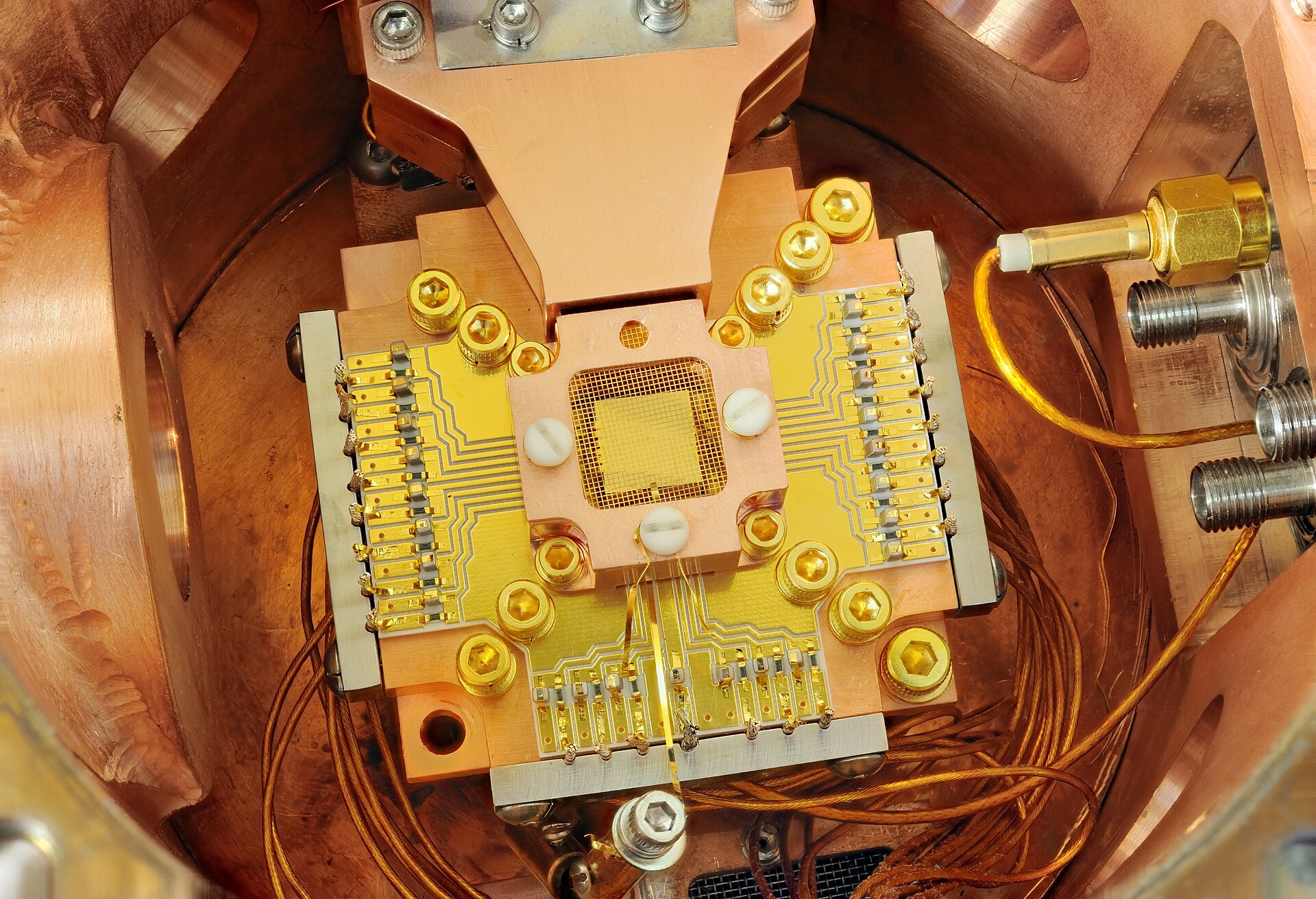
A NIST ion-trapping setup provides quantum-control context. The simulator, comparison method, and verification limits discussed in the article are specified separately.
Y. Colombe/NIST · Image source · Public domain

The most interesting quantum-simulation result is not necessarily the one with the largest device. It is the one that answers a well-posed physical question more reliably or efficiently than the alternatives, with evidence that its answer is meaningful. A July 2026 resource study of neutral-atom simulation and a March 2026 preprint comparing superconducting calculations with neutron-scattering data approach that goal from different directions. Alongside a 2025 theoretical verification protocol and a May 2026 control proposal, they reveal a central issue: when calculating the full reference answer becomes difficult, checking a quantum experiment requires more imagination than simply rerunning it on a conventional computer.
A simulator does not need to print its full state
A collection of fifty ideal qubits is described by more than a quadrillion complex amplitudes in a general pure-state representation. That mathematical size helps explain why brute-force simulation becomes expensive. It does not mean an experimenter can read out a quadrillion useful numbers in one measurement. A quantum measurement yields a limited outcome, and estimating a physical quantity normally requires repeated preparations. The scientific task must specify which observable is wanted, at what accuracy and after how much evolution, rather than equating state-space size with accessible computational output.
For example, measuring a local magnetization is different from reconstructing every amplitude. So is estimating a two-point correlation at a chosen separation. Classical methods can exploit this distinction: they may calculate the requested observable without representing the entire state exactly. A fair comparison gives each approach the same question and error tolerance. Requiring a conventional computer to solve a vastly harder reconstruction problem while asking the quantum device for one coarse average would manufacture an advantage through the benchmark definition.
Two routes to the same physical question
An analog simulator implements interactions that resemble a target Hamiltonian and lets its hardware evolve continuously. A digital simulator assembles an approximation from a sequence of gates. Neither label guarantees correctness. The analog apparatus may include unwanted couplings or drift, while the digital sequence has gate errors and approximation errors from its chosen decomposition. Both routes involve calibration, state preparation and statistical estimation. Their useful differences emerge only after those costs and inaccuracies are made explicit.
A preprint submitted on 7 May 2026 proposes universal analog quantum simulation using optimized continuous-time controls. Its numerical examples extend the dynamics accessible with a platform's native interactions. That is a control-framework proposal supported by simulations, not a reported experimental demonstration of universal analog advantage. The distinction is productive: it identifies a way to ask a fixed-interaction device more questions while leaving open whether the required controls can be calibrated and executed with adequate precision in a laboratory.
Run time and energy are separate comparisons
Resource Assessment of Classical and Quantum Hardware for Post-Quench Dynamics was published in PRX Energy on 15 July 2026. It combines experimental neutral-atom data with numerical benchmarks and fitted scaling laws for run time and energy use. The authors compare analog quantum hardware against matrix-product-state and neural-quantum-state approaches and identify regimes where the hardware is competitive. Larger-system projections remain projections: their credibility depends on the extrapolation model, target accuracy and which portions of preparation, sampling and operation enter the accounting.
Time and energy should not be conflated. A hypothetical system drawing ten kilowatts for ten seconds uses 100 kilojoules. Another drawing one kilowatt for two hundred seconds uses 200 kilojoules, despite drawing less power at each instant. Likewise, a short physical evolution is not the same as a short end-to-end calculation if preparation and repeated readout dominate the schedule. These elementary unit checks are useful safeguards when comparing a continuously evolving quantum apparatus with a classical program running on a processor cluster.
The competing algorithm is part of the benchmark
Tensor-network methods compress a quantum state by retaining the correlations that a chosen representation can support. Their cost can grow sharply when entanglement becomes difficult to compress, but that growth depends on geometry, time and the requested quantity. Other numerical approaches exploit different structures. A benchmark against one implementation therefore establishes a comparison with that implementation and its tested parameter range. It cannot prove that every possible future classical algorithm must fail at the same point.
This does not make experimental comparisons meaningless. It makes them revisable, like other performance measurements. A strong report publishes the target dynamics, observable definitions, error budgets and resource conventions so that a new classical method can be tested on the same workload. Researchers can also present a family of sizes and evolution times rather than a single favorable instance. If the crossover moves after a better classical approximation appears, that change is useful knowledge about the physical problem's structure.
Laboratory data can test the observable directly
The preprint Benchmarking quantum simulation with neutron-scattering experiments, first submitted on 16 March 2026 and revised in April, computes dynamical structure factors using a superconducting processor with up to fifty qubits. It compares simulated spectra with inelastic neutron-scattering measurements of KCuF3. The preprint status matters: the arXiv record cited here does not establish journal peer review. The comparison tests whether a quantum-classical workflow can reproduce meaningful material observables, rather than proving a general speed advantage over the best classical calculation.
A dynamical structure factor organizes how correlations depend on momentum and energy. Neutron experiments access this information by measuring how a sample exchanges energy and momentum with scattered neutrons. Matching a measured spectral feature is therefore a connection between two different experimental routes, not merely agreement between two programs. Still, a real material is not an exact copy of an ideal model: finite temperature, additional couplings, instrumental resolution and sample properties can matter. Agreement needs an uncertainty budget, and disagreement can originate in the model as well as the processor.
Verification can ask for a checkable witness
A PRX Quantum paper published on 5 March 2025 proposes an efficiently verifiable analog-advantage protocol using a Feynman-Kitaev history-state construction. The construction ties a computation's progress to an auxiliary record that can be tested through suitable measurements. Its stated verification costs depend on a security parameter and the protocol's assumptions. It is a theoretical route to verification, not evidence that ordinary large analog experiments already possess a plug-in classical certificate for every physical quantity they measure.
My inference is that useful quantum simulation will need several kinds of trust at once. Calibration checks whether the apparatus implements the intended controls; small instances provide classical comparisons; independent material measurements test physical observables; specialized protocols can supply stronger formal guarantees for suitable tasks. None answers every question alone. The strongest future advantage claims will state their workload, accuracy, resource boundary and verification method together. That combination would let a reader understand both why the result is difficult to obtain classically and why the reported quantum answer deserves to be used.
Sampling uncertainty imposes another resource bill. For independent measurements of a bounded zero-or-one outcome, estimating a probability near one half from ten thousand shots gives a standard error of about half a percentage point. Reducing that uncertainty by a factor of ten requires roughly one hundred times as many shots, before accounting for preparation drift or error-mitigation overhead. A simulation advertised at one accuracy can therefore be much cheaper than the same simulation at a tighter tolerance. This calculation is elementary rather than specific to a cited device. Its purpose is to show why benchmark accuracy must be chosen before comparing completion times, rather than adjusted afterward to favor one platform.
Sources & further reading
Primary papers, project documentation, and research releases used in this article. Publication dates below refer to the sources themselves.
- Resource Assessment of Classical and Quantum Hardware for Post-Quench DynamicsPRX EnergyPublished Checked
- Benchmarking quantum simulation with neutron-scattering experimentsarXivPublished Checked
- Efficiently Verifiable Quantum Advantage on Near-Term Analog Quantum SimulatorsPRX QuantumPublished Checked
- Universal Analog Quantum SimulationarXivPublished Checked
FOLLOW THE QUESTION
Explore physics