PHYSICS
LZ’s 248 keV candidate: why a 2.6-sigma event is not a dark-matter discovery
LZ’s September 2026 high-energy recoil candidate tests how rare-event experiments separate interesting fluctuations from evidence for new particles.
Research checked
Newest cited publication
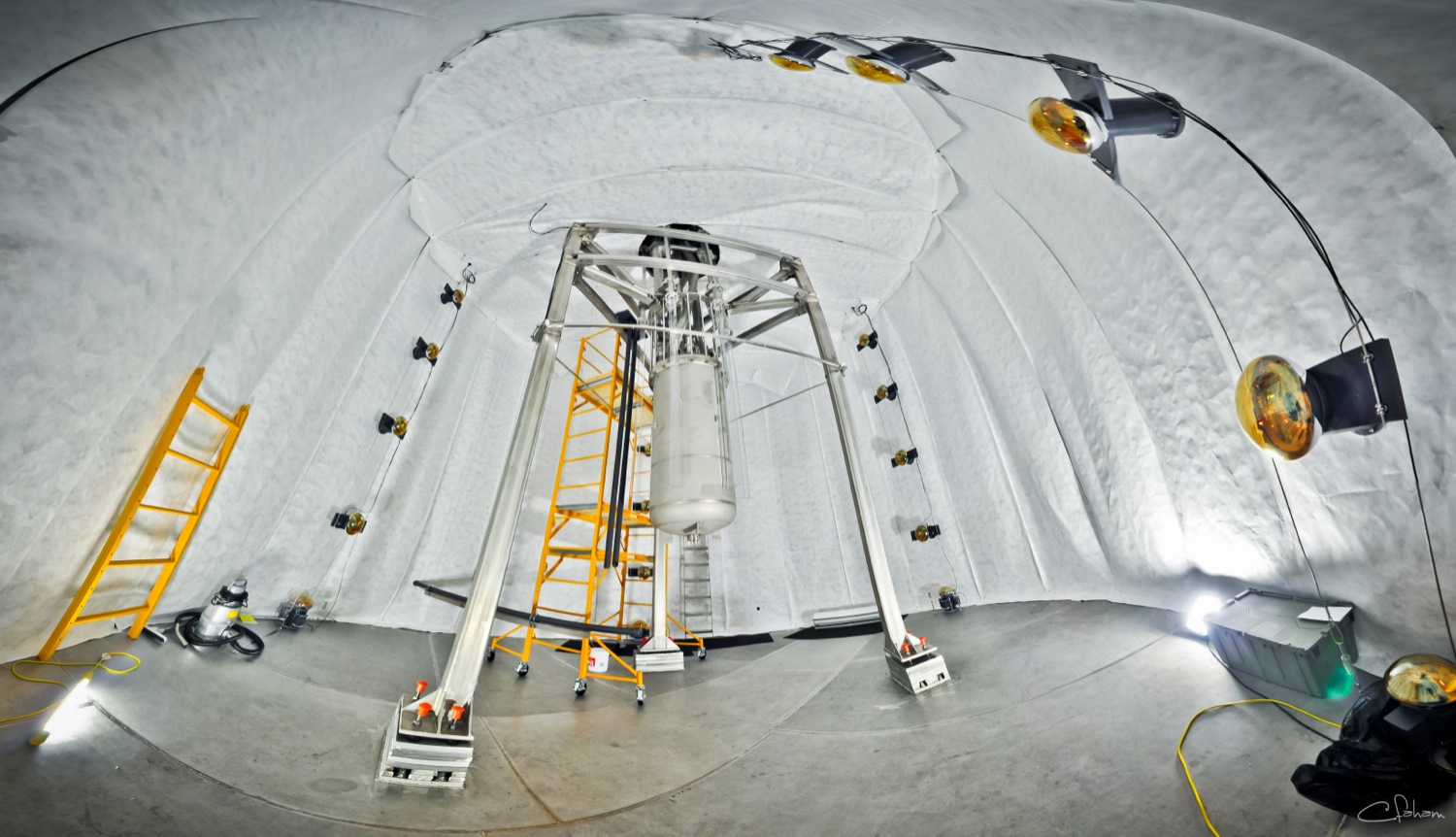
The earlier LUX xenon detector provides hardware lineage and underground-detector context; the candidate event discussed here comes from its successor experiment LZ.
Carlos Faham (Gigaparsec at English Wikipedia) · Image source · CC BY 3.0

A single unusual event can deserve months of attention without establishing a new particle. That is the position of the LUX-ZEPLIN collaboration, known as LZ, after its September 2026 extended-energy dark-matter analysis. The experiment reported a candidate consistent with a xenon nucleus recoiling with an energy near 248 kiloelectronvolts. Its global significance is 2.6 standard deviations, below the customary discovery threshold. The useful question is therefore how an event becomes interesting, which assumptions make it unusual, and what observations would turn curiosity into a convincing physical explanation.
The result extends an existing search window
LZ presented the analysis on September 1, 2026, and posted the accompanying preprint on September 2. It used an exposure of 2.84 tonne-years and extended its nuclear-recoil window to approximately 270 keV. The candidate energy was 248 keV, with separate statistical and systematic uncertainties of 23 keV each. Across the tested models the largest local significance was 3.4 sigma, while accounting for the broader search reduced it to 2.6 sigma globally. The paper was a preprint submitted for publication, rather than an established dark-matter discovery, at the research cutoff.
Energy windows matter because a detector does not ask every possible question equally well. Imagine two proposed particles that can strike xenon. One tends to make many small recoils; another can produce a comparatively hard spectrum. Looking only at low energies gives the first proposal more opportunity to reveal itself. Opening a higher-energy window changes the competition between hypotheses. It also requires understanding detector response in a region that may have received less attention in the main search.
A recoil is reconstructed from a chain of measurements
The experiment sits underground at the Sanford Underground Research Facility and uses a two-phase xenon time projection chamber. Its active xenon target is about seven tonnes. Auxiliary detectors help identify activity that can accompany unwanted interactions. The shielded location and surrounding instrumentation reduce backgrounds, but they cannot guarantee that every isolated signal in the central xenon has an exotic origin.
A useful way to audit a candidate is to separate three propositions. First, the electronics recorded pulses. Second, calibrated models translate those pulses into a position, an energy and an interaction classification. Third, a population model says how often ordinary processes should create that combination. An unfamiliar event can challenge any one of those stages. A detector artifact, an uncommon conventional interaction and a new particle are different explanations even if their displays initially look similar. Careful analysis has to keep all three stages open to scrutiny.
Tonne-years measure opportunity, not certainty
An exposure of 2.84 tonne-years is a product of usable target mass and live observation time after the relevant selections. It does not mean that every tonne of the physical apparatus contributed equally at every moment. As a simple illustration, a hypothetical two-tonne fiducial target observed for 1.42 years would have the same mass-time product before efficiency corrections. That arithmetic says nothing by itself about the probability of a particular interaction.
The expected count also depends on the incident particle population, its interaction strength, the recoil-energy distribution and the chance of accepting the event. A longer exposure can improve sensitivity, yet it also accumulates ordinary backgrounds. A search with negligible background behaves differently from one limited by uncertainty in a background rate. Reporting mass-time alone cannot establish how compelling a surviving event is. The spectral window and the calibrated efficiency are part of the experiment’s effective opportunity to see a signal.
Why the global significance is the relevant headline
Consider a fictional analysis that inspects one fixed energy interval and sees an upward fluctuation. Now consider an analysis allowed to inspect many intervals, several interaction models and multiple spectral shapes. Even if every background calculation is correct, the second analysis has more opportunities to find something that looks unusual. This is the logic of the look-elsewhere effect. The tests are usually correlated, so the adjustment is not obtained simply by multiplying a probability by the number of plot bins.
A significance is a statement about the behavior of a specified statistical test under a hypothesis. It is not the probability that dark matter exists, nor the probability that the candidate itself is genuine. LZ used a profile likelihood ratio and reported the search-wide adjustment explicitly. Treating the local 3.4-sigma value as the entire result would remove information about how the interesting model was selected. The smaller global value captures a more demanding question: how surprising is the best-looking feature after the allowed search has been considered?
The hardest backgrounds may be the rarest ones
Rare-event experiments often understand their common backgrounds better than their extreme tails. Suppose a background normally produces several deposits and a veto can reject it. The dangerous subclass is the one in which the additional deposits escape recognition. Its rate depends on geometry, thresholds and reconstruction as well as the underlying interaction. A low average rate therefore does not eliminate the need to study unlikely event topologies.
That distinction suggests a practical reading strategy. Ask which control samples constrain the background, whether calibrations reach the relevant energy, and how uncertainty in a response model affects the fitted signal. Do not expect an error bar on reconstructed energy to summarize every uncertainty in origin. Statistical uncertainty can reflect limited information in the measured pulses, while systematic uncertainty can reflect calibration or modeling choices. Two events with similar energies need not have equally credible particle interpretations.
A candidate and an exclusion limit answer different questions
For context, LZ’s earlier standard WIMP analysis, revised in July 2025, reported no excess above its modeled backgrounds in 4.2 tonne-years. A WIMP is a weakly interacting massive particle. That analysis gave a strongest spin-independent limit of 2.2 × 10⁻⁴⁸ square centimetres at a mass of 40 GeV/c² and 90% confidence. Its median expected sensitivity was 5.1 × 10⁻⁴⁸ square centimetres at the same mass. These are properties of that analysis and its assumptions, not universal statements excluding every form of dark matter.
There is no logical conflict between a limit in one search and an interesting candidate in another. The tested spectra, accepted events and statistical questions can differ. A limit curve asks how large an interaction strength remains compatible with the observations under a specified model. A candidate study asks whether a feature needs an additional explanation. Neither should be casually substituted for the other, especially when the new study deliberately expands the recoil-energy range.
A fair follow-up has to risk being wrong
A useful follow-up plan would identify a test before opening the next data sample. For example, an analyst could define a recoil interval and a model-dependent expected ratio between high- and low-energy events. The next sample would then test that prediction with fewer choices made after seeing its contents. Such a plan need not insist that every source of uncertainty has vanished. It must make the remaining flexibility visible.
This is my proposed standard for assessing a future interpretation, not an assertion that LZ has already announced those exact tests. A candidate becomes more informative when it narrows what should happen next. If a hypothesis can explain either the appearance or absence of any subsequent event by changing unrestricted parameters, it may be mathematically flexible while offering little experimental discrimination.
What would make the interpretation stronger
My assessment is that the decisive next step is predictive agreement. A proposed signal should specify where future events occur, how their energies are distributed, and why neighboring regions do not already contradict it. If a model is adjusted only after inspecting one event, many stories can be made to fit. A fresh dataset gives the story a chance to fail without further adjustment.
Independent detector checks matter just as much as collecting a second point on a plot. Reproducing the response with calibrations, testing alternate reconstructions and comparing experiments with different background vulnerabilities can distinguish a physical pattern from an instrumental exception. The September result earns attention because the collaboration quantified its unusualness and exposed the limits of the inference. Its scientific value does not depend on promoting a 2.6-sigma fluctuation into a discovery before those harder tests are available.
Sources & further reading
Primary papers, project documentation, and research releases used in this article. Publication dates below refer to the sources themselves.
- Search for dark matter particle interactions in an extended nuclear recoil energy window with the LUX-ZEPLIN (LZ) experimentLZ Collaboration / arXivPublished Checked
- The LZ Dark Matter ExperimentLZ CollaborationChecked
- Dark Matter Search Results from 4.2 Tonne-Years of Exposure of the LUX-ZEPLIN (LZ) ExperimentLZ Collaboration / arXivPublished Checked
FOLLOW THE QUESTION
Explore physics