PHYSICS
One Extraordinary Neutrino, Many Possible Origins: KM3-230213A in 2026
What the record-energy KM3NeT event measured, why its source remains uncertain, and how 2025–2026 follow-up work tests competing explanations.
Research checked
Newest cited publication
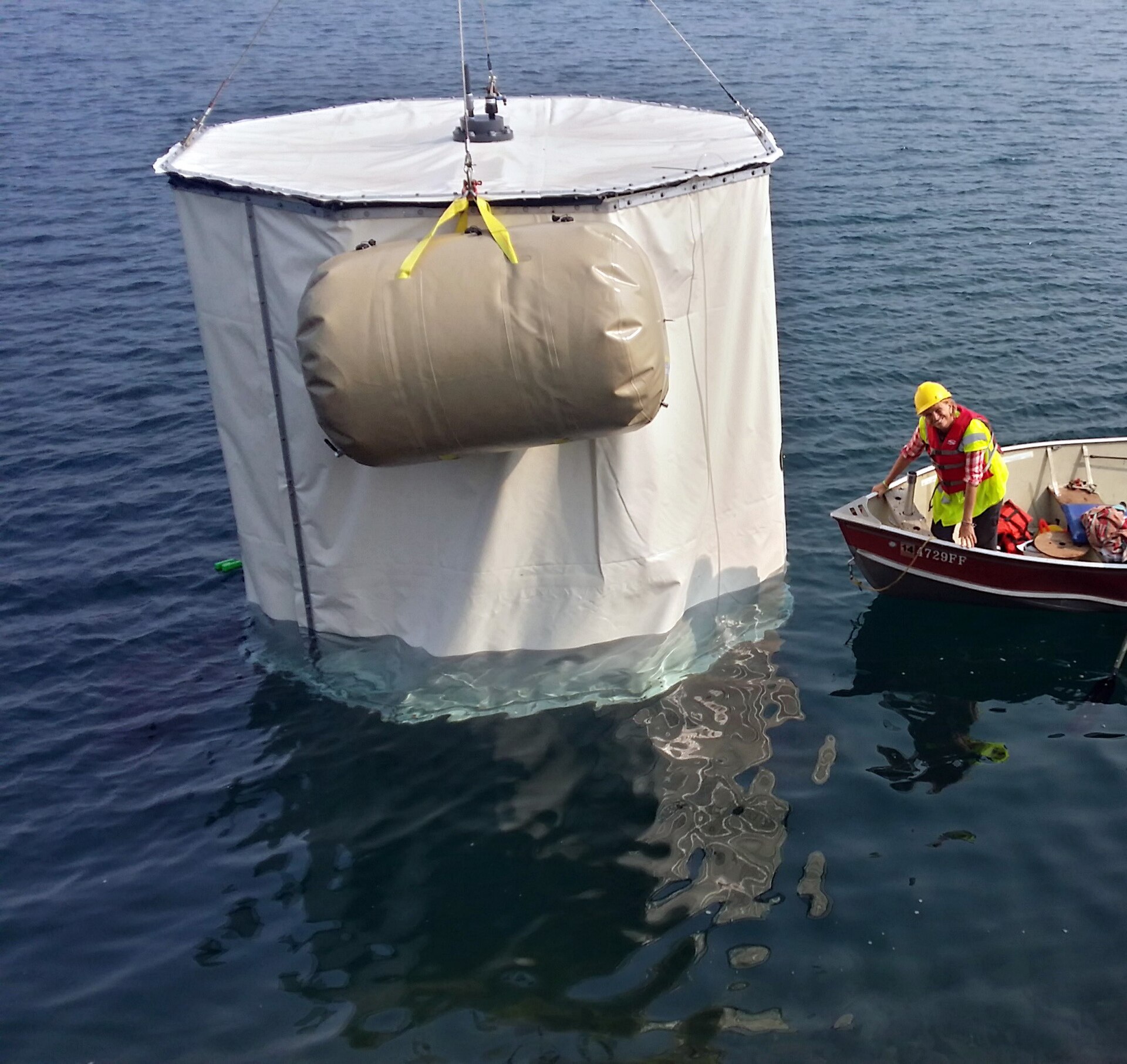
A CHIPS detector deployment illustrates the practical scale of neutrino instrumentation; KM3NeT uses a separate deep-sea array with the geometry described in the article.
Jerry Meier (University of Minnesota), via UCL Mathematical and Physical Sciences · Image source · CC BY 2.0

On February 13, 2023, an exceptionally bright particle track crossed part of a deep-sea detector in the Mediterranean. The KM3NeT collaboration published its interpretation in Nature on February 12, 2025: a cosmic neutrino had probably generated an enormously energetic muon near the detector. The event, KM3-230213A, became a major new clue about the Universe’s most powerful particle accelerators. By the October 18, 2026 cutoff used here, follow-up research had multiplied possible explanations without delivering a securely identified source. That combination is scientifically healthy. A remarkable observation can be robust while its astrophysical interpretation remains open. Understanding the distinction requires following the chain from light recorded in seawater to a particle energy, then from a sky direction to a possible cosmic engine.
The detector saw a charged particle’s light
KM3NeT detects Cherenkov light from fast charged particles travelling through seawater. A neutrino itself is neutral and does not leave such a luminous trail. Its interaction can create a muon, whose direction and energy losses provide evidence about the incoming neutrino. The published analysis estimated the muon energy at the detector at roughly 120 petaelectronvolts, with large asymmetric uncertainty. The inferred neutrino energy had a median near 220 petaelectronvolts under an assumed energy spectrum. Those are related estimates, not two interchangeable direct readings.
A petaelectronvolt is a million billion electronvolts. As a unit conversion, 220 petaelectronvolts corresponds to about 0.035 joules, using approximately 1.602 × 10⁻¹⁹ joules per electronvolt. That seems small beside household energies, but it is immense for a single particle. The conversion is only a scale illustration; it does not shrink the event’s uncertainty. Most everyday objects distribute their energy among enormous numbers of particles. Here the scientific surprise concerns the concentration of energy in one interaction and what physical environment could create its parent particle.
Why the energy estimate has a long uncertainty range
A through-going muon need not begin or end inside the instrumented volume. The observed light samples only part of its path. Large stochastic energy losses can illuminate different regions unevenly, while water transparency and sensor response affect the recorded brightness. Inferring the parent neutrino adds another layer: some incoming energy went into particles other than the muon, and the muon may have lost energy before entering the detector. Simulation connects these hidden stages to what the sensors recorded.
An everyday analogy is estimating the total fuel used on a journey after observing one noisy segment of engine operation. A useful model can produce a well-motivated estimate, but different plausible journeys still fit the same observed segment. In this event, a model for the incoming energy distribution helps assign relative weight to possible parent energies. A median is therefore a summary of an inference with assumptions. Repeating the central value to many significant figures would add visual precision without adding knowledge.
One event does not uniquely specify a population
In a May 8, 2026 conference contribution, a KM3NeT representative reviewed the event’s possible astrophysical origins and its relation to limits from IceCube and the Pierre Auger Observatory. That contribution is an experiment-associated proceedings preprint, not a second record-energy event. Its continuing discussion of multiple scenarios makes the current status clear: explaining the observed event rate and identifying the actual source remain separate tasks. A rare upward statistical fluctuation is one possibility that population comparisons must retain.
For an original toy calculation, suppose a model predicts an average of 0.1 events in an exposure. Under Poisson counting, the probability of at least one event is one minus the exponential of minus 0.1, approximately 9.5 percent. Observing one event would be interesting, but it would not automatically invalidate that model. A competing model predicting one event would make the observation less surprising, yet would also need to satisfy other experiments. This example uses invented rates and is not a significance calculation for KM3-230213A.
Production near a source or along the journey
One broad explanation places neutrino production near an astrophysical accelerator. Energetic protons or nuclei interact with matter or radiation, producing unstable particles whose decays yield neutrinos. Another explanation is cosmogenic production: ultra-high-energy cosmic rays interact with background photons during propagation through space. In the latter case, the neutrino need not point to a uniquely visible flare that occurred at the same moment. The two ideas make different population predictions even when both can accommodate a single high-energy detection.
The useful discriminator is therefore more than an attractive object inside an error circle. A source model has to explain particle acceleration, interaction efficiency and the accompanying radiation. A propagation model must also describe the original cosmic-ray composition and distribution of sources. My inference is that the decisive evidence will likely be comparative: additional neutrinos with a characteristic energy distribution, associations that survive statistical trials, or increasingly restrictive limits from complementary instruments. A successful story has to explain both what appears and what does not.
A delayed gamma-ray search still tests something
VERITAS reported a follow-up campaign in a September 29, 2025 proceedings preprint. Its observations were made in February and March 2025, after the neutrino event had been announced, and produced upper limits on very-high-energy gamma-ray emission. The timing matters: the neutrino was detected in 2023. Observations two years later can constrain persistent or long-lasting activity, but they cannot simply replay the sky at the instant the original neutrino arrived. A nondetection must be interpreted with the actual observing window attached.
Gamma rays and neutrinos can originate in related hadronic processes, yet they do not travel through the Universe identically. Radiation fields can absorb high-energy photons and redistribute their energy into lower-energy cascades. A source might be bright in neutrinos while its gamma-ray signal is obscured, delayed or outside an instrument’s most useful energy range. That flexibility does not make follow-up useless. It means a quantitative model must be carried through the source, propagation and instrument response before an upper limit can reject it.
A proposed gamma-ray-burst association needs its assumptions
A separate 2026 study by Ruiqi Wang and Bo-Qiang Ma examined possible associations with gamma-ray bursts while allowing Lorentz invariance violation. Its arXiv record was submitted April 15 and revised May 22, and lists a journal publication in The Astrophysical Journal. The existence of a published correlation analysis is not a measurement that Lorentz invariance fails. The assumed propagation model changes which time-separated events qualify as possible partners. The proposed association and the new-physics hypothesis are therefore entangled.
Searching a large catalogue naturally creates opportunities for coincidence. If the time window, angular window and energy-dependent delay are adjustable, the number of effective trials can grow substantially. A credible test must account for those choices and compare the result against a suitable null distribution. The strongest future confirmation would use a model fixed before inspecting new events. Predicting a fresh association is more constraining than explaining an already famous event after choosing the most accommodating parameters.
What would make the next event more informative?
Additional events could change this field in several different ways. Repeated arrival directions would strengthen a source interpretation. A broad isotropic distribution could support a population or propagation explanation. A prompt alert followed by simultaneous electromagnetic observations could connect neutrino production to an identifiable transient. Improved detector calibration would narrow the allowed sky region and energy distribution. None of these outcomes is guaranteed, but each reduces a different ambiguity in the present inference chain.
The durable achievement of KM3-230213A is the opening of an observational question at an extraordinary energy. The unresolved origin is part of that achievement, not a reason to replace uncertainty with the most dramatic available theory. As of the research cutoff, the defensible account combines a published exceptional event, substantial modeling, and active follow-up research. The next advance will come from explanations taking risks: making predictions specific enough that new neutrinos, photons or nondetections can prove them wrong.
Sources & further reading
Primary papers, project documentation, and research releases used in this article. Publication dates below refer to the sources themselves.
- Observation of an ultra-high-energy cosmic neutrino with KM3NeTKM3NeT Collaboration / NaturePublished Checked
- KM3-230213A and potential astrophysical sourcesPer Arne Sevle Myhr on behalf of KM3NeT / arXivPublished Checked
- VERITAS Follow-Up Observations of the Ultra-High-Energy Neutrino Event KM3-230213AConnor Mooney for VERITAS / arXiv; PoS(ICRC2025)953Published Checked
- Correlation between Ultrahigh-Energy Neutrino KM3-230213A and Gamma-Ray BurstsRuiqi Wang and Bo-Qiang Ma / arXiv; The Astrophysical JournalPublished Checked
FOLLOW THE QUESTION
Explore physics