PHYSICS
Fractional Hall States at Zero Field Face the Strain Test
New 2026 work tests how strain, electric fields and competing magnetism reshape fractional Hall states in moiré materials—and what transport can establish.
Research checked
Newest cited publication
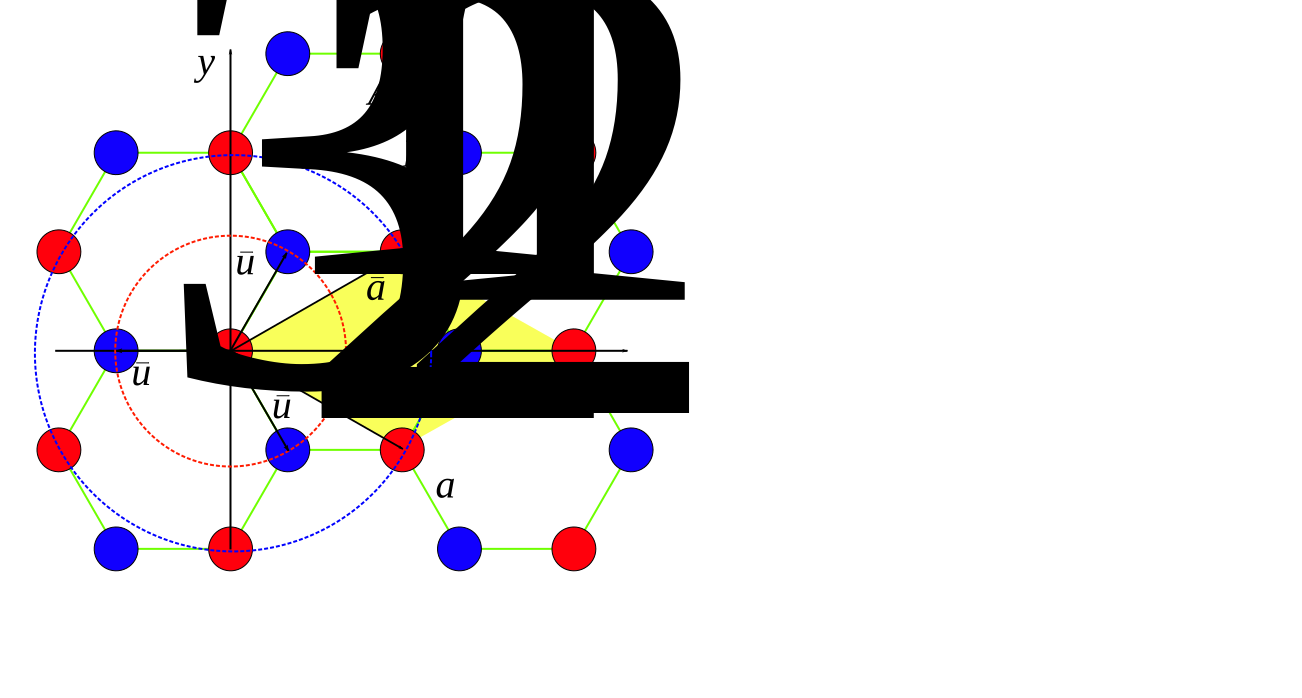
A graphene lattice diagram illustrates a two-dimensional crystal structure. The fractional Hall systems and strain conditions examined here are specified in the text.
Ququ · Image source · CC BY-SA 3.0

An electronic phase can be spectacular and fragile for the same reason: many particles have agreed on one collective arrangement. Fractional Hall states in twisted atomically thin materials now offer a particularly sharp example. They can appear without the large magnetic field traditionally used to organize electrons into quantum Hall states, yet tiny changes in structure or electrostatics can favor a different arrangement. Results available by 18 October 2026 increasingly ask where that collective agreement survives, rather than treating a fractional conductance plateau as the end of the investigation.
The 2026 strain question
A theory preprint submitted by Bo Peng and Jin-Xin Hu on 1 June 2026 examines anisotropy in moiré fractional Chern insulators. In their models, moderate anisotropy preserves the fractional phase, whereas stronger distortion reduces its many-body gap and can favor charge stripes or a metallic phase. These are model-dependent phase transitions, not a report that a particular laboratory device has already been mechanically switched through every predicted state. The important experimental suggestion is that unequal stretching along different directions is a meaningful control parameter.
To understand the question, separate two energy costs. The bandwidth measures how much an individual electron can gain by choosing a different momentum. The interaction energy measures how much electrons gain by organizing around one another. A narrow band makes interactions relatively influential, but it does not dictate which collective state wins. Stretching can change both the band geometry and the spatial shape of the electronic wavefunctions. Consequently, a material can remain strongly interacting while losing the particular topological order that initially made it interesting.
Why a small twist amplifies structural detail
Place two almost aligned periodic grids on top of one another and a much larger interference pattern appears. A moiré crystal turns that geometric observation into an electronic landscape: the local arrangement of one atomic layer relative to another changes gradually across a long supercell. Electrons moving through the bilayer therefore encounter a pattern whose scale differs substantially from the atomic spacing. Gate electrodes can change carrier density, while a perpendicular electric field can alter how charge is distributed between the two layers.
As a simple geometric illustration, a small-angle moiré period scales approximately as the atomic spacing divided by the twist angle expressed in radians. Doubling a sufficiently small angle therefore roughly halves that period. This is an approximation for ideal matching lattices, not a calibration formula for a strained experimental sample. It explains why fractions of a degree deserve attention. When the large pattern is generated by a small mismatch, a small additional mismatch can have an appreciable effect on the resulting electronic landscape.
The rival phase can be magnetic
An experimental paper published in Nature Communications on 4 April 2026 reports competing magnetic ground states in twisted bilayer molybdenum ditelluride. Devices near a three-degree twist showed suppressed zero-field optical magnetic and Hall signals at certain fillings, with field-driven transitions into quantized states. The authors interpret the combined evidence as an antiferromagnetic ground state competing with ferromagnetic Chern phases. Changing the vertical electric field could reversibly move the system between these regimes. The wording matters: an interpretation supported by several probes is stronger than a single vanishing signal, but it still rests on those probes and their resolution.
A small net magnetic response alone would not settle the issue. Oppositely ordered moments can cancel, unrelated domains can average out, or a measurement can miss the component to which it is insensitive. Combining transport with magneto-optical information constrains those alternatives. The same logic applies when an applied field produces a beautiful plateau: the field may have selected a state that was not the zero-field ground state. An experimental phase diagram must therefore specify the path used to prepare the sample, including magnetic history, gate settings and temperature.
A fractional Hall response is one part of the evidence
A graphene preprint first submitted on 25 December 2025 and revised on 2 June 2026 broadens the material landscape. Zexu Li and colleagues study a twisted structure combining Bernal bilayer graphene with rhombohedral tetralayer graphene and report integer and fractional anomalous Hall states, including a response associated with 7/3 in their conductance convention. They argue that the fractional state extends beyond familiar classifications. As of the cited version, this is a preprint claim, and its unusual assignment should be assessed alongside the complete transport data and the proposed competing explanations.
The elementary Hall bookkeeping is already instructive. In a clean incompressible state, a conductance of two-thirds of the conductance quantum corresponds, when longitudinal conduction is negligible, to a Hall resistance of three-halves of the resistance quantum. If longitudinal conduction remains appreciable, simply taking one reciprocal is insufficient because conductivity and resistivity are matrices. This is why a convincing fractional-state measurement reports both transverse and longitudinal channels. Fractional quantization also does not by itself constitute an interferometric measurement of the exchange statistics of individual excitations.
Stabilizing a phase means changing its competitors
An earlier theoretical study submitted on 20 May 2024 proposed that an added exchange interaction could enlarge the parameter range of fractional Chern states in twisted molybdenum ditelluride. That work is useful background for the 2026 discussion because it treats magnetic proximity as a way to modify both band topology and bandwidth. It also identifies competing charge-ordered phases in its calculations. The proposal is not equivalent to a demonstrated robust device: a real neighboring magnet introduces interfaces, disorder and additional couplings that an idealized model may omit.
Think of stabilization as an energy comparison rather than a generic improvement in sample quality. Reducing disorder can help a gapped state reveal itself, but changing exchange or strain may lower a rival state even more. A useful research program measures how several candidate orders respond to the same tuning knob. Does a charge stripe appear as the fractional plateau disappears? Does optical magnetism change at the same boundary? Does the activation scale weaken before the transition? Answers to those linked questions are more diagnostic than maximizing one impressive-looking number.
Compare the gap with the thermal scale
A useful independent scale check starts with the thermal energy, which is about 0.086 millielectronvolts per kelvin. A hypothetical many-body gap of 0.2 millielectronvolts therefore corresponds to an energy scale near 2.3 kelvin. That conversion is not an operating-temperature prediction or a number measured in the cited studies. It only shows how a gap that sounds substantial in a band calculation can still demand a cold laboratory. Disorder broadening, imperfect contacts and a small energy advantage over a competing phase can impose further restrictions.
This comparison also clarifies what an activation fit measures. A slope obtained from the temperature dependence of dissipative transport need not equal the clean theoretical gap, because disorder can introduce localized states or alternative conduction paths. Comparing calculated and experimental gaps requires matching the physical definition as well as the unit. Reversible tuning within one device can be especially informative because many uncontrolled fabrication differences remain fixed while the relevant energy balance changes.
What would make the strain test persuasive?
An informative experiment would vary strain reversibly while independently tracking carrier density and electric displacement. Otherwise, a mechanical intervention could accidentally move the sample to a different filling and create an apparent phase transition for the wrong reason. Measurements on warming and cooling would test hysteresis, while several contact configurations would check that a plateau is not dominated by a peculiar current path. Spatial imaging, where feasible, could reveal whether a device is uniformly changing phase or gradually rearranging competing patches.
The larger opportunity is a controlled comparison between topology and ordinary symmetry breaking. A fractional fluid can resist small disturbances without choosing a visible periodic charge pattern. A stripe state advertises a preferred direction and wavelength. Following the transition between them would expose how those distinct kinds of organization exchange stability. The 2026 studies supply concrete mechanisms and contrasting platforms for that comparison. They do not establish universal strain thresholds, room-temperature operation or a ready source of individually controlled anyons; those remain separate experimental achievements.
Sources & further reading
Primary papers, project documentation, and research releases used in this article. Publication dates below refer to the sources themselves.
- Anisotropic Moiré Fractional Chern Insulators and Their Phase TransitionsarXivPublished Checked
- Evidence of competing ground states between fractional Chern insulator and antiferromagnetism in moiré MoTe2Nature CommunicationsPublished Checked
- Fractional High-Chern Insulator in Twisted Rhombohedral GraphenearXivPublished Checked
- Stabilizing fractional Chern insulators via exchange interaction in moiré systemsarXivPublished Checked
FOLLOW THE QUESTION
Explore physics