PHYSICS
n2EDM in 2026: how to search for a neutron’s hidden electric asymmetry
PSI’s 2026 n2EDM program targets an electric dipole moment through ultracold neutrons, field reversals and magnetic controls, without claiming a new limit.
Research checked
Newest cited publication
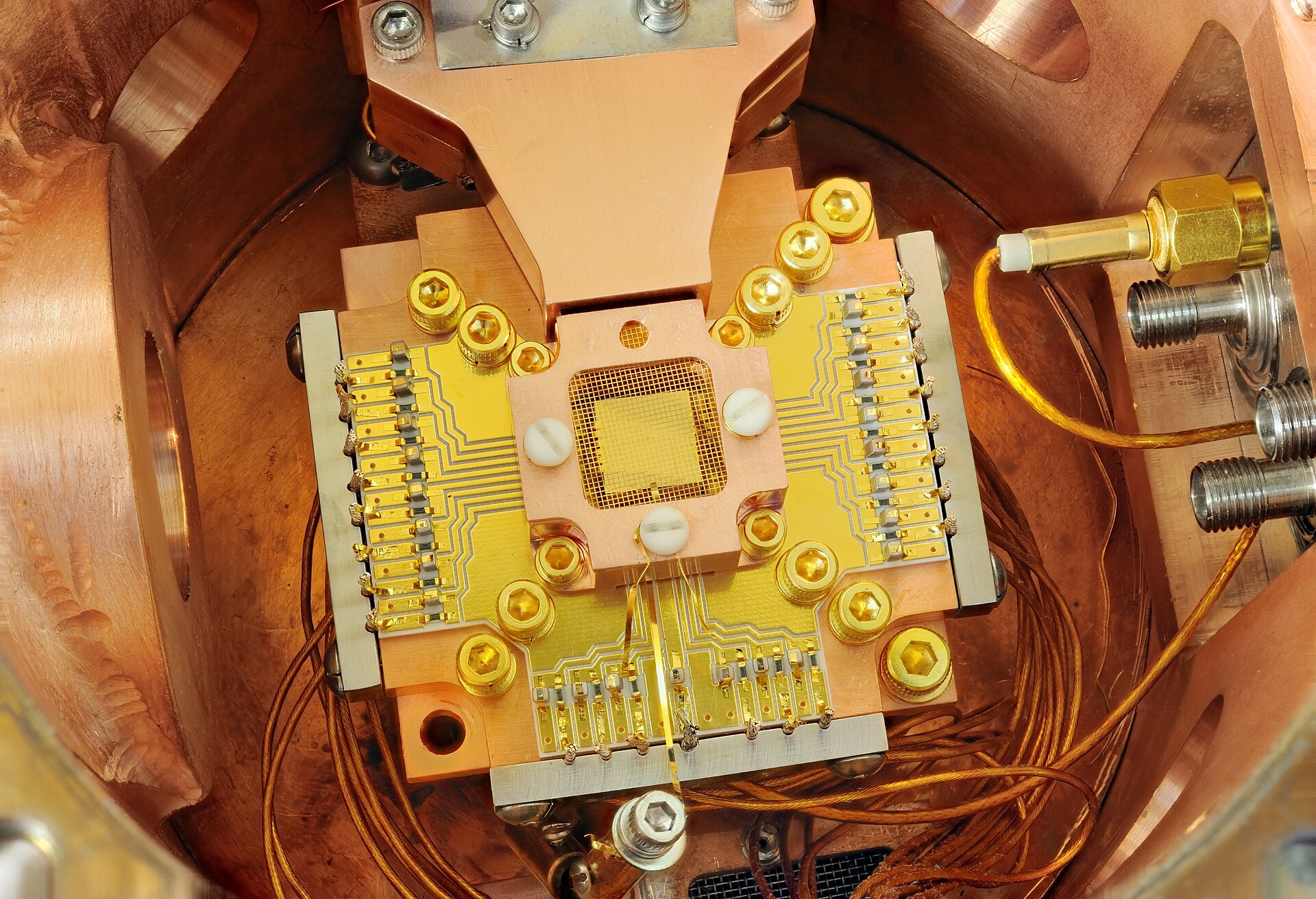
A NIST ion-trap photograph supplies precision-laboratory context. The neutron electric-dipole experiment uses neutral particles and the different apparatus described in the article.
Y. Colombe/NIST · Image source · Public domain

A neutron has no net electric charge, yet its internal charge distribution can still be tested for a permanent electric asymmetry. The n2EDM experiment at the Paul Scherrer Institute, or PSI, is designed to search for this electric dipole moment with extraordinary sensitivity. A September 2, 2026 workshop contribution describes the mercury magnetometry required for its baseline target of 1 × 10⁻²⁷ elementary-charge centimetres. That is a sensitivity objective, not an announced neutron dipole measurement. The frontier here is an increasingly controlled comparison of frequencies, where a false magnetic shift can resemble the tiny electric effect being sought.
The 2026 update concerns measurement infrastructure
The September workshop material explains that mercury-199 atoms operate as co-magnetometers inside the neutron storage volumes. Their job is to track the magnetic environment experienced by the neutrons, guard against systematic shifts and avoid introducing enough noise to dominate the statistical uncertainty. The contribution presents system upgrades and magnetometer measurements. It does not announce a new upper bound on the neutron electric dipole moment.
For a concrete established baseline, the collaboration’s 2020 paper reported a neutron dipole estimate of (0.0 ± 1.1 statistical ± 0.2 systematic) × 10⁻²⁶ e·cm. It interpreted that result as an absolute-value upper limit of 1.8 × 10⁻²⁶ e·cm at 90% confidence. The dates matter: quoting the old bound alongside a 2026 engineering update must not turn it into a newly achieved sensitivity. A target describes what a program aims to measure; an upper limit describes what a completed analysis supports.
Neutrality does not require a perfectly symmetric charge distribution
A familiar electric dipole consists of equal positive and negative charges separated by a distance. Its net charge is zero, but its energy changes when its orientation is reversed in an electric field. A neutron is a quantum composite particle rather than a little rigid charged rod. Still, the dipole concept provides a well-defined parameter that describes how its internal structure could couple to an applied electric field.
The useful visualization is therefore about symmetry, not a literal photograph of charge blobs inside a neutron. If the spin defines an intrinsic direction and a permanent electric dipole aligns with that direction, certain spatial and time-reversal transformations act differently on the spin and electric distribution. A nonzero permanent neutron dipole would consequently reveal symmetry violation. Measuring a small value can constrain possible new interactions even when the experiment does not directly create the heavy particles invoked by those theories.
An electric-field reversal turns an energy question into a timing question
Neutrons have a magnetic moment, so their spins precess in a magnetic field. The experiment compares spin-precession frequencies for electric fields directed parallel and antiparallel to the magnetic field. A true electric dipole contributes an energy shift that changes sign when the electric field reverses. The measurement looks for that correlated change while controlling the much larger magnetic contribution.
The basic logic can be understood through subtraction. Imagine that two measured frequencies contain the same large magnetic term but opposite small electric terms. Subtracting the frequencies cancels the common term and doubles the small difference. This is powerful only if the supposedly common contribution really is common. A magnetic field that changes slightly whenever the high voltage reverses can survive the subtraction and imitate the effect of a dipole. Field reversal is a discrimination strategy, not automatic proof of origin.
A numerical example shows the scale of the task
Take an illustrative electric dipole of 10⁻²⁷ e·cm in a field of 10,000 volts per centimetre. Multiplying the dipole by the field gives an energy scale of 10⁻²³ electronvolts. The electric contribution to the splitting of opposite spin orientations is twice that, 2 × 10⁻²³ electronvolts. Dividing by Planck’s constant gives a frequency of about 4.8 nanohertz. These are calculated values for an example, not reported operating parameters or measured n2EDM performance.
The arithmetic explains why the experiment cannot be reduced to a sufficiently accurate voltmeter. An electric field establishes the possible signal scale, but the observable is an accumulated quantum phase and a statistical comparison across many particles and cycles. Increasing the number of detected neutrons helps count the phase more accurately. Extending coherent evolution helps a small frequency difference accumulate. Preserving spin contrast and preventing correlated disturbances are equally important because information lost to uncontrolled evolution cannot be restored just by collecting more counts.
A reference species is powerful because it shares the volume
The 2026 mercury contribution emphasizes that the reference atoms occupy the same storage volumes as the neutrons. A nearby external sensor can track an overall disturbance while missing what happens inside the chamber. An internal reference is closer to the actual measurement environment. It provides a simultaneous record against which neutron-frequency changes can be compared.
Sharing a volume does not guarantee sampling it in the same way. Different particles move differently, respond differently to gravity and can average spatial field patterns differently. Imagine a room with warmer air near the ceiling. A sensor that spends most of its time near the floor and another that samples all heights can report different averages without either being defective. Magnetic gradients create the analogous problem in a spin-precession experiment. The reference removes common changes most cleanly when the relationship between its average and the neutron average is understood.
Uniformity is as important as stability
PSI’s project page describes passive and active magnetic shielding and highlights work on reducing residual fields and improving their uniformity. The experiment’s technical design builds on the earlier apparatus with an order-of-magnitude sensitivity improvement as its goal. These are demanding requirements for the entire measurement region, not just for a single point where the field happens to be especially quiet.
A stable gradient can bias comparisons if the stored particle distributions change. A spatially uniform field that drifts can create a different problem. Consequently, a full uncertainty budget needs both field mapping and time-dependent monitoring. Checking only the central magnetic field risks overlooking effects that depend on the volume sampled by the particles. This is why improved shielding, uniformity and magnetometry are scientifically substantive achievements even before they produce a new final dipole bound.
Long running reduces only the uncertainties that average away
Independent counting errors often shrink in proportion to one divided by the square root of the number of observations. Under that idealization, reducing an uncertainty by a factor of ten requires one hundred times as many equally informative observations. Improving polarization, detected neutron number or interrogation quality can change the information in each cycle, so more calendar time is only one route to better precision.
A fixed bias linked to electric-field reversal behaves differently. Repeating a biased cycle can make the statistical error small while leaving the offset in place. That is why an apparently tiny error bar is insufficient without systematic checks. The distinction gives the 2026 magnetometry work its context: reducing unwanted field behavior helps ensure that more data measure the neutron rather than the repeatability of an instrumental offset.
A null result constrains theories through an uncertainty budget
The 2020 baseline analysis used blinded datasets and two independent analysis groups. Blinding reduces the opportunity to unconsciously choose cuts that move the answer toward a preferred value. It does not eliminate the need for physical modeling, but it makes agreement after the analysis choices are fixed more informative. For a result so close to zero, the method of controlling bias is part of the evidential story.
My assessment is that the meaningful 2026 question is whether the improved apparatus can demonstrate an uncertainty budget consistent with its target under real operating conditions. More neutrons, longer running and smaller field noise should be judged together with reversal-correlated effects and calibration stability. A future nonzero result would need independent confirmation; a stronger null result would narrow allowed interactions. Neither outcome should be anticipated by relabeling design sensitivity as a completed discovery. The current progress is the preparation of a more discriminating experiment.
Sources & further reading
Primary papers, project documentation, and research releases used in this article. Publication dates below refer to the sources themselves.
- ¹⁹⁹Hg Co-Magnetometer System for the n2EDM Experiment at PSIPaul Scherrer Institute / Neutron Electric Dipole Moment Workshop 2026Published Checked
- Measurement of the permanent electric dipole moment of the neutronnEDM Collaboration / arXivPublished Checked
- The design of the n2EDM experimentnEDM Collaboration / arXivPublished Checked
- Search for the neutron electric dipole moment at PSI: The n2EDM Project of the nEDM collaborationPaul Scherrer InstituteChecked
FOLLOW THE QUESTION
Explore physics