PHYSICS
M87’s changing polarization: a magnetic movie with missing frames
New M87 observations connect a changing polarization pattern with 2026 work on the jet base, while exposing the limits of magnetic-field inference.
Research checked
Newest cited publication
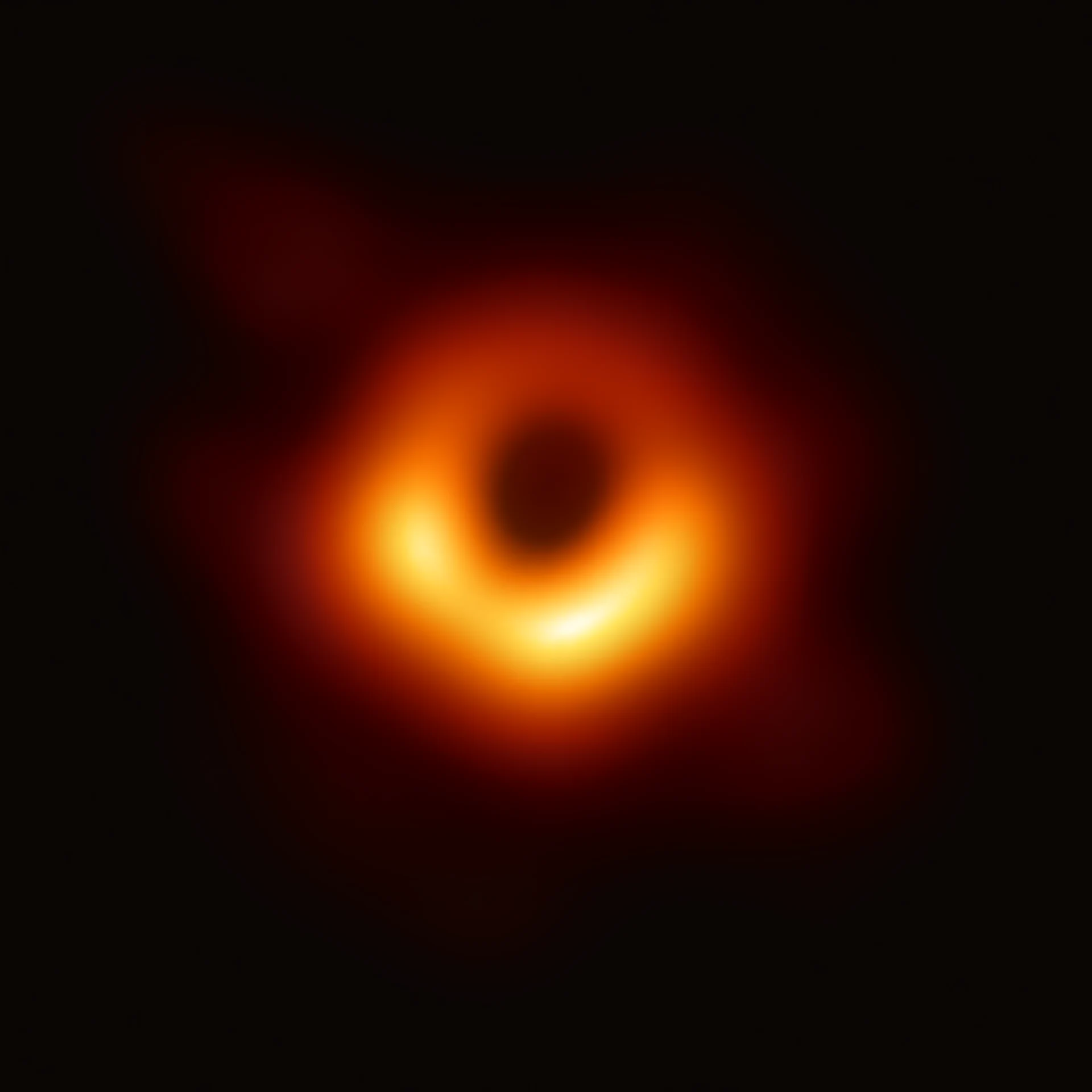
The Event Horizon Telescope’s M87 image identifies the observed black-hole environment; the time-dependent polarization measurements discussed here contain additional information.
Event Horizon Telescope / ESO · Image source · CC BY 4.0

A black hole image can look reassuringly familiar while its physics changes dramatically. In September 2025, the Event Horizon Telescope collaboration compared polarized observations of M87* from 2017, 2018, and 2021. The bright ring persisted, but the pattern drawn by the polarization changed. Work released in January and June 2026 adds a related question: how much of the surrounding radio emission comes from the beginning of the jet? Together these results turn a famous picture into a problem about time, magnetized matter, and incomplete measurements. They do not provide a continuous movie or a direct compass reading at every point. Understanding that distinction is what makes the observations interesting.
One stable scale, several changing observables
The collaboration reported a ring diameter of 43.9 ± 0.6 microarcseconds across the three observing epochs. Linear polarization was weaker in the later images, and the winding direction of the electric-vector pattern differed in 2021. These are measurements of radiation from plasma around the black hole, interpreted through an imaging pipeline and a model of how light travels. They are not measurements of material sitting motionless on the event horizon.
Intensity and polarization answer different questions. Intensity adds up the energy arriving from a small patch of sky. Linear polarization also preserves information about a preferred direction of the light’s electric field. Suppose two equally bright unresolved regions each emit strongly polarized radiation, but their directions differ by ninety degrees. Their total brightness adds, while their linear polarization can cancel. A decrease in measured polarization therefore need not mean that magnetic fields became weaker. The geometry may have become more mixed within a resolution element or along the line of sight.
This distinction also explains why a nearly constant ring diameter can coexist with a strongly changing polarization map. Gravity and viewing geometry can set a characteristic apparent scale while electrons and magnetic structures vary inside it. A stable outline is compatible with a restless source of illumination. The observations test that separation rather than requiring every feature of the image to remain fixed.
Why a polarization flip is not automatically a field reversal
The September 16, 2025 collaboration release explicitly identifies two possible ingredients in the apparent flip: changes within the emitting flow and propagation through a Faraday screen. The word apparent matters. A rotating pattern of electric-vector directions is not the same statement as a complete reversal of magnetic polarity throughout the black hole environment. Such a stronger interpretation would need additional evidence.
Faraday rotation provides a useful example of an inverse problem. When polarized radio light traverses magnetized plasma, its direction can rotate. In a simple external screen, the angle change is proportional to the square of wavelength. An illustrative screen that rotates the angle by ten degrees at one wavelength would rotate it by forty degrees at twice that wavelength, provided the same approximation holds. That arithmetic is not a fit to M87; it shows why observing frequency can help distinguish emission geometry from intervening material.
Real sources make the problem harder. Different depths can emit and rotate light simultaneously. Turbulence can mix contributions with different orientations. Relativistic motion and curved light paths alter what an observer receives. A change between two dates could consequently involve several physical causes. Measuring polarization at additional frequencies, with comparable resolution and calibration, supplies more independent constraints. Replacing a dramatic headline with this list of possibilities does not weaken the discovery. It identifies exactly what the discovery has made measurable.
An Earth-sized telescope still has gaps
Radio interferometry combines signals from separated telescopes. Each telescope pair samples information about structure at particular angular scales and directions. The separation between the pair is called a baseline. Long baselines constrain fine detail; shorter baselines help recover broader emission. The method does not record a complete photograph and then sharpen it. It constructs an image from a limited set of spatial measurements.
Consider an analogy using a musical chord. Knowing a few frequencies constrains the sound, but several combinations of missing frequencies could still fit those measurements. Additional instruments can discriminate among those possibilities. In an interferometer, adding a station changes many telescope pairs at once, so its value depends on location as well as sensitivity. More collecting area alone cannot replace every missing baseline.
The 2021 M87 campaign added Kitt Peak and NOEMA to the array, improving coverage relative to earlier observations. That upgrade helps explain why comparing image appearance requires care: the source and the instrument both changed between campaigns. A trustworthy time comparison therefore checks whether reconstructions with different assumptions and data coverage support the same physical conclusion. Repeated recovery of the ring is a valuable consistency check, but it does not erase uncertainty in fainter structures. Those structures can be scientifically important precisely because they are difficult to recover.
The 2026 connection to the jet base
On January 28, 2026, the collaboration described model-based evidence for additional compact emission near the likely jet base in the 2021 data. Intermediate baselines helped identify emission that a ring alone could not explain. The interpretation localized a candidate region about 0.09 light-years away in projection. The release also stresses that deducing this component is an earlier step than obtaining a clear image of its morphology.
A June 3, 2026 study, available on arXiv and marked accepted for Astronomy & Astrophysics, investigated detectability using synthetic data. It varied jet brightness, array configuration, and reconstruction method. Its conclusion concerns what these observing arrangements can recover under the assumed source models. A simulated successful recovery is evidence about measurement capability, not an independent observation that a particular jet structure exists.
That distinction suggests a practical experimental design. Inject several plausible faint components into synthetic observations, hide the input from the reconstruction procedure, and ask which features survive. Then test whether a ring-only source produces similar artifacts. A robust detection should work across reasonable modeling choices while a false component should be rejected. This approach treats algorithms as part of the experiment. It is especially useful when the desired feature lies close to a much brighter one.
What the next frame must establish
My reading of these results is that the most valuable next observation is one that reduces a specific degeneracy, rather than merely producing a prettier ring. Coordinated frequencies can constrain propagation effects. Better baseline coverage can separate compact jet emission from reconstruction artifacts. Repeated epochs can test whether a changing pattern has a characteristic timescale or instead reflects irregular fluctuations.
Timing also matters conceptually. Three snapshots establish that the source differed at those sampled times. They do not specify the path between them. A pattern could have changed gradually, reversed repeatedly, or undergone a short transition followed by a long quiet interval. Each history can agree with sparse endpoints. Inferring a cycle from so few frames would add information that the observations do not contain.
The broader physics question is how an accreting black hole redirects some available energy outward. Polarization constrains the organized and disordered magnetic environment; faint extended emission constrains where the jet begins to become visible. Combining those channels can eventually distinguish competing models more strongly than either alone. For now the achievement is already substantial: a persistent gravitational scale has been observed alongside changing radiative structure, and 2026 work clarifies how to search for the missing connection to the jet.
Sources & further reading
Primary papers, project documentation, and research releases used in this article. Publication dates below refer to the sources themselves.
- Horizon-scale variability of M87* from 2017--2021 EHT observationsEvent Horizon Telescope Collaboration / arXivPublished Checked
- New EHT Images Reveal Unexpected Polarization Flips at M87*Event Horizon TelescopePublished Checked
- Probing the jet base of M87's supermassive black holeEvent Horizon TelescopePublished Checked
- Constraining the jet base emission of M87* with past and future Event Horizon Telescope observationsLa Bella et al. / arXivPublished Checked
FOLLOW THE QUESTION
Explore physics