PHYSICS
Parker Solar Probe’s Reconnection Encounter: Why Sunward Particles Matter
Parker Solar Probe’s 2026 reconnection analysis separates proton scattering from heavy-ion beams and tests how magnetic energy becomes energetic particles.
Research checked
Newest cited publication
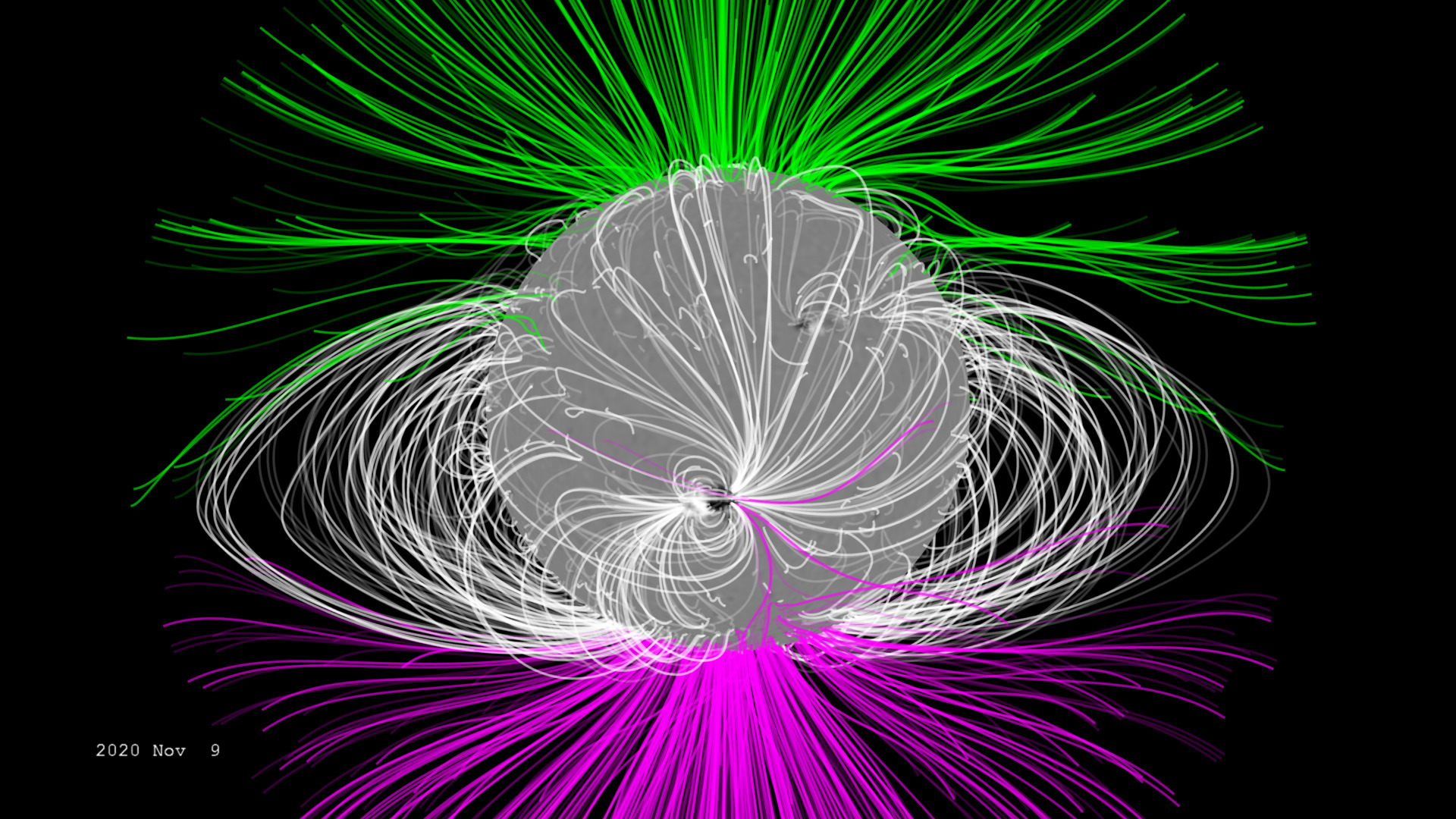
A NASA solar magnetic-field visualization supplies context for the magnetic geometry and plasma processes probed by Parker Solar Probe.
NASA’s Scientific Visualization Studio: Tom Bridgman (Global Science and Technology, Inc.); Joy Ng (eMITS); Laurence Schuler and Ian Jones (ADNET Systems, Inc.) · Image source · Public domain
A particle arriving from the direction of the Sun and a particle moving toward the Sun tell different stories. That distinction makes a Parker Solar Probe encounter unusually useful. A study announced by Southwest Research Institute on March 31, 2026, and explained by NASA on April 15 examines particles measured during a 2022 crossing of the heliospheric current sheet. The spacecraft was on the Sunward side of a reconnection event, positioned to sample the returning jet. The interesting result is not simply that magnetic fields accelerate particles. Protons and heavier ions retained different directional and energy patterns, exposing how acceleration and subsequent transport can become entangled.
A 2026 analysis of a 2022 encounter
The author-deposited paper describes Encounter 14 at roughly 16.25 solar radii from the Sun’s center. Its evidence combines particle energy spectra, particle directions relative to the magnetic field, and local wave activity. The reported populations include protons and ions of helium, oxygen, and iron. These are charged atomic nuclei or partially stripped atoms, not a new kind of solar material. The paper reports protons reaching approximately 400 kiloelectronvolts, while emphasizing differences between species rather than a universal acceleration curve.
An event date and an analysis date answer different questions. The measurement happened in 2022; the paper and institutional explanations became available in 2026. Neither date licenses treating every later solar encounter as confirmation. The immediate scientific advance is a more discriminating comparison between models and one unusually informative natural experiment. A model must account for the particles that arrived, their energies, their directions, and the waves observed alongside them, using one physically consistent history.
What reconnection changes
In an idealized conducting plasma, magnetic structures move with the fluid. Reconnection occurs where that description breaks down locally: magnetic connectivity changes and magnetic stresses can accelerate plasma. Field lines are a representation of a continuous field, so the familiar picture of snapping strings should be read as an illustration of changing geometry and released stress. It does not describe solid objects breaking. Electric fields, contracting structures, and moving plasma all enter the energy transfer.
A useful bookkeeping exercise distinguishes a local energy density from the energy a particle accumulates along its path. A traveler can receive several payments from different locations without any single cashier supplying the total. Likewise, comparing an energetic particle only with the magnetic energy immediately beside a detector need not identify the full acceleration reservoir. Establishing the reservoir requires geometry, timing, transport, and a population energy budget. This is a reason to examine the whole event rather than interpret an individual particle’s energy as a self-contained efficiency measurement.
A beam can broaden after acceleration
The Southwest Research Institute explanation attributes the proton population’s broader directions to stronger scattering by waves, while heavier ions remain more beam-like. The paper also finds different energy-spectrum slopes for the different species. Those two observations belong together: a spectrum recorded at one location contains the effects of both energization and the journey to the instrument. An initially narrow population can become broad before it arrives. A detector therefore does not automatically photograph the accelerator’s original output.
Consider an independent thought experiment. Release identical sets of fast particles through two corridors. One corridor contains moving deflectors; the other is almost empty. At the exit, the first set occupies more directions even if both sets began with the same directional spread. If the deflections also depend on speed, the energy distribution at a particular exit angle changes. That example does not establish the solar mechanism, but it explains why directional measurements constrain an interpretation that energy counts alone would leave ambiguous.
Why species do not necessarily share a trajectory
A charged particle’s magnetic response depends on charge divided by mass. For motion across a uniform field, the gyroradius is mass times perpendicular speed divided by charge times field strength. As a deliberately illustrative calculation, a nonrelativistic 100-kiloelectronvolt proton in a 100-nanotesla field has a speed of about 4,380 kilometers per second. With its velocity perpendicular to the field, its gyroradius is about 457 kilometers. These assumed values are not a reconstruction of the Parker event.
A helium nucleus carrying twice the proton charge and roughly four times its mass has twice that gyroradius at the same perpendicular speed in the same field. At equal energy per particle, its speed is different, so the comparison changes. At equal energy per nucleon, another comparison applies. This is why a graph’s energy axis and charge-state assumptions matter. Wave frequencies and wavelengths introduce additional scales; matching a particle’s gyromotion to a fluctuation can make one population scatter efficiently while another responds weakly. Merely calling both populations ions suppresses the physical distinctions that the new observations are testing.
The spacecraft samples a changing environment
Pitch angle means the angle between a particle’s velocity and the local magnetic field. A narrow pitch-angle distribution is not automatically a narrow cone centered on the Sun. The field itself has direction and can rotate. An instrument must combine its viewing geometry with field measurements before turning a directional count into a statement about Sunward motion. Moreover, an instrument’s energy range, cadence, background subtraction, and sensitivity influence which differences can be resolved.
There is also a time-space ambiguity. A spacecraft may cross a stationary boundary, remain near an evolving boundary, or do both. A short-lived change in counts can therefore encode motion through structure as well as evolution of the structure. My inference is that the most valuable follow-up is a joint forward calculation: generate particles and waves, transport the particles through a modeled event, then predict the particular instrument’s counts. Comparing that prediction with observations is a stronger test than matching only a fitted spectral slope.
Travel time can test an acceleration story
An additional independent check comes from time of flight. In the illustrative hundred-kiloelectronvolt proton example above, a straight path of one million kilometers would take about 228 seconds. A particle with four times the kinetic energy has twice the nonrelativistic speed, so the same path would take about 114 seconds. If populations are released together, their arrival times can therefore carry information about the distance to a source. These numbers use invented geometry, not a distance inferred for this encounter.
The inference becomes less direct when particles scatter, follow a winding magnetic path, or begin accelerating at different times. A delay could indicate a longer journey rather than a weaker accelerator. A useful model should predict the energy-dependent arrival sequence together with directional spreading. Agreement on both would remove some of the freedom to explain any one spectrum after the fact, while disagreement could identify which transport assumption needs revision.
What would turn an event into a general explanation?
NASA’s September 10, 2026 mission update reports that Parker completed its twenty-ninth close approach on September 4 and that the mission was extended into 2029. That operational update provides context for continuing measurements; it is not itself another reconnection result. More encounters can sample different magnetic geometries, solar conditions, and particle populations. The aim should be repeated tests in which a model predicts when strong species differences will appear and when they should disappear.
A convincing explanation must survive unfavorable comparisons. It should identify events with little scattering, distinguish acceleration near the detector from particles arriving from elsewhere, and conserve energy when all relevant populations are included. It should also state which charge states and wave modes it assumes. The present result narrows an important question: how much of a measured energetic-particle spectrum is written in the accelerator, and how much is rewritten on the way out? Answering that question would improve the physical basis of space-weather models without pretending that one encounter already supplies a reliable forecast.
Sources & further reading
Primary papers, project documentation, and research releases used in this article. Publication dates below refer to the sources themselves.
- Proton and Heavy Ion Acceleration by Magnetic Reconnection at the Near-Sun Heliospheric Current SheetCaltechAUTHORS / The Astrophysical JournalPublished Checked
- SwRI-led research indicates a more complex Sun’s magnetic engineSouthwest Research InstitutePublished Checked
- NASA’s Parker Solar Probe Finds Surprises in an Explosion Near the SunNASAPublished Checked
- After Latest Swing Past Sun, NASA’s Parker Solar Probe Checks inNASAPublished Checked
FOLLOW THE QUESTION
Explore physics