ENGINEERING
X-59 and the engineering of a quieter sonic boom
NASA’s 2026 X-59 flights connect shock-wave shaping with flight controls, pilot visibility and the difficult measurement of sound reaching the ground.
Research checked
Newest cited publication
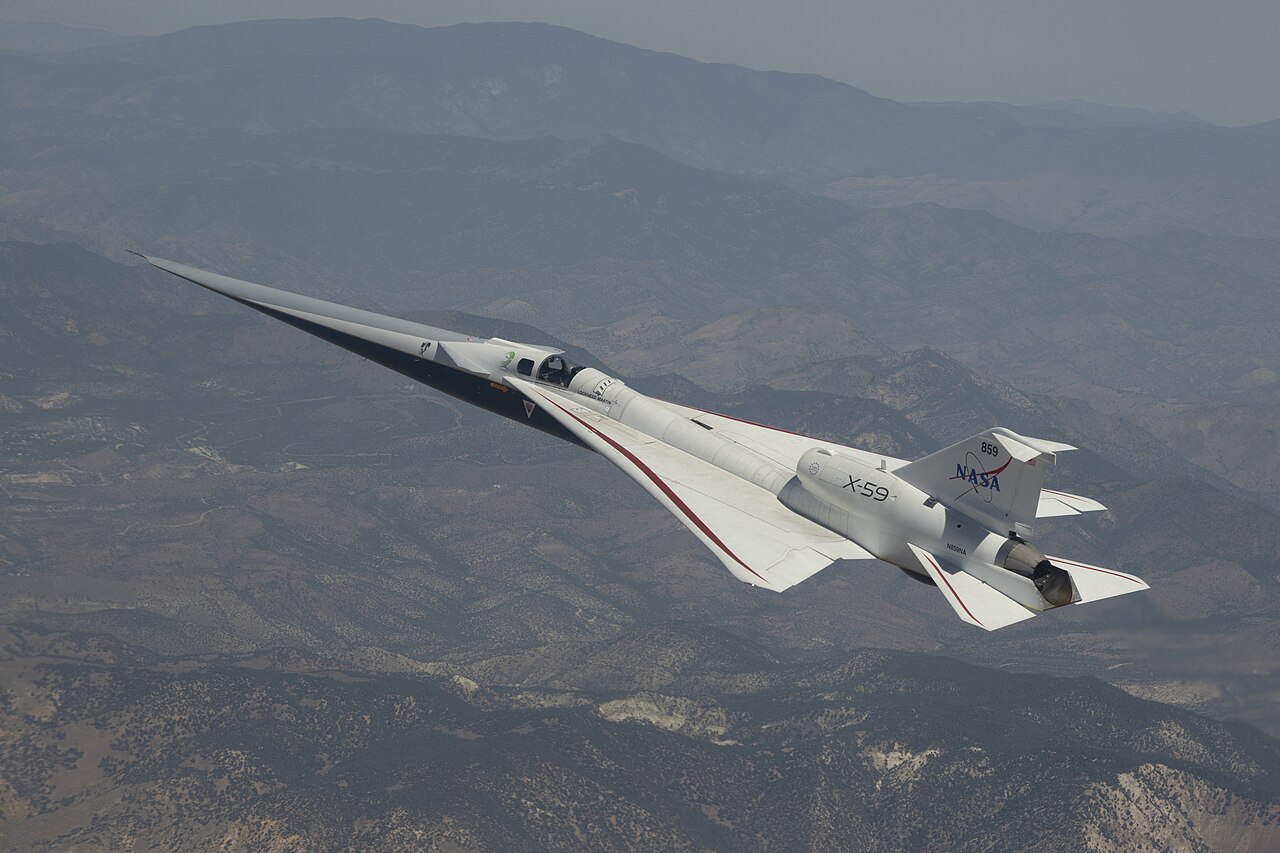
NASA’s X-59 flies near Armstrong Flight Research Center on May 12, 2026, during flight-envelope expansion. A flight photograph alone cannot establish the community noise response.
NASA / Jim Ross · Image source · Public domain (US government / NASA)

A long, unusually slender aircraft crossed an important threshold on June 5, 2026: NASA’s X-59 flew faster than sound for the first time. One week later, it reached Mach 1.4 and approximately 55,000 feet, its intended conditions for future community noise research. Those are real flight achievements, following the aircraft’s initial, subsonic flight on October 28, 2025. They are not by themselves proof that a commercial aircraft can operate quietly over cities. The interesting engineering lies in the chain connecting an aircraft’s shape to a measured pressure signal, a pilot’s ability to fly the required trajectory, and an eventual listener’s experience. X-59 is a research instrument that happens to be an airplane. Its performance matters because uncontrolled changes in speed, altitude or attitude would also change the acoustic experiment.
An aircraft shape can organize its pressure disturbances
Supersonic flight produces pressure disturbances that cannot travel upstream through the surrounding air. The aircraft continuously generates these disturbances along its path; a boom is not a single event that occurs only at the moment it crosses the sound barrier. As waves propagate downward, their evolution depends on the initial pressure pattern and on the atmosphere. A conventional configuration can allow separate disturbances to merge into stronger changes. The low-boom design problem is to distribute the aircraft’s contributions so the arriving signature is less abrupt and less objectionable.
NASA describes X-59’s geometry as deliberately shaping and distributing shock waves, with its engine mounted above the main fuselage. That choice illustrates a central systems trade. Aerodynamic shape must satisfy an acoustic objective while leaving room for fuel, load-bearing structure, an engine installation and a controllable aircraft. A smooth-looking outside surface can conceal difficult packaging underneath. Moving an inlet or canopy is not merely a styling decision: it alters flow, mechanical interfaces and the pressure field that the experiment is trying to establish.
Envelope expansion builds a usable experimental instrument
The first flight stayed well below the speed of sound, at roughly 12,000 feet with the landing gear extended. Its purpose was to evaluate the assembled aircraft rather than demonstrate the final acoustic objective. By May 2026, NASA reported progressively varied flights, including landing-gear retraction, operation close to Mach 1 and measurements from strain gauges. Fuel, hydraulics, environmental controls and pilot vision were among the systems assessed. These checks link an analytical design to the behavior of an actual vehicle with tolerances, flexible components and interacting subsystems.
An envelope is a region of permissible operating conditions, not a single maximum-speed number. Imagine a controller that behaves comfortably during gentle level flight but approaches an actuator limit during a maneuver at a different speed. A small test step can expose that issue before a larger one becomes hazardous. The same incremental process helps validate structural predictions: a strain measurement can reveal whether the assumed distribution of loads matches reality. Aircraft performance testing therefore also improves confidence that later acoustic measurements are being collected under known and repeatable conditions.
The nose creates a human-interface problem
X-59 does not give its pilot a conventional forward-facing windshield. Its shape creates an obstruction that NASA addresses with the eXternal Vision System, which combines cameras and a high-resolution cockpit display. In 2021, NASA described comparative flight tests using another aircraft: pilots using direct vision and the electronic system detected traffic in deliberately arranged encounters. The team also tested hardware under vibration and other environmental conditions. This older development work explains an essential dependency behind the newer flight milestones.
A camera feed suitable for casual observation is not automatically suitable for flying an experimental jet. Latency, image contrast, the apparent size of distant traffic and the alignment of displayed information can influence decisions. Those are engineering considerations rather than claims that a particular deficiency occurred. A practical design must also consider failed data, frozen images and the pilot’s workload when the scene changes quickly. The absence of a forward window turns image processing and display reliability into parts of the aircraft’s operational capability.
A fast flight and a quiet flight answer different questions
NASA’s June 5 report states that the aircraft reached approximately Mach 1.1 at 43,400 feet. It also explains a crucial limitation: the accompanying F-15 produced conventional sonic booms that obscured whatever sound the X-59 made. The event established supersonic flight performance, not an uncontaminated public demonstration of its sound signature. Keeping those claims separate prevents a successful safety milestone from being mistaken for a completed acoustic experiment.
Measurement contamination is easy to understand in another setting. To characterize a quiet pump, one would not place an uncharacterized louder motor beside the microphone and interpret the combined sound as the pump alone. Flight research has additional constraints, including the need to monitor a new aircraft safely. A chase airplane can be valuable in one phase and problematic for another measurement. Research programs therefore change instrumentation, geometry and procedures as the question moves from whether the vehicle flies properly to what pressure waveform it produces.
Reaching the intended test point is necessary evidence
The June 12 flight reached the target Mach number and altitude; NASA’s cockpit image recorded 55,030 feet. NASA nevertheless described more performance testing and subsequent acoustic validation before community response work. Planned probing from an instrumented F-15 would provide early information about the aircraft’s shock pattern. The public result supports a specific conclusion: the aircraft could reach its designed operating condition. It does not establish that every planned later phase had already been completed.
A useful way to think about this distinction is as a sequence of calibration questions. Can the aircraft hold the intended condition? Is the surrounding atmospheric state characterized well enough? Does the measured near-aircraft signature agree with the prediction? How does that signature evolve before reaching a ground array? Each question introduces an uncertainty. Agreement at one stage is encouraging but does not erase uncertainty at the next. A credible final result needs the measurement chain to remain traceable rather than replacing it with a single headline speed.
Repeatability also requires recording the state of the experiment, not just the aircraft’s nominal set point. Two passes at the same reported Mach number can encounter different winds or vertical temperature profiles below them. Sensor calibration, timing and aircraft position must be associated with the correct pass before the ground waveform is compared with a model. One useful engineering practice is to ask whether another team could reconstruct the measurement from the recorded conditions and processing choices. If a result depends on an undocumented adjustment, it is harder to learn whether disagreement came from the design tool, the atmosphere or the measurement itself. That traceability is what turns a flight campaign into reusable engineering knowledge.
The next aircraft would inherit methods, not this exact shape
The broader value of a demonstrator is the evidence it provides for design tools and assessment methods. A passenger aircraft would have a different cabin, payload, operating schedule and economic burden. Its acoustic design would need to survive those constraints along with repeated maintenance and a range of atmospheric conditions. X-59 cannot settle every one of those questions, and the reports cited here do not claim that it does.
What it can do is tighten the connection between calculation, construction and observation. That connection is unusually demanding when the desired output is a small pressure disturbance far from a large, fast machine. The latest verified flight milestones make the acoustic experiment more concrete. The decisive next evidence is a well-characterized signature and, eventually, carefully collected community response. Quiet supersonic engineering advances when a prediction becomes a repeatable measurement with its uncertainties still visible.
Sources & further reading
Primary papers, project documentation, and research releases used in this article. Publication dates below refer to the sources themselves.
- NASA’s X-59 Completes First Flight, Prepares for More Flight TestingNASAPublished Checked
- NASA’s X-59 Prepares for First Supersonic FlightNASAPublished Checked
- NASA Completes Tests of X-59 eXternal Vision SystemNASAPublished Checked
- NASA’s X-59 Aircraft Flies Supersonic for First TimeNASAPublished Checked
- NASA’s X-59 Reaches Speed, Altitude for Future Quiet Supersonic FlightsNASAPublished Checked
FOLLOW THE QUESTION
Explore engineering