ENGINEERING
A flying robot carries its controller, while power remains the hard part
Two 2026 microrobotics preprints show progress in onboard flight electronics and wing sensing while keeping energy autonomy a separate engineering goal.
Research checked
Newest cited publication
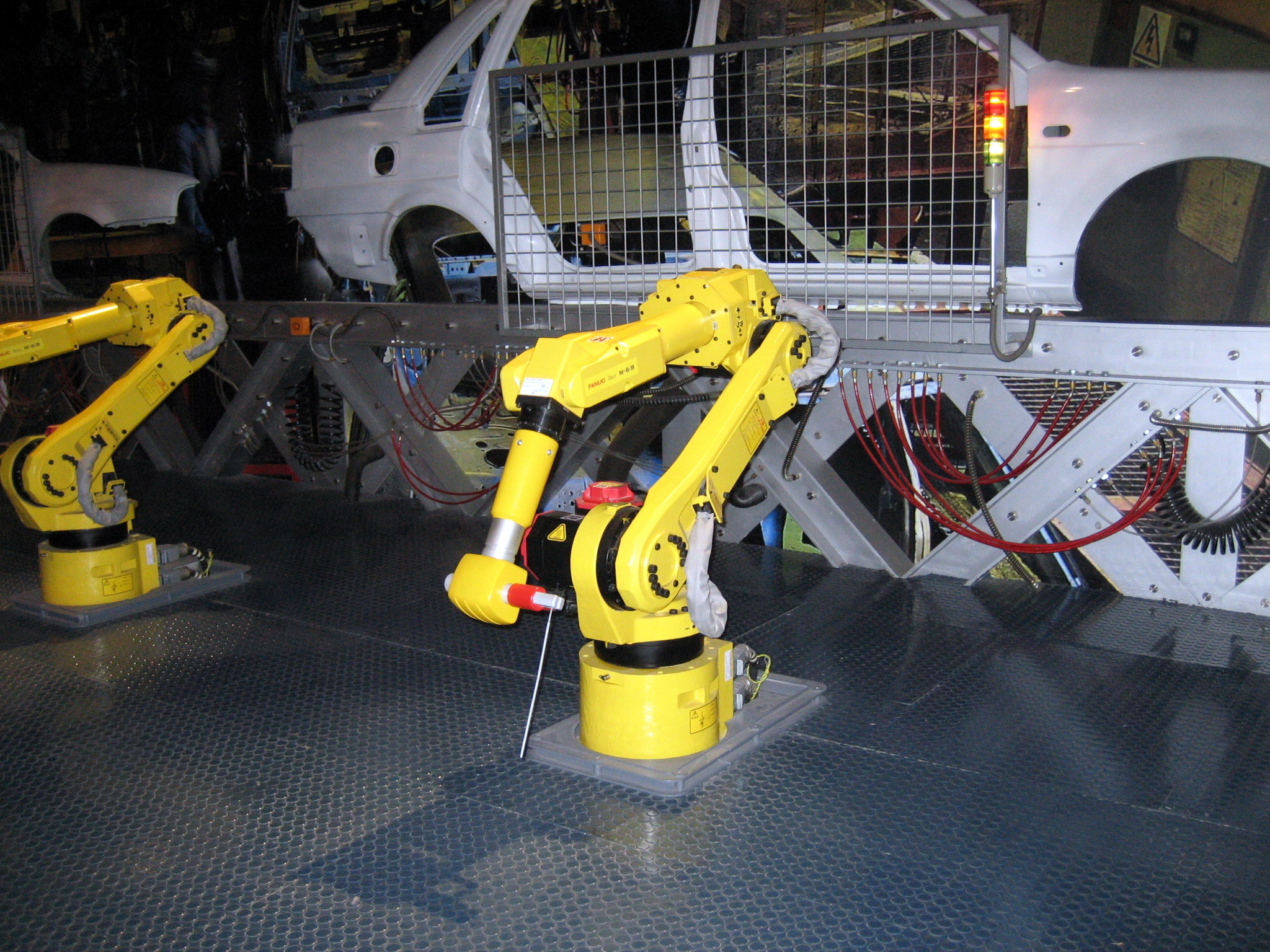
An industrial robot supplies general robotics context. The insect-scale flying platform, its controller, and its external power connection are described separately in the text.
Mountain / Wikimedia Commons · Image source · CC BY-SA 3.0

A tiny flying robot can know where it is going without carrying the energy that keeps it airborne. That distinction matters when an insect-scale demonstration is described as autonomous. Researchers are solving several tightly coupled problems: generating lift, measuring motion, calculating control commands and supplying electrical power. A February 9, 2026 preprint reports a 1.29-gram flapping-wing robot with onboard sensing and computation. An August 22 preprint explores sensors embedded in flapping mechanisms themselves. Together, these results make a useful engineering story about moving capability onto a small aircraft. They do not establish a fully independent robotic insect ready to inspect a building or replace natural pollinators.
Different experiments remove different external dependencies
The February paper reports a 244-milligram electronics package on the 1.29-gram platform. With onboard sensing and computation, the robot demonstrated ten-second hovering and a seven-second setpoint-switching flight. Its driving voltage remained generated offboard. The same paper separately describes an operator-guided, thirty-second obstacle-and-flower demonstration using onboard sensing but offboard computation. Keeping those configurations distinct is essential: combining their most impressive features into a single fully onboard flight would overstate what the experiments show.
Think of autonomy as a set of dependencies rather than a yes-or-no label. A navigation experiment may remove external position cameras while retaining an electrical connection. A powered experiment may remove that connection while relying on external illumination. A trajectory may be stabilized automatically while a person still chooses high-level commands. None of these arrangements makes an experiment meaningless. The engineering question is which dependency has been removed, what mass or energy cost that required, and what new failure mode appears once laboratory support is absent.
Every useful sensor must pay for its ride
The reported electronics package represents about nineteen percent of the total platform mass: 0.244 divided by 1.29 is approximately 0.189. That arithmetic illustrates the burden of useful sensing at this scale. The full paper also describes an inertial measurement unit, a time-of-flight sensor, optical flow sensing and a microcontroller. These components do different jobs rather than providing interchangeable versions of position. Integrating them requires choosing how much information the robot needs to keep flying, not merely selecting the smallest available chips.
An independent thought experiment makes the tradeoff concrete. Start with a hypothetical one-gram aircraft and add a one-tenth-gram sensor without changing the wings. Its required average lift rises by ten percent. If additional power electronics then require a larger battery, the system must support that new mass too. This feedback is why component improvements do not simply add up. A sensor that saves computation may justify its weight; a lighter device that produces noisier measurements could demand more filtering or tighter mechanical isolation. The best choice depends on the behavior the assembled aircraft must achieve.
Position estimation has environmental assumptions
External motion capture observes a robot from a prepared room. Onboard sensing must infer motion from what the vehicle can measure locally. A downward-looking optical system, for instance, can estimate movement across a visible surface, while a range sensor constrains distance to that surface. This general explanation should not be mistaken for a claim that every floor, flower or outdoor scene will produce equally useful measurements. A demonstration outside a motion-capture volume removes one laboratory restriction while leaving many environmental assumptions to test.
A sensible validation campaign would vary illumination, texture, surface geometry and air movement independently. Repeating flights over a patterned floor and then a visually uniform panel could reveal a dependency that a single successful trajectory conceals. Changing one condition at a time would also distinguish an estimator problem from a lift or control problem. I would want the attempted-flight denominator, not just selected examples: how many takeoffs were attempted, how many completed, and which interventions occurred? Those proposed measurements would make the practical operating envelope easier to compare across laboratories.
The flapping mechanism itself becomes a sensor
The August 2026 preprint takes a different approach to onboard information. It integrates thin piezoelectric polymer sensors into an actuator and a pitching hinge, measuring wing stroke and pitch. In chirp experiments, the authors report root-mean-square errors of 0.44 degrees for stroke and 2.44 degrees for pitch within the relevant frequency range. It is a submitted research manuscript, and these measurements characterize embedded sensing. They do not demonstrate complete autonomous flight by themselves.
The reason to measure the mechanism directly is straightforward. A controller commands motion, but manufacturing variation, contact or wear can make actual motion differ from that command. A local measurement provides an additional observation of the physical system. The researchers demonstrate collision detection using the sensing hinge and study asynchronous flapping with the sensing actuator. These are bounded applications. My inference is that such observations could help diagnose changes during operation, provided future experiments show that the added signal remains reliable when combined with a full flight controller and realistic disturbances.
Spectacular flips answer a different question
A December 3, 2025 MIT report described a related microrobot performing ten consecutive flips in eleven seconds with advanced control. It also clearly stated that the controller ran on an external computer and that the robot used a power tether. That achievement demonstrated agile controlled motion under its experimental setup. The 2026 onboard-electronics work addresses a different integration problem. Reading the two together shows progress across separate dimensions, while avoiding the unsupported idea that a platform has already combined every capability from every demonstration.
This distinction is especially useful when watching edited videos. A flight can be short because the experiment tests a maneuver rather than endurance. A cable can supply energy while also imposing drag or other mechanical effects. A small test arena can provide excellent repeatability while hiding practical navigation difficulties. The right response is to identify the experimental purpose. For an agility paper, ask whether maneuvers are repeatable and stable. For an autonomy paper, ask what happens when external computation or sensing is removed. For a deployment claim, require the combined system to complete a useful task.
Onboard computing does not close the power budget
The February paper explicitly leaves integration of onboard power electronics and energy sources as future work. Its experiments therefore should not be read as battery-endurance measurements. The general obstacle is that stored electrical energy, conversion hardware and actuation must fit within a lift-limited mass budget. Additional storage can prolong operation only if the aircraft can carry it while maintaining adequate control authority. That is a coupled mechanical and electrical design problem, not something settled by a faster microcontroller.
Here is a hypothetical energy calculation, separate from any reported prototype. A constant one-watt load operating for thirty seconds consumes thirty joules, or about 0.0083 watt-hours. A real system needs more than a nominal storage capacity: voltage conversion has losses, current delivery may be limited, and useful reserve is necessary for controlled landing. Stating both average power and mission duration makes the calculation inspectable. It also exposes why a thirty-second video does not establish thirty seconds of stored-energy flight if the electrical supply is external.
Combine the capabilities, then report what was attempted
The two 2026 preprints suggest complementary integration paths: lightweight electronics that estimate body motion, and sensing structures that observe the flapping mechanism. They are separate studies, so their components cannot be assumed compatible without further work. Combining them would introduce additional wiring, calibration and processing requirements. It could also offer information useful for fault detection or wing control. Those possibilities are reasonable engineering directions, not results demonstrated by simply citing both papers.
A strong next milestone would specify the entire aircraft configuration, list every external dependency and report repeated task completion under controlled changes in environment. Include the mass of the energy source and conversion electronics whenever power autonomy is claimed. Publish unsuccessful flights and identify operator interventions. Such evidence would make progress easier to recognize, not harder: it would show precisely which laboratory support had become unnecessary. The promising development in 2026 is that sensing and computation can increasingly travel with the wings. The next challenge is to make their supply of usable energy travel with them as well.
Sources & further reading
Primary papers, project documentation, and research releases used in this article. Publication dates below refer to the sources themselves.
- Controlled Flight of an Insect-Scale Flapping-Wing Robot via Integrated Onboard Sensing and ComputationarXivPublished Checked
- Towards insect-like distributed proprioception in actuators and appendages for flapping-wing insect-scale aerial robotsarXivPublished Checked
- MIT engineers design an aerial microrobot that can fly as fast as a bumblebeeMIT NewsPublished Checked
FOLLOW THE QUESTION
Explore engineering