ENGINEERING
Grid-Forming Inverters Must Prove Their Behavior in the Field
A 2026 Kauai field report connects real power-plant events with the tests, energy limits and control assumptions behind grid-forming inverter claims.
Research checked
Newest cited publication
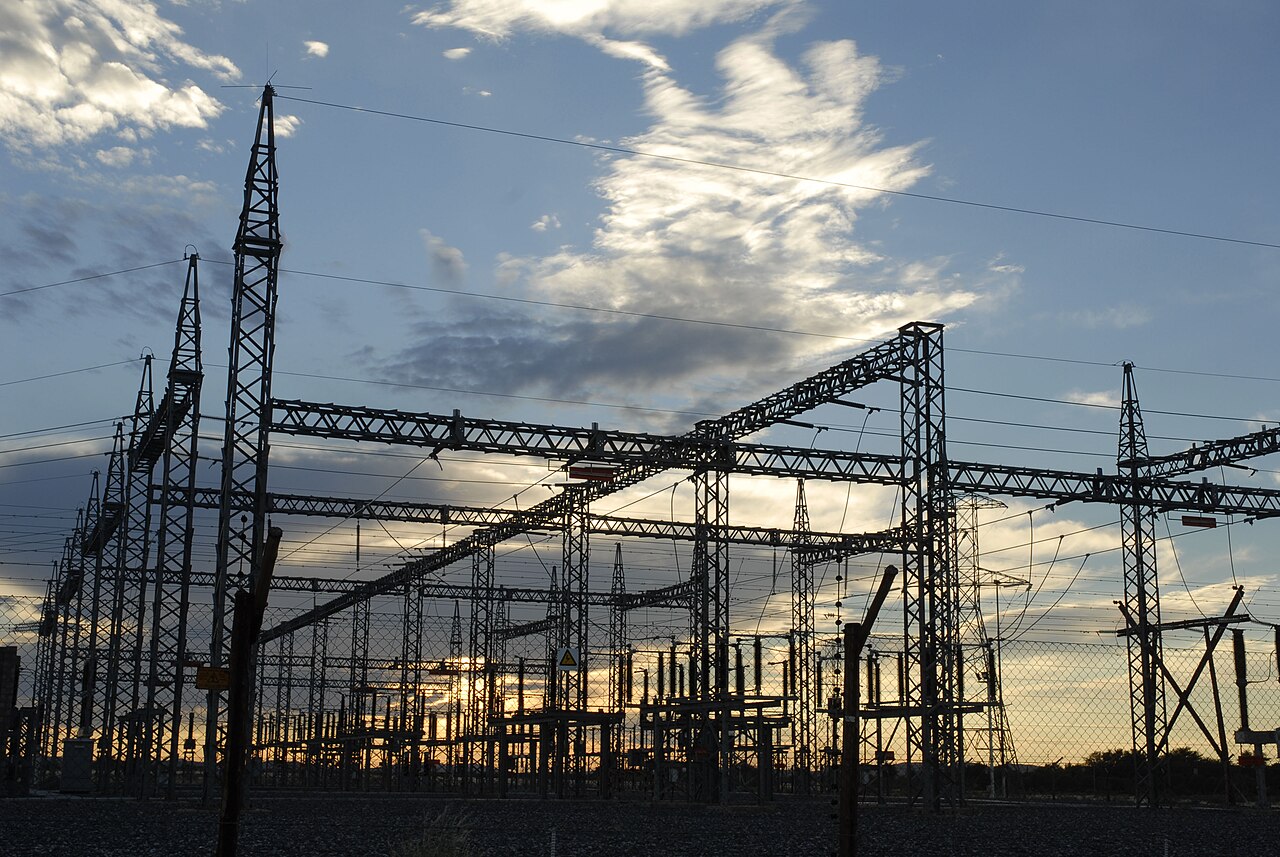
A high-voltage substation supplies grid-infrastructure context; the behavior of a grid-forming inverter must be assessed through the dynamic tests described in the article.
Graeme Williams / Media Club · Image source · CC BY-SA 2.0

A power converter can do more than follow an electrical grid’s existing rhythm. With suitable controls, it can help establish voltage and frequency, a capability usually described as grid forming. The difficult question is how that behavior survives real disturbances, physical current limits and interactions with other equipment. A 2026 national-laboratory report examines two photovoltaic-and-battery plants on Kauai operating in grid-forming mode alongside a transmission network. Its field evidence is especially useful when read with earlier event analysis and newer control theory: these sources answer different questions, from what happened on a real island grid to what can be guaranteed inside a mathematical model.
Why the Kauai report is a meaningful step
The 2026 report by Hoke and colleagues describes two major grid-stability events and compares plant behavior with a specification developed by the UNIFI consortium. It concerns an actual network containing several kinds of generation, rather than a simulated island with perfectly known parameters. The authors present benefits, feasibility and operational challenges. The public abstract does not provide enough detail to reconstruct every event numerically, so it would be unjustified to invent a universal improvement percentage or claim that these observations settle all questions about inverter-dominated grids.
Field observations are valuable partly because reality supplies disturbances that designers would not choose in a tidy laboratory demonstration. They also make causal interpretation harder. Weather, dispatch, plant settings and other connected equipment can change between events. An observed improvement becomes more persuasive when a validated model reproduces the measured waveforms and tests alternative explanations. A strong analysis should state which parameters were measured, which were inferred and how sensitive the conclusion is to plausible uncertainty. Real operation provides essential evidence; careful reconstruction turns that evidence into reusable knowledge.
Forming a voltage is different from following one
A helpful electrical picture is a controlled voltage source behind an impedance. The controller establishes an internal voltage magnitude and angle, while power exchange depends on how that internal quantity relates to the external network. A grid-following arrangement instead commonly uses an estimate of the existing grid angle to control injected current. This simplified comparison explains why control interactions change as the network becomes electrically weaker. It does not imply that every commercial device uses the same algorithm or that one label completely specifies its response.
Consider two people carrying a flexible beam. If both constantly adjust their motion by watching only the other, their corrections can amplify one another. Providing a stable local reference can help, but their strength and reaction limits still matter. The analogy is incomplete—electrical waveforms obey circuit laws rather than human judgment—but it captures why feedback design and network coupling cannot be assessed separately. Engineers need an explicit dynamic model showing which measurements drive which actions and over what time scales. The word forming should begin that examination, not replace it.
Fast control still has to respect physical limits
A converter cannot supply unlimited power merely because its control law requests it. Its switches and cooling impose current and thermal limits, and its direct-current side must provide the energy being delivered. Battery energy storage creates useful flexibility, but its available headroom and state of charge remain finite. The Kauai report explicitly concerns hybrid photovoltaic-and-battery facilities and distinguishes how their solar and battery inverters are connected. It should not be read as evidence that an otherwise identical solar-only plant can deliver the same sustained response under every illumination condition.
An illustrative energy check puts fast support in perspective. Delivering an extra ten megawatts for two seconds transfers twenty megajoules, or about 5.56 kilowatt-hours. The energy quantity can be modest compared with a utility battery’s stored energy, yet the demanded power and converter current can still be decisive. These are hypothetical values, not measurements from Kauai. During a voltage disturbance, supplying the same power may require more current, just as the converter is trying to remain within its protection envelope. Evaluating the transition into and out of current limiting is therefore part of validating the control behavior.
An oscillation is evidence about a whole feedback system
A 2024 presentation by Dong and colleagues used a Kauai oscillation event to examine stability risks with a high share of inverter-based resources and the potential role of grid-forming controls. It provides useful historical context for the later field report, rather than a separate claim that every island should use the same settings. An oscillation involves the combined behavior of controllers, network impedances and operating points. Identifying its frequency is a first observation; identifying which feedback paths sustain it requires additional analysis.
This is why a device-level compliance test and a system-level stability study are complementary. A manufacturer can verify response to a prescribed voltage waveform, while an operator must ask what happens when that response influences the waveform seen by neighboring devices. Changing one plant’s setting may remove one poorly damped mode while moving another. Tests should therefore cover meaningful operating ranges and foreseeable changes in network topology. The objective is not to enumerate every imaginable disturbance. It is to use evidence and models to identify the combinations most likely to challenge the actual installation.
A stability theorem is powerful because its assumptions are explicit
A June 2025 preprint by Miller and colleagues studies incremental passivity for a particular grid-forming scheme called Hybrid-Angle Control. Passivity is an energy-based property that can make interconnected-system analysis more manageable. Under the paper’s specified conditions, decentralized certificates support stability conclusions when connecting the modeled inverters with other passive elements. The result is a theoretical contribution demonstrated with an example case, not a certificate for every inverter advertised as grid forming. Its assumptions and chosen control law are essential parts of the claim.
The practical value of such a theorem is that it suggests what a designer should preserve when combining components. The practical risk is silently extending its guarantee beyond the model. Delays, measurement filters, saturations and protective mode changes can alter the properties on which a proof relies. A useful engineering handoff maps each mathematical assumption to an implementation feature or a verification test. Where that mapping fails, the theory still provides insight, but additional analysis or experiments are needed. A proof and a field test can reinforce one another without pretending to answer exactly the same question.
What a credible field-validation package should contain
For a new plant, the most useful evidence would connect laboratory characterization with commissioned behavior. Before energization, hardware tests can exercise limiting conditions safely and check model fidelity. During commissioning, controlled disturbances can verify selected responses within the operator’s approved envelope. Later operational events can test whether those models remain representative. Recording firmware versions, settings, network conditions and measurement timing makes comparisons possible. Without that traceability, a successful event may be impossible to reproduce and a later mismatch may be impossible to diagnose.
The 2026 Kauai report makes the discussion more concrete by examining real plants connected to a working network. It does not remove the need for site-specific assessment, nor does a promising theory eliminate energy and current constraints. The next engineering advance will be clearer agreement between specifications, models, laboratory results and field observations across more equipment and operating conditions. Grid-forming control becomes dependable infrastructure when its useful behavior is repeatable, its limits are visible and operators know how it changes as the surrounding system evolves.
Sources & further reading
Primary papers, project documentation, and research releases used in this article. Publication dates below refer to the sources themselves.
- Field Verification of Grid-Forming Inverter-Based Power Plant Performance for Transmission System ReliabilityNational Laboratory of the RockiesChecked
- Network-Independent Incremental Passivity Conditions for Grid-Forming Inverter ControlarXivPublished Checked
- Stabilize High-IBR Power Systems with Grid-Forming InvertersNational Laboratory of the RockiesChecked
FOLLOW THE QUESTION
Explore engineering