ENGINEERING
Fusion magnets move from record fields to repeatable manufacture
A September 2026 superconducting-tape order highlights the manufacturing, cryogenic and quality-control tasks between a magnet demonstration and a power plant.
Research checked
Newest cited publication
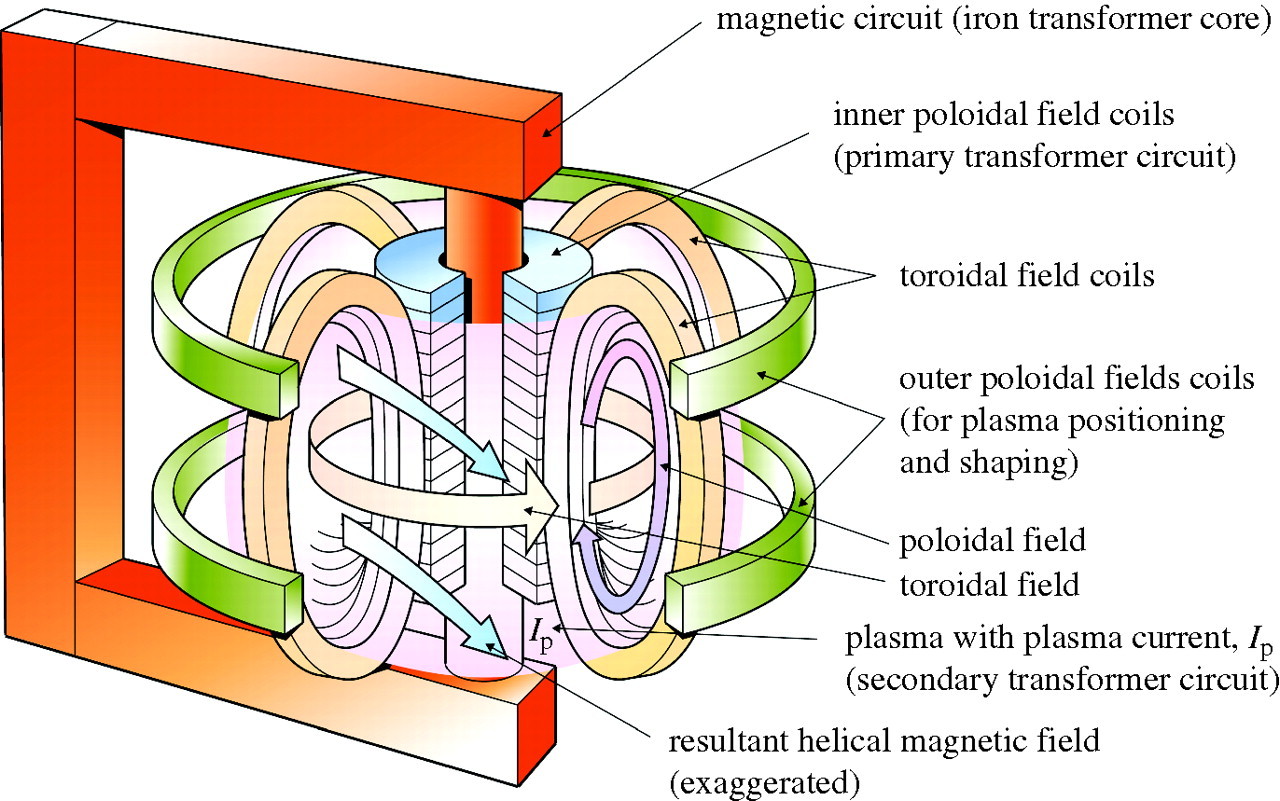
A tokamak confinement diagram illustrates the magnetic geometry that fusion hardware must support; the magnet manufacturing and quality-control methods are described in the article.
Chris Llewellyn Smith and Steve Cowley · Image source · CC BY 3.0

A powerful superconducting magnet is both a scientific instrument and a manufactured structure that must survive an unforgiving operating environment. The distinction became especially visible on September 30, 2026, when Commonwealth Fusion Systems announced an agreement to buy more than 10,000 kilometers of high-temperature superconducting tape from Fujikura for future ARC power plants. An order is not an operating fusion plant, and planned manufacturing expansion is not delivered product. It nevertheless makes the industrial challenge concrete. The next step is not merely to possess a conductor that can carry current. It is to turn long lengths of conductor into magnets with predictable geometry, protection, cooling and service life.
What the 2026 agreement does and does not demonstrate
The CFS announcement describes a long-term tape supply agreement and investment by Fujikura in manufacturing capacity. It links the material to ARC development, including the planned Fall Line Fusion Power Station in Virginia. This is supply-chain evidence: a developer and supplier are arranging material availability at a scale intended to support future construction. It is not evidence that ARC has produced electricity, that every ordered kilometer has been manufactured or that a complete reactor magnet set has passed acceptance. These distinctions matter because procurement milestones often arrive well before integrated engineering demonstrations.
The conductor itself belongs to a larger technical history. CFS’s magnet documentation describes a 20-tesla large-bore magnet demonstrated in 2021, developed with MIT. That older demonstration is useful background for understanding why tape supply has become an industrial question. The 2026 order should not be presented as a new record-field experiment. Its significance lies in moving toward repeated manufacture, where material consistency, inspection throughput and delivery reliability can become as consequential as the best performance of a single carefully characterized prototype.
A long tape must be good along its length
The rare-earth barium copper oxide family, often shortened to REBCO, enables superconducting conductors with attractive performance under demanding magnetic conditions. In a practical coil, however, current-carrying capability depends on temperature, local magnetic field, orientation and mechanical strain. A useful production specification therefore describes an operating envelope rather than a single headline current. Testing one short sample cannot establish that a long delivered length has no consequential weak region. Manufacturing and acceptance procedures must decide what is measured continuously, what is sampled and what happens when measurements approach a limit.
A simple hypothetical yield calculation shows why this matters. If ten independently accepted operations each succeed on the first attempt with probability 0.98, the probability that all ten succeed on the first attempt is about 0.817. That is arithmetic, not a measured fusion-factory yield. It illustrates how apparently small process losses can accumulate across a manufacturing sequence. Better local yield, earlier defect detection and repairable intermediate assemblies can all improve final output. The appropriate goal is a predictable accepted magnet, not merely a high production rate of untested conductor.
The structure carries the consequences of a high field
A superconducting coil does not escape electromagnetic force. Current interacting with magnetic field creates substantial loads that the winding pack and supporting structure must transmit without unacceptable movement or strain. For intuition, magnetic energy density in vacuum is B squared divided by twice the magnetic permeability of free space. At 20 tesla, that expression is roughly 159 million joules per cubic meter, numerically equivalent to 159 megapascals as a pressure scale. It is not the calculated local stress in a specific CFS component; real stress depends on geometry, materials and load paths.
That distinction between a useful scale and an actual design calculation is essential. A coil’s local stress can concentrate near joints, changes in section or interfaces with supports. Cooling from assembly temperature introduces differential contraction before the magnet is energized. Repeated energization can then add cyclic loading. Manufacturing tolerances influence how loads are shared, so a design that works in an ideal model still needs dimensional inspection and representative testing. Structural reliability depends on the assembly sequence and contact conditions as well as on nominal material strength.
High-temperature superconducting still means cryogenic engineering
The phrase high-temperature superconducting is relative to earlier superconductors; it does not mean that a fusion magnet can operate as an ordinary room-temperature electrical component. The cooling system has to maintain the required temperature margin while handling heat leaks and operational loads. Thermal links, insulation, penetrations and instrumentation all contribute to that balance. A conductor with excellent laboratory performance offers limited value if a poorly controlled local heat input drives part of the installed coil out of its acceptable operating region.
Protection is equally important. If a region becomes resistive, electrical energy can turn into localized heat. A credible protection design must detect an abnormal condition, distinguish it from measurement noise and manage stored energy before damage develops. Sensor placement, validation tests and response timing become part of magnet acceptance. These are general engineering requirements rather than claims that a particular 2026 system has completed every test. Public reporting that includes representative fault tests and recovery behavior would help readers assess how far a demonstration has progressed toward a serviceable power-plant component.
Manufacturing partnerships must produce transferable evidence
A second 2026 development addresses the surrounding industrial capability. On May 20, CFS and Singapore’s Agency for Science, Technology and Research announced a five-year research collaboration involving technologies for commercial fusion plants. The announcement highlighted advanced materials, precision manufacturing and materials testing, building on earlier component work. A partnership of this kind is a development commitment, not a declaration that its future technologies are already qualified. Its practical value will depend on whether processes and test evidence can move from specialist research settings into controlled production.
Transfer requires more than sending a drawing to a new supplier. A manufacturing procedure may depend on tooling stiffness, surface preparation, temperature history or an inspection technique known mainly to its original operators. Supplier qualification should expose those dependencies and identify which variables must be controlled. The resulting records should allow a later production lot to be compared with the qualified one. That makes collaboration measurable: it can establish a repeatable capability and a clear acceptance basis, rather than simply adding another organization to a project diagram.
The useful next milestone is a reproducible acceptance result
For magnet manufacturing, the strongest future evidence would connect conductor lots to completed coil performance. Readers should be able to distinguish purchased material, delivered material, accepted winding assemblies and magnets tested under representative thermal and electromagnetic loads. Those quantities answer different questions. A large tape order can reduce a supply bottleneck, while a high acceptance yield can show that the production process is becoming repeatable. Neither alone establishes the availability, maintainability or electrical efficiency of a complete fusion power station.
The engineering case will mature through a sequence of bounded demonstrations: stable conductor quality, reproducible assembly, controlled cooldown, verified protection and successful integration with neighboring systems. Commercial schedules remain projections until the relevant equipment and plant tests are complete. The September 2026 agreement is therefore most interesting as an industrial commitment to make that sequence possible. It moves attention toward the machinery, measurements and procedures that turn a promising magnet into a product that can be built again and trusted to behave consistently.
Sources & further reading
Primary papers, project documentation, and research releases used in this article. Publication dates below refer to the sources themselves.
- Commonwealth Fusion Systems Places Largest Single Purchase Order of HTS Tape with Fujikura to Accelerate Development of ARC Power PlantsCommonwealth Fusion SystemsPublished Checked
- A*STAR and Commonwealth Fusion Systems Sign a Collaborative Research Agreement to Advance Fusion Supply Chain Capabilities in SingaporeCommonwealth Fusion Systems and A*STARPublished Checked
- HTS magnetsCommonwealth Fusion SystemsChecked
- TechnologyCommonwealth Fusion SystemsChecked
FOLLOW THE QUESTION
Explore engineering