ENGINEERING
Electrolyzer scale-up is a manufacturing and operating problem
ITM’s 2026 Lingen commissioning update and Chronos production plans show why stack fabrication, plant integration and measured operating duty belong together.
Research checked
Newest cited publication
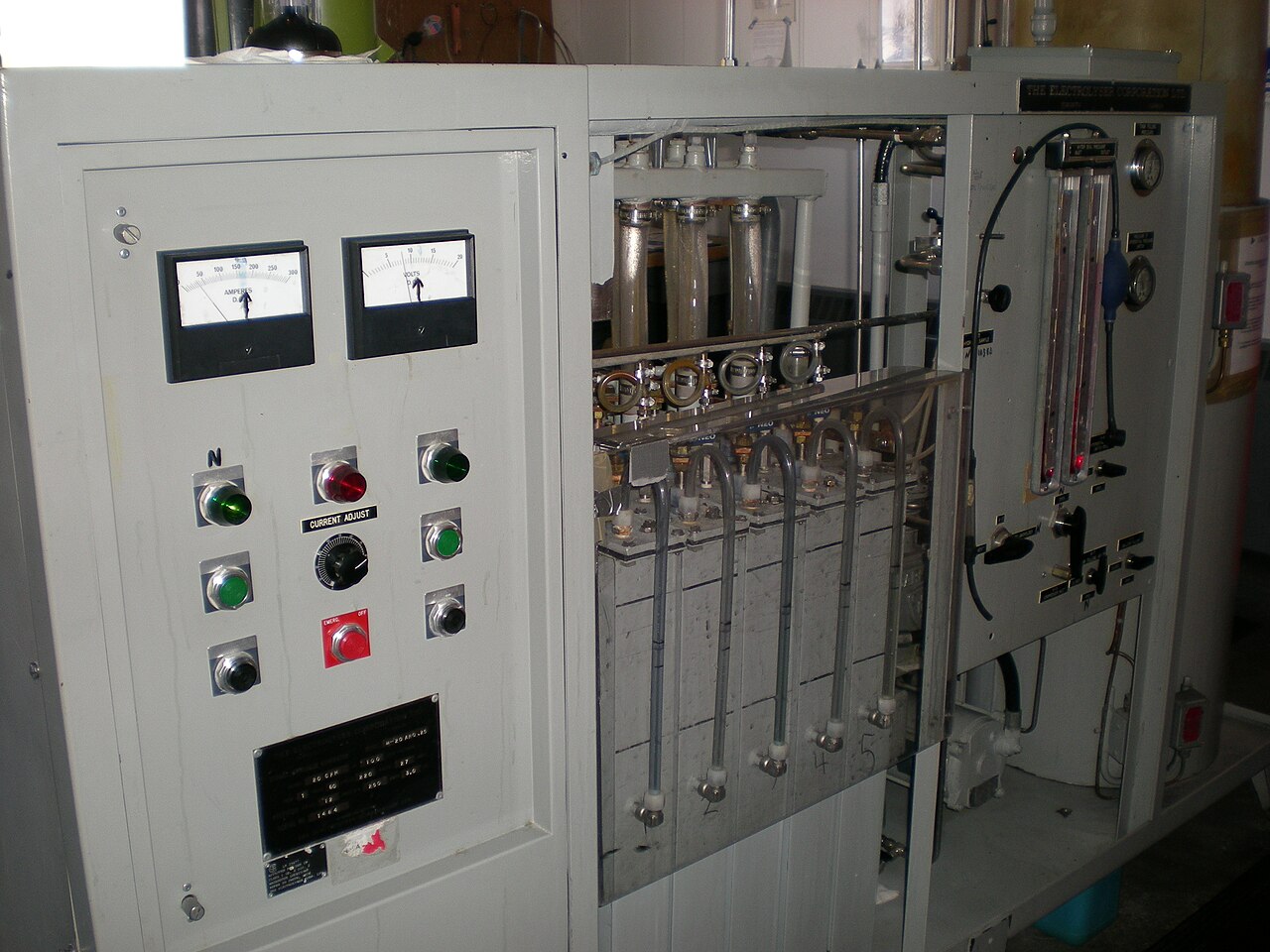
An electrolyser photographed in 2008 provides a concrete example of hydrogen-production equipment; it does not establish the efficiency or scale of a newer project.
CambridgeBayWeather / Wikimedia Commons · Image source · CC BY-SA 4.0

A hydrogen electrolyzer is easy to summarize and difficult to scale well. Electricity splits water, but an industrial plant must also control water quality, heat, gas separation, pressure, purity and safe operation across changing loads. Two 2026 announcements from ITM Power illuminate different parts of that challenge. On August 4, the company reported initial hydrogen delivery from RWE’s Lingen electrolysis project during commissioning. On July 9, it announced formal funding for a planned manufacturing line for its next-generation Chronos stack. One concerns early integrated operation; the other concerns future production capability. Together they show why electrolyzer scale-up needs more than a larger nameplate number.
An operating chain is more than an installed stack
ITM’s August update states that hydrogen produced at Lingen traveled through roughly 120 kilometers of pipeline to Evonik’s chemical park in Marl. The company and Linde Engineering were delivering two 100-megawatt plants, but the release explicitly described the project as undergoing commissioning and ramp-up toward full 200-megawatt commercial operation. Initial delivery therefore demonstrates a functioning production-to-customer connection at that stage. It does not by itself establish that both plants were continuously delivering their full rated output or meeting a specified lifetime efficiency guarantee.
This distinction is useful because industrial hydrogen has to arrive as an acceptable product. A stack can produce gas while downstream equipment struggles with moisture, pressure control or availability. A customer also needs predictable delivery and a procedure for interruptions. Connecting electrolysis to a pipeline and a real industrial user exposes those interfaces. The most informative later evidence would report production over a defined interval, delivered purity, energy use, downtime and the scope of equipment included in each measurement, rather than treating first hydrogen as the end of commissioning.
A gigawatt factory is a capacity plan, not a gigawatt of operation
The July 9 announcement describes a planned Chronos manufacturing line in ITM’s existing Sheffield facilities, supported by a formally awarded £46.5 million grant. It identifies equipment for catalyst-coated membranes, electrode welding, coating, stack assembly and testing, with a target of one gigawatt of annual production capacity. The future line and its anticipated performance should remain labeled as plans. Factory capacity measures how much equipment might be manufactured in a period; it is not the same quantity as installed operating capacity, electricity consumption or hydrogen production.
The manufacturing sequence matters because a stack combines many repeated elements. Uneven coating, contamination, dimensional variation or an unreliable seal can reduce performance or create premature failure. High throughput only helps if accepted output rises with it. A well-designed line detects defects before expensive downstream assembly and preserves a traceable link between process conditions and final testing. The economics of scale therefore depend on yield and reproducibility as much as on the number of assembly stations or the nominal speed of the production equipment.
Choose an energy boundary before comparing efficiency
Proton exchange membrane, or PEM, electrolysis transports protons through a membrane while producing hydrogen and oxygen on opposite sides. For a plant comparison, the relevant energy use may include alternating-current conversion, water treatment, cooling, drying and compression in addition to the electrochemical stack. A reported stack value cannot be compared directly with a whole-plant value unless the difference in scope is made explicit. Pressure and product specification also matter: delivering hydrogen at one pressure is a different service from delivering the same mass at a higher pressure.
An illustrative calculation makes the accounting tangible. A plant drawing 100 megawatts for one hour consumes 100,000 kilowatt-hours. At an assumed whole-plant electricity use of 50 kilowatt-hours per kilogram, it would produce 2,000 kilograms of hydrogen in that hour. At 55 kilowatt-hours per kilogram, the same input would produce about 1,818 kilograms. These assumed figures are not Lingen measurements or ITM guarantees. They show why a seemingly modest difference in specific energy use affects output, cooling requirements and the amount of electricity contracted for a given delivery commitment.
Flexible operation needs a lifetime definition
ITM’s PEM technology description emphasizes rapid response to changes in electrical supply, along with modular construction and condition monitoring. Such capabilities can be useful when a plant follows variable generation or electricity prices. However, the ability to change power rapidly and the ability to do so repeatedly without unacceptable degradation are different claims. An operating specification needs minimum load, ramp behavior, startup procedure and permitted shutdown states. It should also explain how those conditions influence guarantees and maintenance planning.
A lifetime test should represent the intended duty cycle. A steady-load experiment cannot fully predict frequent startup and shutdown, just as aggressive cycling may not represent a plant intended for continuous operation. Measurements should distinguish reversible changes caused by operating conditions from persistent degradation. Water contamination, gas crossover, membrane condition and contact resistance can interact with duty. Useful reporting therefore pairs performance trends with the actual operating history. A small average degradation rate has limited meaning if the test omits the stressful conditions that dominate the planned commercial schedule.
Standard modules still need a coherent plant
ITM’s product range describes equipment at several scales, from smaller packaged systems to modules and larger plant offerings. Standardization can reduce engineering repetition, but the surrounding plant has to supply the right services and handle faults predictably. Cooling equipment, rectifiers, deionized-water systems and gas handling must be sized for the chosen operating envelope. A shared auxiliary system can reduce cost while also creating a common failure point. Modular stacks therefore do not automatically produce a modular availability profile for the whole facility.
Consider a hypothetical plant with four equal production trains and one shared cooling system. Losing a single train might leave three quarters of the nominal output available, but losing the common cooling system could stop all four. The example is deliberately generic; it is not a description of Lingen. It explains why reliability analysis must follow dependencies rather than count modules. Spare parts, access for stack replacement, isolation valves and restart sequences all influence how quickly a fault can be contained and how much production it removes from the delivery schedule.
The next evidence should connect factory quality to plant behavior
The most useful manufacturing progress report would show accepted stack output, test coverage and the relationship between factory measurements and field performance. A factory acceptance test is stronger when its results predict commissioning behavior and later degradation. That connection allows engineers to refine specifications and suppliers to correct process drift. It also helps distinguish a product improvement from a change in test conditions. Public announcements about a new line establish intent and investment; consistent accepted deliveries establish production capability.
For operation, the corresponding evidence is a complete and explicit mass-and-energy balance over a representative period. That includes hydrogen delivered, electricity consumed, product quality, interruptions and maintenance. The 2026 Lingen and Chronos updates are meaningful because they place manufacturing and integration in view at the same time. Their remaining questions are practical: can plants reach and sustain their promised service, and can the equipment be manufactured consistently enough to repeat that result? Answering both is what turns electrolyzer scale from a capacity announcement into an industrial capability.
Sources & further reading
Primary papers, project documentation, and research releases used in this article. Publication dates below refer to the sources themselves.
- First hydrogen from Lingen reaches customerITM PowerPublished Checked
- Award of £46.5m DESNZ GrantITM PowerPublished Checked
- How it WorksITM PowerChecked
- ProductsITM PowerChecked
FOLLOW THE QUESTION
Explore engineering