ENGINEERING
Why landing a reusable booster is a control and inspection problem
New Glenn’s demonstrated landing and October 2026 infrastructure plans reveal why reusable rockets depend on guidance, structural margins and ground operations.
Research checked
Newest cited publication
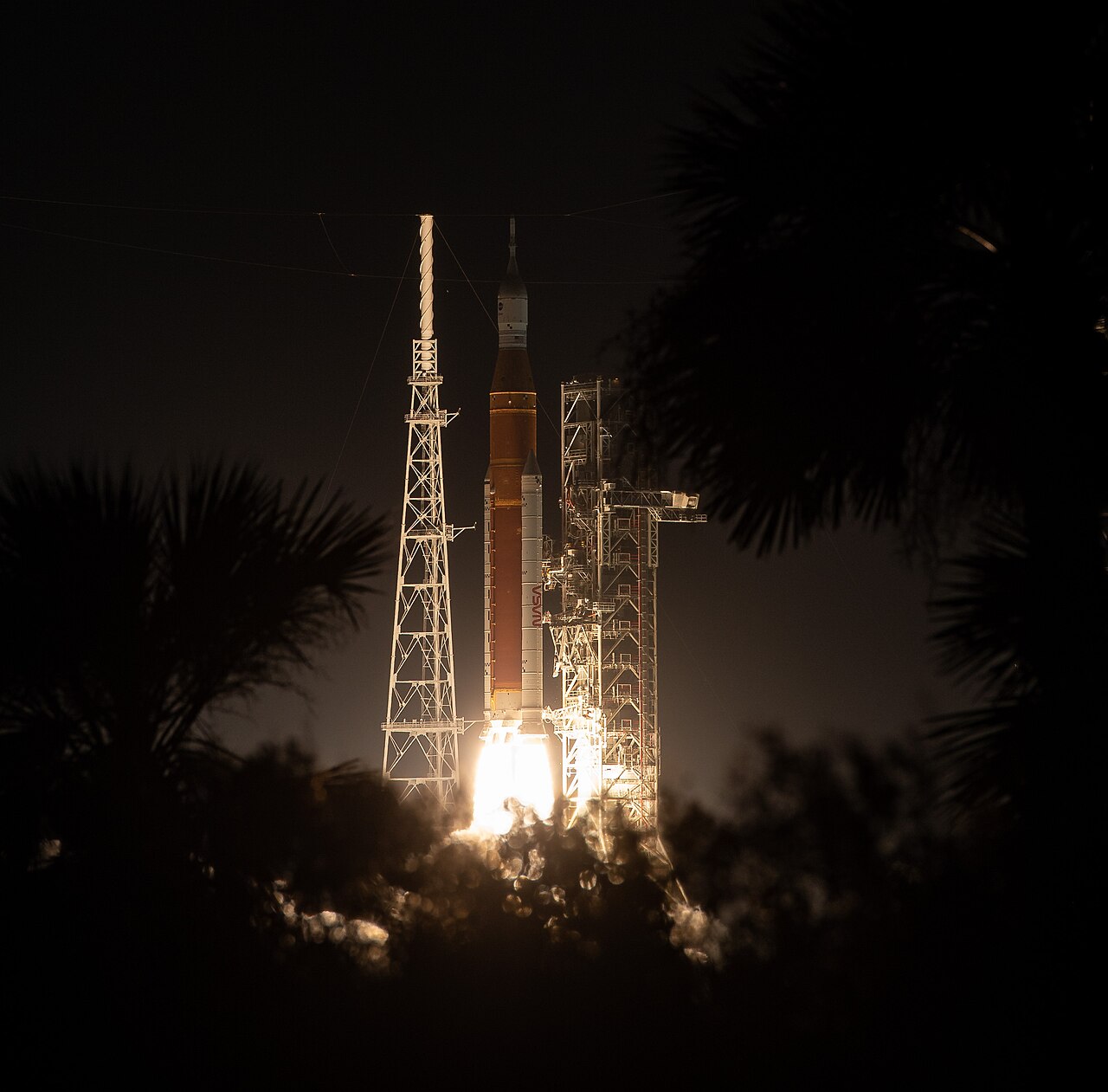
Artemis I launches in November 2022, illustrating the loads and scale of launch hardware. The reusable-landing systems examined here belong to different vehicles.
NASA / Bill Ingalls · Image source · Public domain (US government / NASA)

An upright booster on an ocean platform is an extraordinary image, but it records only one part of reuse. Blue Origin’s New Glenn second mission deployed NASA’s ESCAPADE spacecraft and landed its first stage on November 13, 2025. By October 16, 2026, the company was describing a wider return path: recovery platforms, inspection, refurbishment and facilities intended to support a higher future cadence. Between those announcements, a May 2026 ground-test anomaly damaged launch infrastructure. Together, these documented events show why a reusable launch system cannot be assessed using touchdown footage alone. The vehicle must fly, return within manageable loads, survive inspection, and rejoin a ground process that is itself reliable. This article distinguishes the observed landing from design targets and announced capacity that still required delivery.
A landing establishes one important capability
The official NG-2 mission record confirms both payload deployment and first-stage landing on the sea platform Jacklyn. The flight profile separates the returning booster from the upper stage continuing toward its own mission. That separation creates different engineering jobs: the upper stage must deliver the payload correctly while the first stage manages its remaining energy and propellant to return. Success on one branch does not logically establish success on the other.
A simple energy comparison explains why a landing burn is demanding. Kinetic energy varies with the square of speed, so halving a descending vehicle’s speed removes three quarters of that kinetic energy. Aerodynamic drag can dissipate much of the energy before the final approach, but the vehicle still has to arrive with a controllable attitude and enough propellant. Guidance is therefore not simply aiming at a point. It schedules a trajectory through changing aerodynamic forces, engine capability and remaining mass.
The useful control mechanism changes during descent
Blue Origin’s vehicle description identifies actuated fins, strakes and landing legs, alongside throttle-capable first-stage engines. The fins adjust attitude during descent, while strakes contribute aerodynamic lift and cross-range capability. These published features explain the available mechanisms without revealing the company’s proprietary guidance law. Any detailed claim about its internal optimizer would require evidence beyond the public vehicle description.
Aerodynamic control depends strongly on the air flowing past a surface. At very low density, a fin has little force available; deeper in the atmosphere, the same deflection can create much larger loads. Engine-based control follows a different set of constraints, including thrust level, ignition and the direction of the thrust vector. A practical control system must coordinate these regimes. A command that would be harmless at one altitude can become excessive at another, so the available control authority must be evaluated throughout the trajectory.
Mass also changes as a stage consumes propellant. For a given engine thrust, a lighter stage accelerates more strongly, so an otherwise identical command does not produce an identical trajectory throughout a burn. The controller must account for this changing plant, along with estimates of velocity and position that have their own uncertainty. A landing strategy also reserves propellant for recovery rather than spending every available kilogram on ascent. That reservation is a vehicle-level trade between payload performance and recoverability. Without the manufacturer’s mission-specific data, one should not assign a numerical penalty, but the existence of the trade follows directly from conservation of momentum and finite propellant capacity.
A stable touchdown requires more than low vertical speed
The manufacturer describes six hydraulically actuated landing legs supporting the first stage on a moving platform. Their task includes accepting loads without allowing the tall vehicle to tip. A sea landing introduces relative motion between the target surface and the descending stage. A useful landing condition therefore includes horizontal speed, angular rates and alignment as well as vertical descent rate.
Imagine placing a tall broom upright on a slowly moving tray. A small sideways velocity at contact can matter even when the downward speed is modest. A rocket is vastly more complex, but the example identifies why touchdown is a state rather than a location. Leg geometry, structural compliance and permitted vehicle attitude all influence the margin. This is general mechanical reasoning, not a reconstruction of proprietary landing limits. The official landing demonstrates that the integrated system achieved an acceptable state on that occasion.
A reuse target needs a history of loads and inspections
Blue Origin says New Glenn’s first stage is designed for at least 25 flights. That is a design objective, not evidence that a stage had already completed 25 flights by the research cutoff. Demonstrating repeated service requires tracking what actually happened to an individual vehicle: engine starts, thermal cycles, vibration, pressure cycles, handling and landing loads. A recovered stage can look intact while still requiring careful examination.
Fatigue illustrates why this record matters. Repeated loads can extend a small crack even when each individual load is below the level that would break an undamaged part immediately. Heat can change material properties or damage protective layers. Inspection methods must therefore be chosen for the failure modes that matter, including inaccessible areas. Reuse economics depends partly on whether these checks can identify unacceptable damage without disassembling the entire stage after every mission. A successful recovery begins that assessment; it does not finish it.
The pad is part of the reusable system
In its June 30, 2026 return-to-flight statement, Blue Origin described a May 28 integrated-vehicle hotfire anomaly and an investigation then still underway. It reported damage to the lightning tower, transporter-erector and hydraulic cylinders, while identifying other facilities that remained usable. The company also proposed changing its integration process, including crane-based lifting. Those statements document a recovery plan and provisional investigation status, not a final public root-cause finding.
A launch system has serial dependencies. A healthy booster cannot launch through an unavailable pad, and an operational pad cannot compensate for an unfinished payload or an unqualified vehicle. Ground equipment also handles large structures in orientations different from their flight condition. Lifting points, temporary supports, connection procedures and weather limits can therefore become part of the critical path. The engineering boundary of reuse extends beyond everything that leaves the ground.
High cadence needs parallel work and a closed return loop
The October 16 infrastructure announcement describes new production and integration facilities, work on additional sea platforms, and a booster-processing role for a vertical integration facility. It also states future manufacturing and launch-rate ambitions. These are announced investments and targets; the cited release does not demonstrate that its proposed end-of-decade cadence was already operating. Its more immediate lesson is the explicit coupling of recovery, inspection, refurbishment and flight preparation.
Consider a hypothetical fleet of four boosters, each requiring three weeks between flights. Even if the pad could launch every day, that fleet could not sustain a daily flight rate. Adding boosters might help, but only if inspection bays, engines, transport and personnel can keep up. Conversely, a slow payload-processing queue can leave ready vehicles waiting. Capacity planning requires the entire network of service times and dependencies, including variability and downtime, rather than multiplying an idealized turnaround figure by a calendar.
The strongest next evidence is repeated, documented service
For an outside reader, the most informative future evidence would connect individual recovered stages to their later flights, with clear mission outcomes and increasingly well-characterized processing times. Publicly available data will rarely reveal every inspection result. Even so, repeated operational records are stronger evidence of reusable capability than a stated lifetime target. They show that both flight hardware and ground organization can close the loop more than once.
The 2025 landing and the 2026 infrastructure work belong in the same engineering story because they address different bottlenecks. Guidance brings the stage to a recoverable state. Structures and thermal protection preserve enough condition to inspect and refurbish it. Factories, ships and facilities return it to service. Reusability becomes an operational advantage when these pieces work together repeatedly, while anomalies remain occasions for evidence-based investigation rather than being erased by a spectacular successful landing.
Sources & further reading
Primary papers, project documentation, and research releases used in this article. Publication dates below refer to the sources themselves.
- New Glenn Mission NG-2Blue OriginChecked
- New GlennBlue OriginChecked
- New Glenn Return to FlightBlue OriginPublished Checked
- Building the Infrastructure for More Frequent Launches in FloridaBlue OriginPublished Checked
FOLLOW THE QUESTION
Explore engineering