ENGINEERING
Cement without the same carbon bill: electricity, binders, and the scale-up test
Cambridge’s electric cement work links demolition waste and steel recycling. Its 2025 chemistry study explains why industrial scale also needs precise hydration control.
Research checked
Newest cited publication
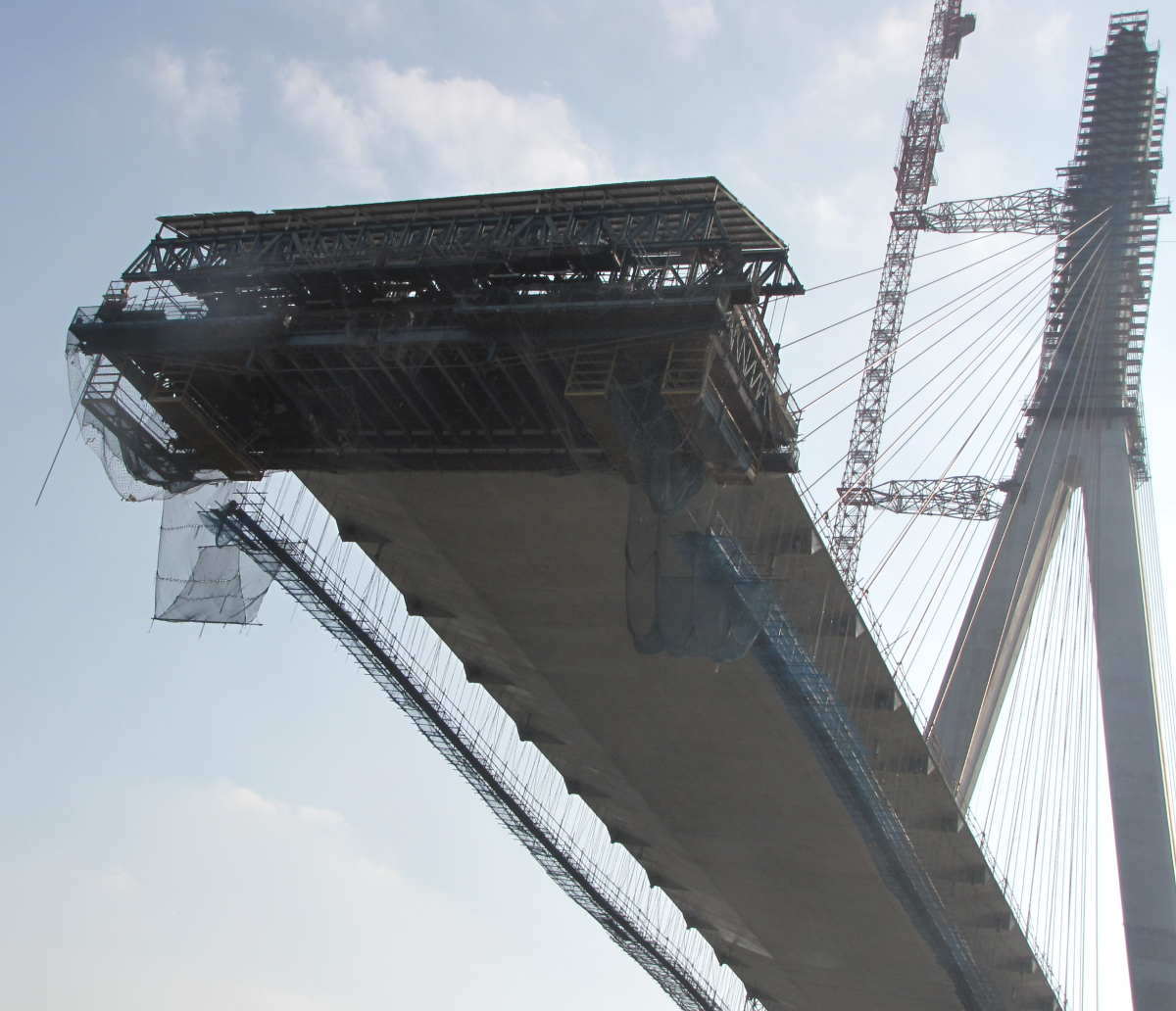
A bridge under construction provides context for the structural demands that lower-carbon cement and alternative binders must meet.
Bill Bradley (Billbeee) / Wikimedia Commons · Image source · CC BY 2.5

The difficult part of decarbonizing cement is that its emissions come from two places. A furnace needs energy, but limestone also releases carbon dioxide when its chemistry changes. Replacing the furnace fuel cannot, by itself, remove the second source. Cambridge Electric Cement approaches both questions by using previously manufactured cement paste and the hot metal already present in steel recycling. A 2025 follow-up study examines a less photogenic but essential issue: what happens when that recycled clinker meets water. As of October 2026, this is a developing industrial process with reported demonstration trials, rather than evidence that every cement kiln can immediately disappear. Its importance lies in connecting circular materials, electrified production, and the chemical quality control needed for a reliable construction product.
Separate the heat bill from the chemistry bill
An ordinary cement plant transforms a carefully proportioned mineral mixture into clinker, the hard intermediate subsequently ground into cement. Limestone contributes calcium, while other ingredients provide silicon, aluminum, and iron. Heating calcium carbonate liberates carbon dioxide. Supplying identical heat with clean electricity would change the energy ledger without preventing that particular reaction. A credible comparison must therefore report fuel emissions and process emissions separately, then add electricity generation, transport, and preparation of the replacement feedstock.
Here is a deliberately simplified accounting exercise, not a measured footprint for Cambridge’s process. Suppose a conventional product carries 100 units of emissions: 40 from heat, 50 from raw-material chemistry, and 10 from everything else. Eliminating combustion removes at most those 40 units unless the chemistry also changes. Reusing already decarbonated calcium could attack another part of the total, but crushing, separating, and reheating the old material still consume resources. The exercise explains why a convincing low-carbon binder needs a boundary diagram as much as a striking percentage.
Why molten steel can do two jobs
The original Cambridge research, published in Nature in May 2024, showed that recovered cement paste can replace part of the lime-based flux used during electric steel recycling. Flux helps manage the nonmetallic material above the metal. In this route, the resulting slag can be cooled into a material suitable for making cement. That couples two existing material streams instead of proposing a furnace solely for a new binder. The university’s accompanying explanation makes clear that low-carbon electricity is an important condition for the lowest-emission outcome.
The useful systems idea is co-production. A steel recycler already pays for a very hot, electrically heated environment. A cement recycler wants mineral reactions at high temperature. Sharing equipment can reduce duplicated infrastructure, but it also ties the businesses together. A cement operator cannot assume that the steel plant will accept any waste stream, alter every production schedule, or sacrifice metal quality to improve binder output. The interface becomes a specification problem: which incoming composition, particle size, and contamination levels can both operations tolerate?
The 2025 result: the powder still has to behave
Shiju Joseph and colleagues’ 2025 paper, Microstructure and hydration of interstitial in clinkers produced over molten steel, compared electric clinkers with commercial materials using diffraction, microscopy, and heat-release measurements. The reducing environment changes the availability of ferric iron and the reactivity of tricalcium aluminate, one clinker component. The study found that sulfate control, fineness, and blending matter for managing the resulting hydration behavior. This is a laboratory investigation of material chemistry, not a certification of every possible concrete made from the process.
That distinction matters on a building site. A binder must remain workable long enough to transport and place, then develop the intended properties at an acceptable rate. Increasing a reaction’s speed is not automatically an improvement if it shortens the practical working window. Conversely, slowing every reaction could delay formwork removal or finishing. Engineers therefore need a controlled sequence of reactions. The practical objective is a reproducible envelope of setting and strength behavior across raw-material batches, ambient temperatures, and admixture combinations.
The overlooked separation plant
An old slab is not a bag of used cement. It contains coarse stone, sand, steel reinforcement, and perhaps coatings or contamination. Recovering the paste requires separating materials that were designed to adhere strongly. The 2025 hydration paper explicitly discusses the difficulty of obtaining a sufficiently calcium-rich recovered fraction. Its experiments use prepared hydrated paste as a controlled analogue, which helps isolate chemistry but does not erase the messier industrial feedstock question.
Consider a hypothetical demolition load containing one tonne of potentially useful paste mixed through several tonnes of aggregate. If the separation system recovers only half that paste, the furnace’s excellent chemistry does not rescue the lost material. If it recovers nearly all the paste but grinds excessive aggregate into the product, the oxide balance changes. Recovery yield, purity, electricity use, dust control, and the quality of the remaining aggregate must therefore be assessed together. A good circular process should produce useful streams on both sides of the separator.
Industrial trials are an important intermediate step
Cambridge Electric Cement’s demonstrator documentation reports progression from small induction-furnace experiments through a six-tonne pilot electric arc furnace to industrial melts at CELSA UK’s 150-tonne furnace, beginning in May 2024. The company describes the program as reaching technology readiness level seven. Its stated construction pathway begins with lower-risk, nonstructural uses. These are the operator’s reports of demonstration activity; an undated project page does not establish a new October 2026 commissioning event or a continuously operating commercial cement line.
A larger furnace tests problems a small crucible cannot reveal. Operators must sample a heterogeneous feed, transfer hot slag, choose a cooling route, and keep the steel operation stable. Repetition also matters. One acceptable batch demonstrates possibility; many consecutive batches with traceable inputs begin to demonstrate process capability. A useful public trial report would include the spread of product properties, rejected batches, downtime, and electricity demand. Those records would let a customer judge reliability rather than infer it from the vessel’s capacity.
Batch-to-batch variation deserves particular attention when recovered materials supply the feed. A useful acceptance system would retain representative samples, connect them with furnace records, and record the concrete mixture in which the binder was used. If a later test fails, that chain helps determine whether the cause was separation, mineral chemistry, grinding, storage, or concrete production. Traceability also allows successful batches to teach the operator something. Without it, an industrial campaign can generate many tonnes of material while producing surprisingly little transferable knowledge.
Ask for a functional product, then count everything
My engineering interpretation is that recycled electric cement should be compared per delivered function, not merely per tonne of powder. If two binders require different quantities to provide the same strength and durability in the same exposure, their tonne-for-tonne footprints can mislead. The comparison also needs explicit treatment of shared steelmaking burdens and credits. Giving both products all the emissions savings would double count the benefit, while allocating everything to one product could obscure why the coupled route is attractive.
The next persuasive evidence would connect a characterized demolition stream, sustained industrial runs, independently checked environmental accounting, and concrete performance under relevant exposures. Those checks do not diminish the central advance. They describe the route from an inventive reaction pathway to material that engineers can specify with confidence. Electrification can change the production equipment, recycling can change the calcium source, and careful hydration control can make the output useful. The full achievement requires all three to work together, repeatedly, outside the laboratory.
Sources & further reading
Primary papers, project documentation, and research releases used in this article. Publication dates below refer to the sources themselves.
- Electric recycling of Portland cement at scaleNaturePublished Checked
- Microstructure and hydration of interstitial in clinkers produced over molten steelUniversity of Cambridge / Journal of the American Ceramic SocietyPublished Checked
- Cement recycling method could help solve one of the world’s biggest climate challengesUniversity of CambridgeChecked
- Industrial demonstratorCambridge Electric CementChecked
FOLLOW THE QUESTION
Explore engineering