ENGINEERING
Structural batteries put strength and stored energy on the same balance sheet
A May 2026 carbon-fiber study expands structural battery electrode choices, while coupled mechanics explains why useful energy must be assessed at system level.
Research checked
Newest cited publication
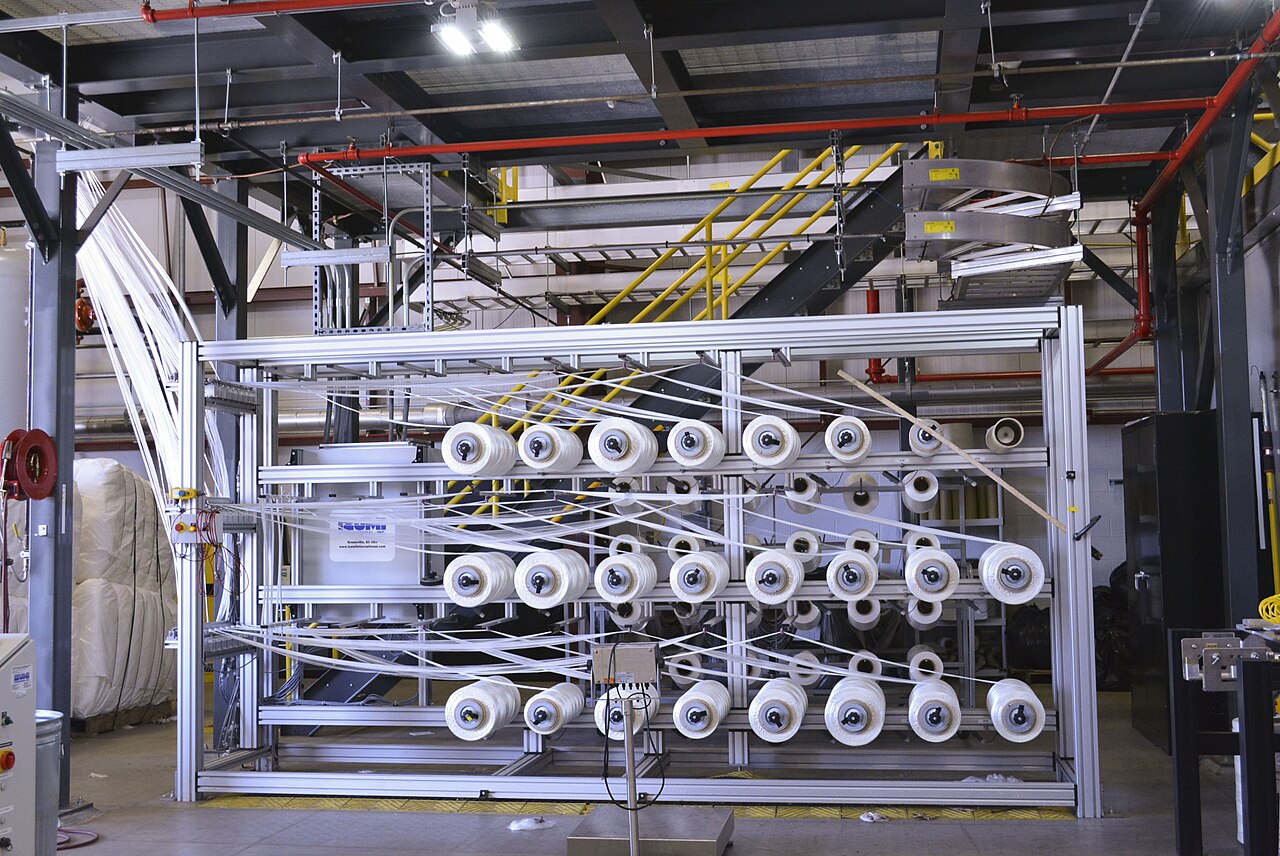
Carbon-fiber spools illustrate one material family that can contribute structural reinforcement. The article examines how load carrying must be reconciled with electrochemical storage.
Oak Ridge National Laboratory · Image source · CC BY 2.0

A structural battery asks a material to do two expensive jobs at once: carry mechanical load and store electrical energy. The attraction is not that battery mass disappears. It is that some of the same material can replace both a conventional structure and part of a conventional battery. This changes the comparison engineers must make. A material with less stored energy per kilogram than a dedicated cell can still reduce the mass of a complete product if it removes enough separate structure. The difficult part is proving that the functions remain compatible through charging, vibration, temperature changes and damage. A May 2026 experiment on partially carbonised fibers, alongside current work on coupled electrochemical mechanics, makes the design problem more precise. It offers new electrode options while showing why strength and charge capacity cannot be optimized in isolation.
The newest result changes the electrode design window
On May 22, 2026, Ruben Tavano and colleagues published an experimental study of partially carbonised carbon fibers in Communications Materials. They varied the maximum carbonisation temperature between 800 and 1100 degrees Celsius. Within that investigated range, increasing the temperature improved mechanical properties and electrochemical behavior together. Some tested fibers offered up to 40 percent higher specific capacity than the commercial intermediate-modulus reference. However, the partially carbonised fibers remained mechanically weaker, and the lowest-temperature material was too poorly conducting for the electrochemical tests. The result expands a materials tradeoff; it does not establish a complete battery with a 40 percent energy improvement.
A carbon fiber’s manufacturing history leaves a microscopic record. Carbon ordering, defects and remaining non-carbon atoms influence stiffness, conductivity and the sites available to lithium. There is no reason for the optimum on one axis to coincide with the optimum on another. Changing a heat treatment can therefore be useful even when it fails to produce the stiffest available fiber. The appropriate question is whether the resulting combination is better for a specified panel, not whether it wins every material property comparison.
An electrode result is different from a structural full cell
An earlier all-carbon-fiber structural battery, reported by Richa Chaudhary and colleagues in 2024, provides an important baseline. Its negative electrode used carbon fibers directly, while the positive electrode used fibers coated with lithium iron phosphate. The paper reported approximately 30 watt-hours per kilogram and a tensile modulus above 76 gigapascals when tested parallel to the fibers. The direction qualifies the claim: aligned composites do not have the same stiffness in every direction. This was a demonstrated laboratory material, rather than a production vehicle body or a universal replacement for aluminum.
Specific capacity and specific energy are also different quantities. Capacity measures charge, while energy additionally depends on voltage. A higher-capacity negative electrode improves a full cell only if the positive electrode, usable voltage range and available lithium allow that extra capacity to be used. Separators, current connections and protective layers add mass without necessarily increasing stored charge. Comparing an individual fiber’s charge capacity with a finished battery pack’s energy density would mix different boundaries and units. A useful report should state what was weighed, which direction was loaded and how much of the cell capacity remained usable under the test conditions.
The system benefit can be calculated without calling anything massless
Consider an illustrative design, not a published prototype. Suppose a small machine needs 60 watt-hours of storage and a separate two-kilogram panel. Assume a conventional complete battery supplies 200 watt-hours per kilogram, so its storage mass is 0.30 kilograms. The combined panel and battery weigh 2.30 kilograms. A two-kilogram multifunctional panel supplying 30 watt-hours per kilogram would store the same 60 watt-hours and reduce that simplified total by 0.30 kilograms, provided it genuinely meets the original structural requirement. That is about a 13 percent reduction of the compared subsystem mass.
The assumptions are the result’s limits. Extra insulation, joints, cooling, power electronics or protective skins could consume the saving. A need for greater bending stiffness could force a thicker panel; a need for higher peak power could require additional conventional cells. Conversely, a component that needs only modest energy might not exploit the full electrochemical capacity of a thick structural panel. The example is useful because it identifies a break-even condition: the multifunctional design must eliminate more separate mass than it adds to meet combined requirements. There is no single material-level energy density that guarantees success.
Mechanical loading changes the routes available to ions
A 2025 computational study by Vinh Tu and colleagues examined how deformation changes effective transport in a structural battery electrolyte. Their modeled material contains a solid polymer skeleton and liquid-filled pores. In one studied case, 20 percent macroscopic compression of a structure initially containing 37 percent porosity reduced effective mobility components by as much as 26 percent. These are model results for the stated geometry and constitutive assumptions, not measured losses in a road-going battery panel. Their value is to identify a mechanism that separate mechanical and electrochemical calculations could miss.
Picture transport through a network of corridors. Compressing the material may narrow some corridors, close others and change the preferred direction of travel. The same external current then has to pass through a changed internal geometry. This can alter concentration gradients and voltage losses even if the electrolyte chemistry has not changed. A panel that performs well on an unloaded laboratory bench may therefore behave differently while it is carrying weight. To design around that interaction, an engineer needs the load history and the electrical operating cycle together, rather than two unrelated certificates.
Stored lithium can create stress before an external load arrives
Carl Larsson’s 2026 doctoral thesis connects fiber swelling, electrolyte mechanics and full-cell voltage behavior. Its models use concentration-dependent fiber properties and microstructures informed by electron microscopy. It also reports an experimental and computational investigation of potential changes under mechanical loading, attributing a major part of the response to the negative electrode’s fibers. This is evidence for an inherent sensing function in the studied system. It is not yet a general method for diagnosing every internal defect in a complex structural component.
The sensing possibility exposes a design complication. A voltage change can reflect state of charge, temperature, current flow, relaxation or strain. Separating those causes requires a calibrated model and measurements with appropriate timing. Similarly, repeated swelling during charge can load an interface even when the surrounding structure is externally at rest. A design that considers only the maximum applied mechanical load may underestimate these internal stresses. The right experiment combines electrical cycling with known mechanical loading and then examines how the interfaces and properties evolve, rather than assuming that two individually durable constituents remain durable when coupled.
The credible next step is a component with a replacement plan
The Chalmers and KTH research project running from 2025 to 2028 explicitly studies constituents, interfaces and coupled processes. Its proposed additional sensing and actuation functions are research aims, not promises that a commercial five-function material is already available. That scope captures the present engineering frontier: understand how the same internal structure participates in several physical processes, then determine when combining functions is worth the resulting complexity. A stronger electrode alone cannot answer the question for an entire machine.
For an actual product, repairability deserves the same attention as peak performance. If an impact damages a load-bearing energy-storing panel, the inspection must assess both structural integrity and electrical isolation. Designers need to decide whether the panel is replaceable, how a damaged region is disconnected and what service data can justify continued use. These requirements may favor smaller modular components over a single highly integrated shell. The most persuasive demonstration would therefore report mass saving alongside power capability, directional mechanical properties, combined aging and a practical maintenance method. Structural batteries become useful when their two jobs remain dependable through service, not merely when both appear in one favorable laboratory measurement.
Sources & further reading
Primary papers, project documentation, and research releases used in this article. Publication dates below refer to the sources themselves.
- Partially carbonised carbon fibres as improved electrodes for structural battery applicationsCommunications MaterialsPublished Checked
- Unveiling the Multifunctional Carbon Fiber Structural BatteryAdvanced Materials / Chalmers repositoryChecked
- Deformation-dependent effective mobility in Structural Battery ElectrolytesInternational Journal of Solids and Structures / Chalmers repositoryChecked
- Multiphysics Modelling and Calibration of Structural Battery Electrodes and Full CellsChalmers University of TechnologyChecked
- Kopplade elektrokemomekaniska processer i strukturella batterierChalmers University of TechnologyChecked
FOLLOW THE QUESTION
Explore engineering