ENGINEERING
Industrial heat batteries: turning electricity into dependable process heat
Operating updates from 2025 and 2026 show where heat batteries can supply useful industrial energy, and why capacity, temperature, and charging power differ.
Research checked
Newest cited publication
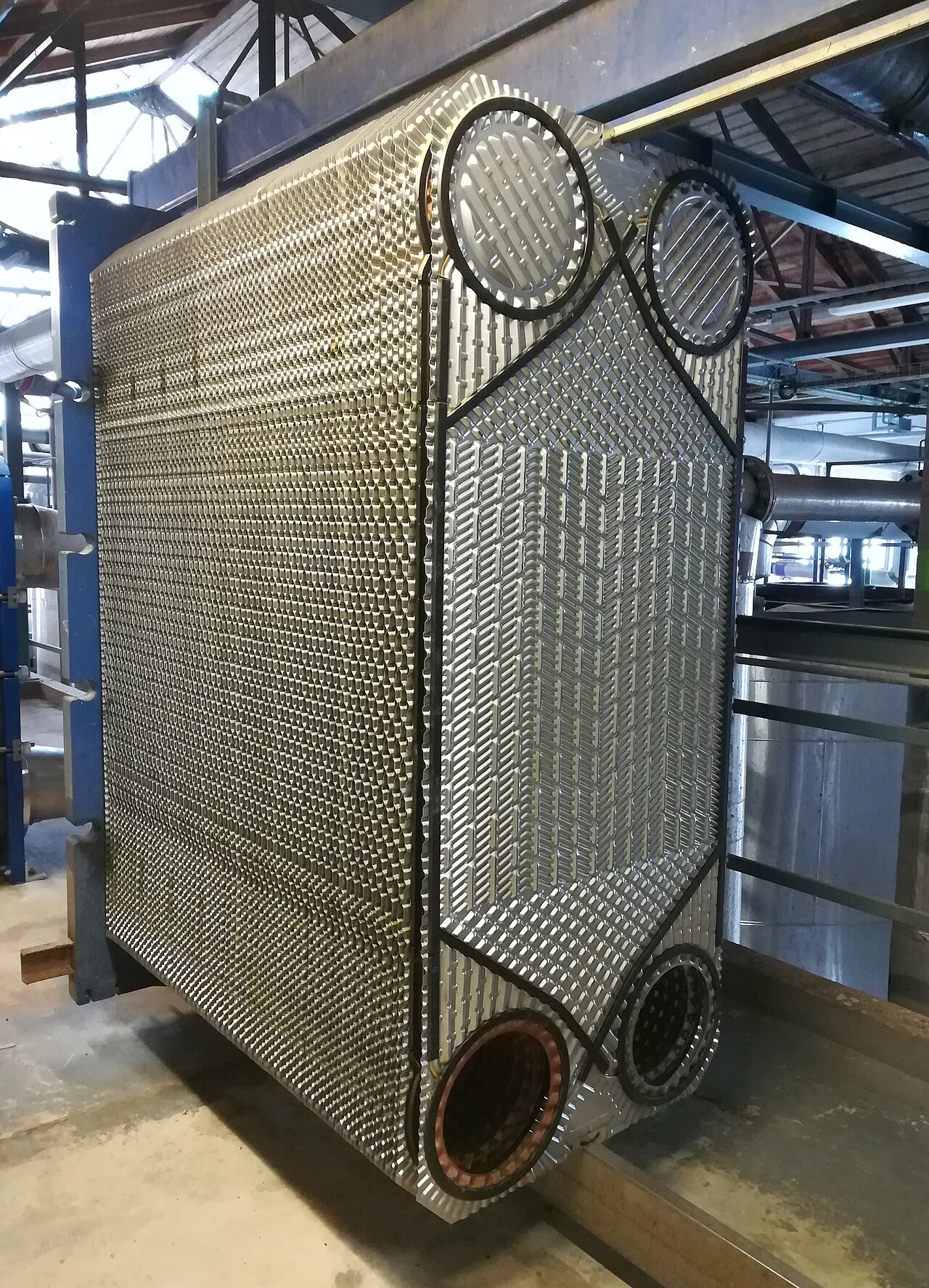
A dismantled heat exchanger illustrates the delivery side of an industrial thermal system. The storage materials and operating cycle of heat batteries are described in the article.
RomanM82 / Wikimedia Commons · Image source · CC BY-SA 4.0

An industrial heat battery begins with a surprisingly direct proposition: if a factory needs heat, store electricity as heat and deliver it in that form later. Avoiding a return trip through an electrical generator can simplify the energy chain. The difficult part is matching a store to a real process that expects the correct temperature, pressure, and output hour after hour. Recent operating announcements provide more substance than a drawing of glowing bricks. They also create an opportunity to separate meaningful field evidence from broader claims that depend on local electricity markets, operating schedules, and the definition of efficiency.
From commissioning to an operating record
Rondo Energy announced on October 16, 2025 that a 100-megawatt-hour heat battery in California had entered daily automatic commercial operation, using on-site solar electricity to deliver continuous industrial steam. Its release reported ten weeks of operation and claimed round-trip efficiency above ninety-seven percent. These are supplier-reported results from that project. They should be read with its stated heat-delivery boundary, rather than interpreted as an independently audited electrical-storage efficiency.
A more recent update comes from Polar Night Energy on June 11, 2026. Its Pornainen installation had completed a year serving a district heating network. The company reported supply reliability of one hundred percent, efficiency above eighty-five percent, and a seventy-percent reduction in network emissions. The installation uses crushed soapstone, despite the sand-battery name. This is a different service and temperature context from a factory steam system; its first-year report adds operating experience without making the two products interchangeable.
Three numbers that need separate units
Storage capacity measures energy, discharge power measures the rate at which heat can be supplied, and temperature describes the quality of that heat for a particular process. A large capacity cannot compensate for an undersized heat exchanger when a production line needs a sudden high output. Likewise, a hot store cannot deliver indefinite energy merely because its maximum temperature is impressive. Proposals become easier to compare when these three specifications are listed separately alongside their operating limits.
For an illustrative factory demanding four megawatts of heat continuously, a full day requires ninety-six megawatt-hours of delivered energy. If all charging happens in six hours, electrical charging power must average at least sixteen megawatts during that window before losses, while four megawatts of heat continue leaving the system. A ninety-six-megawatt-hour store connected to a four-megawatt electrical supply cannot recharge that daily energy in six hours. This arithmetic is independent of brand and material. It is often the first question a project should answer, because the grid connection and charging equipment may be harder to expand than the volume of storage material.
Why material and temperature matter
For simple sensible-heat storage, the energy change is approximately material mass multiplied by specific heat and usable temperature swing. The word usable is essential. Once the store becomes too cool to meet the process requirement through its heat exchanger, some remaining internal heat may have little immediate value to that customer. A design therefore needs a discharge curve showing useful output and temperature as the state of charge falls, not only the maximum energy calculated from a hot block.
Antora describes its own system as resistively heated solid carbon with radiative heat transfer. Its current technology page separates direct heat delivery from future integrated thermophotovoltaic conversion, which would turn light emitted by hot material back into electricity. That product distinction matters. A demonstrated or offered heat service should not be presented as proof of a future electrical generator's efficiency, cost, or operating lifetime. The material choice also changes insulation requirements, seals, atmosphere control, thermal expansion, and the way an exchanger can collect energy without contaminating the process.
Steam is an interface, not just an energy total
A steam user cares about pressure, temperature, dryness, and stability. Delivering the right number of megawatt-hours at the wrong steam condition can be useless or disruptive. A heat battery coupled to a steam generator has to coordinate feedwater, boiling, pressure control, and process demand. During startup, part of the stored energy warms metal and water before useful steam reaches the customer. Those transient periods should be included when comparing actual operating cycles.
A hypothetical process receiving a sudden extra megawatt cannot necessarily draw it immediately from a hot reservoir. The limiting component may be the air circulation system, an exchanger surface, a control valve, or the permitted pressure ramp. The fact that the storage medium is simple does not remove the complexity of the equipment around it. Conversely, keeping an existing boiler available during early operation can allow controlled commissioning and protect production. Whether that backup is rarely used or frequently needed is an important measurement, rather than a detail to omit from an annual performance claim.
Efficiency boundaries and emissions need explicit accounting
The Department of Energy's thermal-storage overview explains the general distinction between storing heat or cold for later use and converting energy through additional electrical stages. That background helps interpret a heat battery's efficiency. Electricity entering the heater, heat leaving the store, and heat reaching the process are three different measurement locations. Auxiliary fans and pumps, overnight loss, standby periods, and useful output during partial discharge can all change the reported ratio.
Consider a simplified charging cycle taking one hundred megawatt-hours of electricity and delivering ninety megawatt-hours of useful process heat. The electricity-to-useful-heat ratio is ninety percent for that chosen boundary. It says nothing by itself about the cost or emissions of the electricity. Charging during a low-price hour can reduce expense without guaranteeing a low marginal carbon intensity. A useful emissions assessment declares the displaced heat source, the electricity accounting method, and backup operation. The same physical store can have different consequences in grids with different generation and in factories with different schedules.
What will make industrial scale convincing
The next valuable evidence is a series of independently documented operating years. Such records should show delivered temperature and pressure, unavailable hours, maintenance, actual charging windows, and the share of customer heat demand supplied. A long lifetime claim becomes stronger when the parts exposed to repeated heating and cooling have inspection results behind them. Degradation can occur in insulation, joints, heaters, and flow paths even when the bulk storage medium remains chemically stable.
The 2025 and 2026 announcements establish that thermal storage is being operated for real heat users, rather than existing only as a modeled energy system. They do not establish one universal winner across all industrial temperatures. The practical design task is to choose the simplest storage and delivery chain that meets a specific process requirement. A successful heat battery makes intermittent charging invisible to production while exposing its own performance clearly to operators. That combination of dependable service and transparent accounting will determine whether the next installation is easier to finance, connect, maintain, and trust.
Sources & further reading
Primary papers, project documentation, and research releases used in this article. Publication dates below refer to the sources themselves.
- Rondo Powers Up World’s Largest Industrial Heat BatteryRondo EnergyPublished Checked
- World’s Largest Sand Battery achieves its targets – Emissions reduced by 70%Polar Night EnergyPublished Checked
- Antora – TechnologyAntora EnergyChecked
- Thermal Energy StorageUS Department of EnergyChecked
FOLLOW THE QUESTION
Explore engineering