ENGINEERING
Megawatt truck charging is an infrastructure project
September 2026 charging standards and new production trucks expose the real work behind high-power charging: interoperability, heat, grid capacity and queues.
Research checked
Newest cited publication
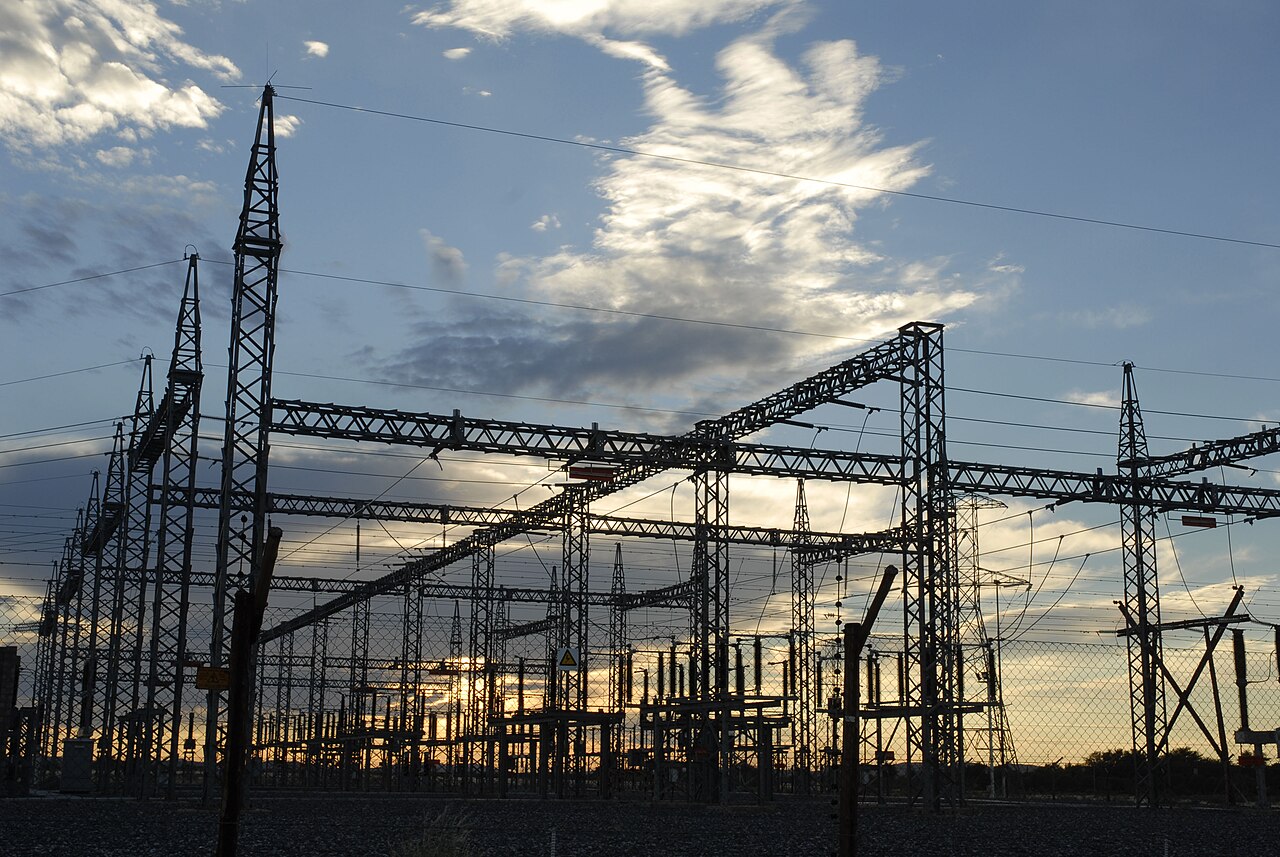
An electricity substation provides background for the connection capacity and grid upgrades required by large truck-charging sites.
Graeme Williams / Media Club · Image source · CC BY-SA 2.0

The striking part of megawatt charging is the power number. The difficult part is arranging for a truck, cable, charger and electricity network to cooperate when the driver actually needs them. During 2026, the technology gained both production vehicles and a more complete standards foundation. MAN announced series production of MCS-equipped trucks in July, and CharIN reported publication of the relevant charging-equipment standard in September. Those milestones move the conversation beyond a spectacular demonstration. They also make an important limitation visible: a connector family called Megawatt Charging System does not mean that every connected vehicle will continuously accept a megawatt, or that every site can supply its chargers simultaneously.
Production trucks give the standard a concrete boundary
On July 30, 2026, MAN announced that its first series-produced truck equipped with the Megawatt Charging System, or MCS, had left its Munich assembly line. It stated a charging capability of up to 750 kilowatts for the relevant eTGX and eTGS variants. The figure matters because it is below one megawatt while still using MCS. A standard defines an interface and a family of capabilities; an individual product operates within its own voltage, current and battery limits.
The announcement followed a February 13 report of winter demonstrations in Sweden at around 750 kilowatts. The earlier event tested practical compatibility in cold conditions; the later one concerned series-production equipment. Neither establishes the performance of every vehicle-charger pairing. What they do provide is a useful progression from an observed integration exercise to a product configuration. The next question is whether the wider charging network can make that capability routinely available along working freight routes.
The standards stack is larger than a plug
CharIN’s February 2026 announcement concerned IEC TS 63379, the technical specification for MCS connectors, vehicle inlets and cable assemblies. Its September 30 update reported publication of IEC 61851-23-3:2026 for the charging equipment itself. The later release lists a wider framework that also includes vehicle requirements and communication standards. Treating this as one finished plug drawing would miss the system boundary: safe energy transfer requires consistent behaviour on both sides of the connector.
A mechanical interface can fit while communication still fails. A vehicle and charger must agree on what power is permissible, respond to changing conditions and stop predictably when a fault occurs. Standards provide a common basis for implementing those behaviours, but publication does not certify that every implementation already interoperates. CharIN’s September release explicitly points towards conformance testing and interoperability validation as the next phase. A standard is therefore infrastructure for reliable engineering, rather than a substitute for testing actual products together.
A charging session is an area under a curve
Power is the rate of energy transfer. Holding an illustrative 750-kilowatt rate for twenty minutes would transfer 250 kilowatt-hours before accounting for losses. The arithmetic is simple: twenty minutes is one third of an hour, and 750 multiplied by one third is 250. A real charging session usually has a changing power profile, so its delivered energy is the sum of power over time. The largest number briefly displayed on a charger cannot determine the entire session’s duration.
MAN’s production announcement gives a more useful operational claim: charging a specified six-battery, 534-kilowatt-hour configuration from 20 to 80 percent state of charge in less than thirty minutes. That claim belongs to that configuration and its stated conditions. As an engineering check, the nominal percentage difference corresponds to about 320 kilowatt-hours, which would need an average of roughly 641 kilowatts over exactly half an hour, before interpreting usable-capacity conventions and losses. The peak and average therefore need separate labels.
High power makes small resistances visible
Electrical power is voltage multiplied by current. At an illustrative 750 volts, delivering 750 kilowatts requires 1,000 amperes. That matches the upper voltage and current figures MAN gives for its new configuration. The practical consequence is that connections carrying high current must be treated as thermal components as well as electrical conductors. Contact condition, cable design, cooling and temperature measurement become part of whether a charging session can continue at its intended rate.
A hypothetical connection resistance of just one milliohm dissipates 1,000 watts at 1,000 amperes, because resistive heating scales with current squared. Reducing current by half would reduce that particular heating term to one quarter, if resistance stayed fixed. This is a worked physical example, not a measured defect in an MCS connector. It explains why engineers care about contact wear, contamination and temperature limits even when the resistance looks numerically tiny. Reliable charging requires that those limits remain respected throughout repeated use.
A charging plaza is a local power system
Imagine a hypothetical freight stop with eight trucks each requesting 750 kilowatts. Their simultaneous demand would be six megawatts before the site’s other loads and conversion losses. Installing eight capable dispensers would not establish that the upstream transformer, grid connection and power-conversion equipment could supply that demand. A credible site design must state how much power is available concurrently and how it is shared when more vehicles arrive than the connection can support.
On-site storage can reduce short peaks, but it cannot supply unlimited energy indefinitely. Suppose a one-megawatt-hour buffer covers an extra two megawatts above the grid connection. Ignoring losses, it lasts only half an hour. It then needs a suitable recharging opportunity before repeating the service. This makes scheduling and grid integration central to the business, even though the most visible product is the cable. My inference is that successful early sites will be selected as much for dependable electrical access as for their position on a map.
Uptime is experienced by a driver with a schedule
A charging system is useful only if its power arrives within the operating window. Queue length, bay geometry and the time required to manoeuvre a truck can matter alongside the electrical charging curve. A pull-through layout may reduce unnecessary reversing; clear access can prevent one parked vehicle from blocking another. These are site-design considerations rather than claims about a particular manufacturer. They become more important when each stopped truck occupies substantial space and has little flexibility in its next departure.
Averages can hide the failure mode. If most sessions complete quickly but occasional communication failures require reconnecting or moving bays, a fleet may need extra schedule margin. The evidence worth publishing includes successful-session rate, waiting-time distributions and recovery after faults, not simply a charger’s maximum rating. Winter demonstrations provide useful experience with one set of conditions. Repeat use by many vehicles, drivers and hardware combinations establishes a much stronger picture of what a public network can reliably deliver.
The next milestone is dependable service at scale
The new standards framework and production vehicles create a clearer foundation for deployment. They also allow more precise questions. Can a charger sustain the power its site promises? Does the vehicle receive the expected energy across the intended temperature range? Can a failed component be isolated and replaced without closing the whole location? Does the network publish availability that reflects what a driver experiences? These questions connect electrical engineering with operations rather than treating them as separate phases.
Megawatt charging has progressed because developers have worked through both hardware and coordination. The 2026 milestones show that progress in concrete terms, while the 750-kilowatt production limit demonstrates why careful product boundaries still matter. The next competitive advantage will come from making high power ordinary: compatible equipment, controlled heat, sufficient grid capacity and predictable access. When those pieces work together, the impressive number on the dispenser becomes something more valuable—a service that a freight operator can confidently put into a timetable.
Sources & further reading
Primary papers, project documentation, and research releases used in this article. Publication dates below refer to the sources themselves.
- MAN starts series production of MCS-ready eTrucksMAN Truck & BusPublished Checked
- MAN demonstrates megawatt charging in Swedish winterMAN Truck & BusPublished Checked
- Official publication of IEC TS 63379: A game-changer for Megawatt Charging System (MCS) standardizationCharINPublished Checked
- IEC 61851-23-3:2026 completes the core standards framework for Megawatt Charging SystemsCharINPublished Checked
FOLLOW THE QUESTION
Explore engineering